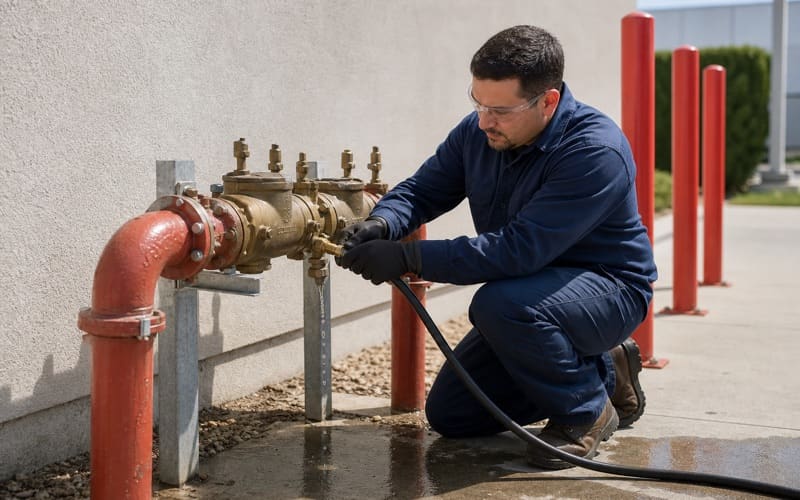
Long Beach Fire Suppression provides commercial fire suppression in Artesia for retail buildings, restaurants, professional and medical offices, recreational facilities, and light commercial property. We install, inspect, service, and repair sprinkler systems, kitchen hood suppression, fire alarms, portable extinguishers, and backflow assemblies. Everything runs through one provider, so a building ends up with a single deficiency list rather than several partial ones. Holding all of it under one agreement gives a building a single compliance position.
We work on commercial and industrial properties only. In a market built largely around smaller multi-tenant buildings and independent businesses, that focus is what keeps a crew from treating a commercial property as a scaled-up residential one. Hazard classification, occupancy type, and travel-distance requirements drive commercial fire protection in ways that have no residential equivalent. A commercial inspection date booked with us also holds, since no residential call competes for the same crew.
The work is compliance-driven rather than incident-driven. NFPA 25 sets inspection and testing intervals for water-based systems, NFPA 96 and NFPA 17A govern commercial kitchen suppression, NFPA 10 covers portable extinguishers, and NFPA 72 covers alarms, with the California Fire Code and Title 19 placing all of it behind an enforced inspection. We inspect, document, and correct. Recurring due dates are tracked against the property, so an obligation arrives as scheduled work rather than as a notice.
Fire Protection by Property Type
Independent Restaurants and Food Service
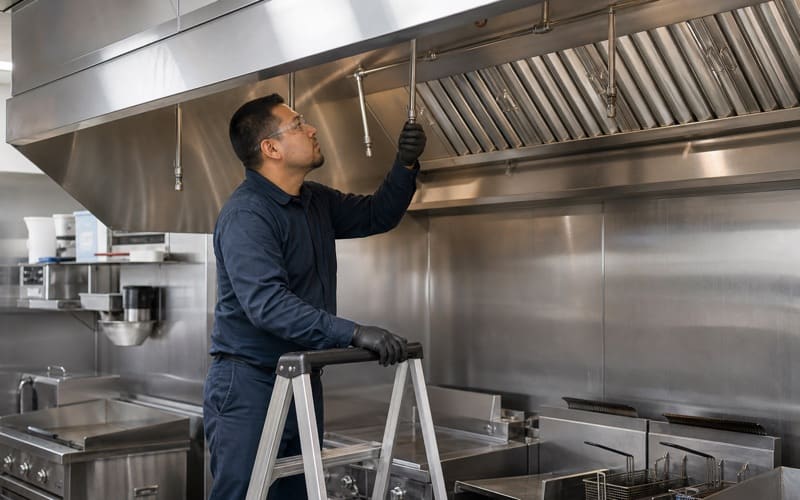
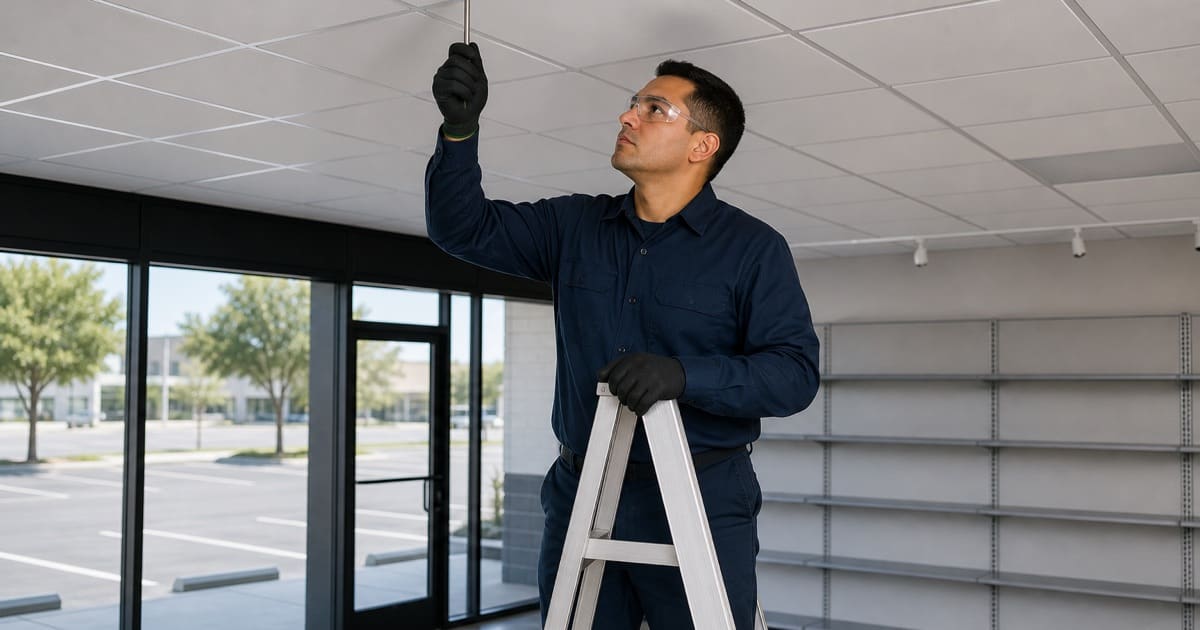
Commercial kitchens carry the shortest service interval of any system in a commercial building, generally requiring wet chemical service twice a year. We service and recharge Ansul R-102 and Pyro-Chem systems, replace fusible links, verify detection cable tension and travel, and test the gas shutoff, electrical interlock, and manual pull station together as a working sequence. Cylinder hydrostatic testing runs on a separate longer cycle, and those dates lapse more often than anything else in a kitchen.
Nozzle coverage is verified against the appliance line as it currently sits, because independent kitchens rearrange equipment frequently and a system correct at installation can be out of coverage within a year. Duct and plenum nozzles receive the same attention as those over the appliances, since a grease fire reaching the duct is the scenario most likely to leave the kitchen. A Class K extinguisher is required in addition to the hood system and must be reachable without passing the cook line. Grease loading in the hood, plenum, and accessible duct is examined at the same service visit.
Retail and Multi-Tenant Commercial
Multi-tenant buildings split responsibility between the landlord, who generally holds the riser, base building sprinkler system, and alarm panel, and tenants who hold extinguishers and suppression equipment inside their space. We document findings by suite so responsibility is identifiable rather than disputed, which prevents the common outcome where a deficiency sits uncorrected while the parties negotiate and the correction deadline continues to run. Coordinating access and any shutdown with the manager and the occupants directly keeps a planned outage from arriving as a surprise.
Extinguisher coverage is determined by hazard classification and maximum travel distance rather than by floor area, so converting sales floor to stockroom or introducing a hazard the original placement never contemplated changes what the building requires. Units also disappear behind stock and fixtures as a space fills, and one that cannot be reached is not providing protection regardless of its service tag. Class K on a cooking line, ABC through general areas, and CO2 near electrical equipment is the distinction that matters. Units also disappear behind stock and fixtures, and one that cannot be reached protects nobody.
Recreational and Assembly Facilities
Artesia is home to the East West Ice Palace, an ice rink co-owned by Michelle Kwan, and facilities of that kind combine large open volumes with mechanical plant, food service, locker areas, and assembly occupancy in one building. High-ceiling spaces affect both sprinkler head selection and alarm notification coverage, since sound levels and strobe placement must account for volume rather than floor area. Notification appliance testing in a space of that volume is placed in a window agreed with the operator rather than dropped into public hours.
Refrigeration and mechanical plant introduces hazards distinct from the public areas around it, and those spaces are frequently inspected less carefully than the visible parts of a building. We schedule inspection and corrective work around programming so testing does not collide with public use. Refrigeration plant, compressor rooms, and electrical equipment spaces each warrant protection suited to what is actually in them. Compressor rooms and electrical equipment spaces each warrant protection suited to what they contain.
Looking for fire suppression closer to West Carson? See West Carson Fire Suppression.
A Gateway City With Deep Roots
Artesia was incorporated on May 29, 1959 and is one of Los Angeles County’s Gateway Cities, with a 2020 census population of 16,395. It was also the childhood home of former First Lady Pat Nixon, who lived there from 1914 to 1931. A compact city of that size concentrates commercial development into a limited footprint, producing a building stock weighted toward smaller multi-tenant properties, independent businesses, and food service rather than large industrial facilities.
Smaller Systems, Identical Obligations
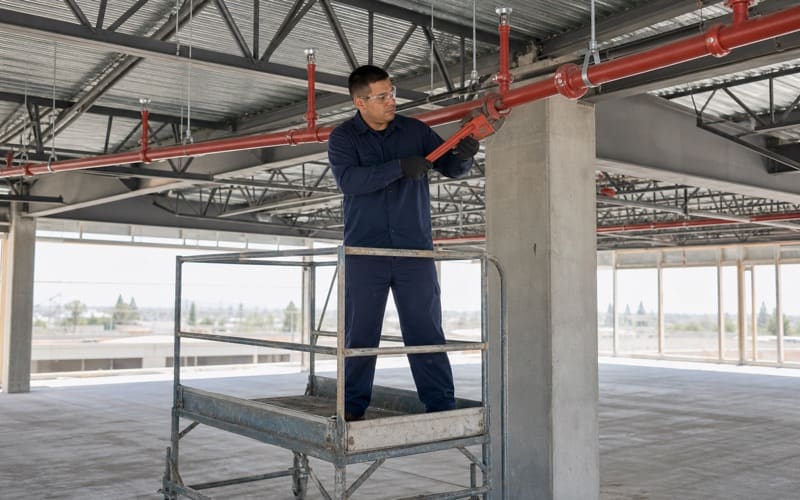
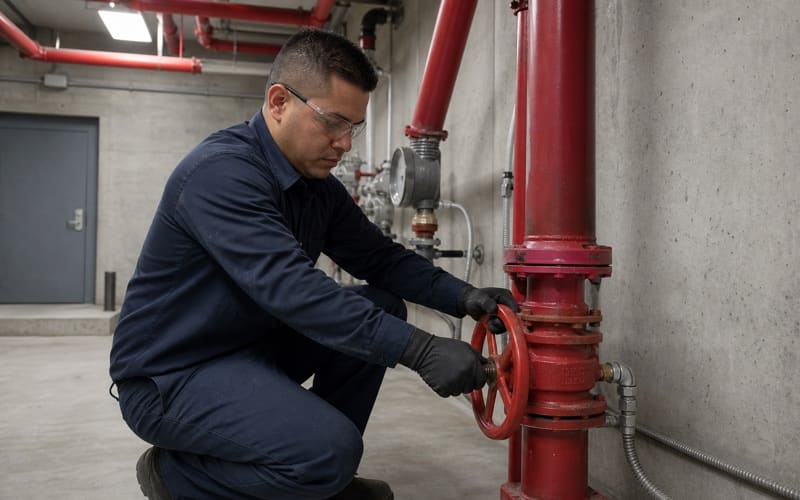
A sprinkler system serving a single-story commercial building has fewer components than a high-rise riser, but the inspection requirements come from the same standard. Control valves are verified open and supervised, main drain testing detects whether the water supply has degraded, waterflow and tamper switches are tested, and heads are examined for damage, paint, corrosion, loading, and obstruction. Valve position and supervision come first, since most systems that fail to deliver water fail for that reason alone.
The five-year internal obstruction investigation applies here as fully as anywhere, and in smaller buildings it is the requirement most likely never to have been performed at all. Properties of this size tend to show a specific pattern: the annual gets done because someone invoices for it, while quarterly checks and long-cycle items quietly lapse. Main drain readings are recorded each visit rather than marked as a pass, because a trend proves what a single figure cannot. Where no evidence exists that one was performed, we schedule it rather than assume it happened quietly.
Coverage That Drifts With Tenant Turnover
Commercial space turns over regularly, and each build-out is an opportunity for coverage to fall out of alignment. New demising walls create areas the original head layout never contemplated, dropped ceilings leave heads above them protecting nothing, and extinguisher placement stops matching the floor plan as it currently exists. We compare what is installed against the walls standing today and describe exactly which areas a change has left short.
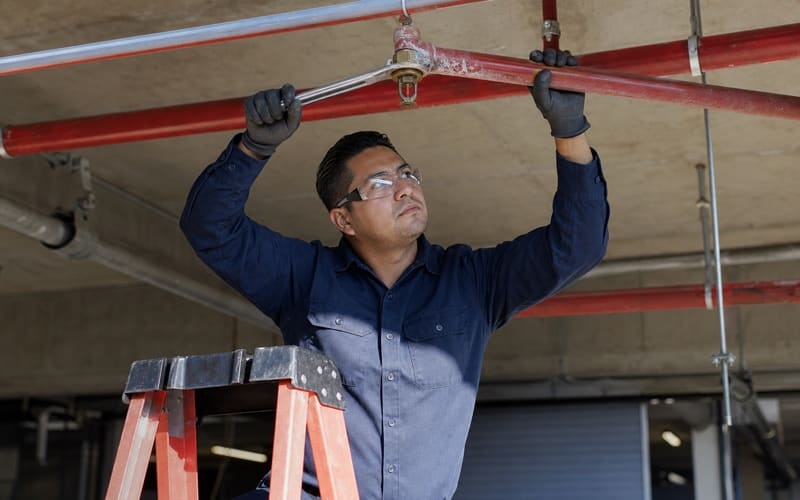
Contractors performing tenant improvements are also a routine source of damage, painting heads during finish work or striking them during ceiling changes, and neither is typically reported. A painted head cannot be cleaned and returned to service, because the coating interferes with the thermal element it depends on to activate at its rated temperature. Escutcheons and cover plates get mismatched during the same work, and a plate from another manufacturer will not release as the assembly was listed to.
Older Buildings and Layered Modifications
Buildings in service since well before incorporation carry systems extended and repaired by successive contractors with documentation of varying quality. As-built drawings frequently do not match what is installed, and unpermitted modifications turn up often enough to expect. We inspect against actual conditions rather than the paperwork on file. Riser tags, head types, and valve positions are better evidence of what a building holds than any drawing on file.
Where we find work that was never submitted for approval, we report it, because it will surface at the next inspection regardless of who performed it. Piping cut and extended during a build-out warrants particular attention, since the workmanship can look acceptable while the hydraulic design is no longer valid. Added mezzanines and interior structures built beneath existing heads create the same problem while the building still looks covered from the floor.
Inspection Records and Deficiency Correction
Establishing What Is Actually Due
NFPA 25 is not one annual event, and treating it as one is the most common compliance gap we encounter. Requirements run on quarterly, semi-annual, annual, and five-year cycles depending on the component, so a property with only an annual history is almost certainly carrying uncompleted items it does not know about. We establish which intervals apply to the systems actually present, review whatever prior records exist, and identify anything that appears never to have been performed.
Long-cycle requirements lapse most reliably, partly because five years exceeds the tenure of many facility managers and partly because nothing about a system’s exterior signals the work is due. We track intervals against the building rather than against whoever currently manages it, so the record survives a change of ownership or management company. The obligation itself sits with the building owner and transfers with the property, which regularly catches new owners whose inspection records did not come with the purchase. We hold the schedule against the property so a change of ownership does not reset the record.
Reports Written to Be Acted On
Each deficiency is documented with a photograph and the code section behind it, so a finding is intelligible to an owner reviewing remotely or a manager comparing several properties. Severity is separated rather than presented as a flat list, because a painted sprinkler head and a partially closed control valve are not equivalent problems and should not appear as though they are. Ordering by consequence also lets an owner act without first arranging a visit to see the condition for themselves.
Corrections are priced individually rather than bundled into a single figure. That lets an owner clear what must be addressed immediately and stage the remainder across budget cycles, and it makes the quote auditable, since every line traces back to the finding that produced it. It draws a clear line between what the code compels and what we would merely recommend as good practice.
Correction, Impairments, and Emergency Work
The crew that performs the inspection performs the corrections, which removes the handoff where a second contractor arrives without context, re-diagnoses documented findings, bills for the visit, and occasionally disputes the original report. For buildings working against a re-inspection date we respond on an emergency basis and sequence the deficiency list so items carrying occupancy consequences clear first. The crew already knows where the riser runs and what the ceiling conceals, which shortens every repair that follows.
Where a repair requires a system to be impaired, we plan and document the window with property management, confine it to the affected area, and restore protection as soon as the work allows. Where a full correction will take longer, isolating the affected section and returning the balance of the system to service is frequently achievable the same day. Photographs taken before and after the work go into the record alongside the dates, so the correction is evidenced rather than asserted.
- Commercial & Industrial Only
- Code-Cited Inspection Reports
- Emergency Impairment Response