Long Beach Fire Suppression services commercial kitchen hood fire suppression throughout Long Beach, CA, serving surrounding cities including Signal Hill, Rossmoor, Lakewood, Wilmington, and Seal Beach. We install, inspect, service, and recharge Ansul R-102 and Pyro-Chem wet chemical systems in restaurants, hotels, schools, hospitals, corporate cafeterias, and commercial bakeries.
Kitchen suppression carries the shortest service interval of any fire protection system in a commercial building. Wet chemical systems over cooking appliances generally require service twice a year under NFPA 17A and NFPA 96, compared with annual or longer cycles for most sprinkler work. The reason is the hazard: cooking oil ignites at temperatures a busy line reaches routinely, burns hot, and reflashes readily unless the fire is both smothered and cooled.
A failed hood inspection can stop food service entirely, which makes this the one system where a deficiency translates directly into closed doors and lost revenue. We treat kitchen findings as time-sensitive rather than routine, and we schedule service between service periods so the line keeps running.
What a Kitchen Hood Suppression System Includes
Wet Chemical Agent and Cylinders
The agent in a modern kitchen system is a potassium-based wet chemical that works by saponification — on contact with hot grease it forms a soap-like layer that smothers the fire and cools the fuel enough to prevent reflash. That cooling action is why water and standard dry chemical are unsuitable over a fryer, and why Class K extinguishers exist as the portable equivalent. We verify cylinder charge, pressure, and condition at every service, and we recharge systems after any discharge, accidental or otherwise. Agent has a service life independent of whether the system has ever operated, and cylinders carry hydrostatic testing requirements on their own cycle. A system that has sat untouched for years is not therefore a system in good condition, which is a common misunderstanding in kitchens that have never had an incident.
Nozzles and Appliance Coverage
Each nozzle is selected and aimed for the specific appliance beneath it, with a flow rating matched to that appliance type. A fryer, a griddle, a char-broiler, and a range each require different coverage, and a nozzle correct for one is not correct for another. Blow-off caps keep grease out of the nozzle orifice between discharges and are inspected and replaced as part of routine service. This is where most real-world non-compliance originates, and it rarely involves anyone touching the system. Duct and plenum nozzles are part of the same design and are easy to overlook because they sit above the visible hood line. They protect the path a grease fire takes out of the kitchen, which makes them arguably the most important nozzles in the assembly even though no one ever sees them.
Detection, Fusible Links, and Piping
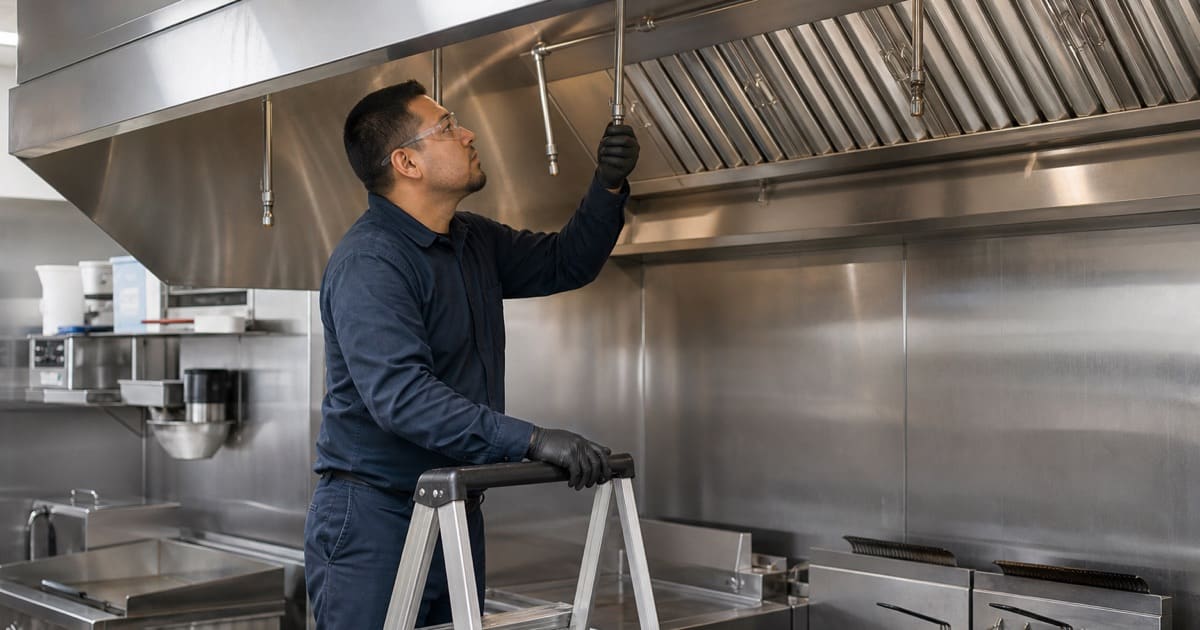
Detection in a wet chemical system is typically mechanical: fusible links held in a tensioned cable run through the hood, which separate at a rated temperature and release the system. Links are replaced on a defined schedule regardless of apparent condition, because grease accumulation and heat cycling degrade them over time. We inspect the cable runs, pulleys, and conduit as well, since a binding cable can prevent a system from releasing even with intact links. Grease migrates into conduit and pulleys over time and stiffens as it cools, so cable travel is verified by testing rather than assumed from appearance. Systems in high-volume kitchens accumulate this faster, and a cable that moves freely at installation can bind within a couple of years in a heavy fry operation.
Gas Shutoff, Electrical Interlocks, and Manual Pull
A hood system has to do more than discharge agent. It must shut off fuel to the appliances, cut electrical power where applicable, and signal the building’s fire alarm system. We test the gas valve, the electrical interlock, and the manual pull station together, because these are the components most likely to have been disabled or bypassed during a repair to an unrelated system. A manual pull station blocked by a rolling rack or a prep table is a finding we write up regularly. The interlocks are also the components most likely to be quietly defeated for operational convenience, since a gas valve that trips during a false activation interrupts service. We test each shutoff by function rather than by inspection, because a valve that looks correct and a valve that closes are different things.
Semi-Annual Service Requirements
What the Service Visit Covers
A semi-annual service covers cylinder and agent condition, nozzle placement and blow-off caps, fusible link replacement, detection cable tension and travel, the gas and electrical shutoffs, the manual pull station, and the connection to the fire alarm. We also verify that a Class K extinguisher is present, current, and mounted where a cook can reach it without passing the appliance line. The hood, ducts, and plenum are examined for grease accumulation that would affect system performance.
Hydrostatic Testing and Cylinder Cycles
Beyond the semi-annual visit, cylinders carry their own longer-cycle hydrostatic testing requirement, and components have service lives independent of their apparent condition. These are the intervals most often missed, because they do not coincide with the routine visit and nothing about the system indicates they are due. We track them against the equipment rather than expecting a kitchen manager to.
Documentation and Inspection Readiness
Health and fire inspections both look at hood system records, and a missing service tag is treated as a missing service. We leave documentation at the time of service and keep records so that when an inspector asks, the answer is available immediately rather than reconstructed from invoices. For operators with several locations, records are consolidated rather than held per site.
Common Findings in Working Kitchens
Appliance Changes That Move Nozzles Out of Coverage
Kitchens rearrange constantly. A fryer swapped for a larger model, a griddle moved to improve workflow, or a char-broiler added at the end of the line can put the existing nozzle configuration out of alignment with what it is protecting. A system that was fully compliant at installation can be non-compliant a year later with no one having touched it, which is why we check appliance layout against nozzle placement at every visit rather than only after a reported change.
Grease Accumulation in Ducts and Plenums
Grease in the hood, plenum, and duct is fuel positioned exactly where a fire would travel, and a fire that reaches the duct is the scenario most likely to leave the kitchen and involve the rest of the building. Duct and plenum nozzles matter as much as the ones over the appliances for this reason. Accumulation rates vary enormously with cooking volume and method, so a high-volume operation frequently needs cleaning intervals shorter than the code minimum. Wok cooking, char-broiling, and heavy frying load a system fastest, while a bakery or a steam-based operation loads it slowly. Setting the interval by menu rather than by calendar is what keeps a kitchen from failing an inspection between compliant service visits.
Disabled Interlocks and Obstructed Pull Stations
Interlocks get bypassed during unrelated repairs and are not always restored. Gas valves are propped, alarm connections are lifted during panel work, and pull stations end up behind storage as the kitchen fills up. None of these are visible as failures during normal operation, and all of them mean the system will not do what it is supposed to do. We test rather than inspect these components for exactly that reason.
Why Choose Long Beach Fire Suppression for Kitchen Hood Fire Suppression
Service Scheduled Around Your Service Periods
Kitchen suppression work does not require closing. We schedule between service periods, during prep hours, or after close, so the line keeps running and the shift is not lost. In hotels and institutional kitchens we coordinate with the operations team so testing does not collide with banquet or meal service. Multi-unit operators get locations grouped into a single visit sequence where geography allows, which keeps mobilization costs down across a portfolio.
One Provider for the Whole Building
Restaurants and hotels carry more than a hood system — sprinklers under NFPA 25, portable extinguishers including Class K units under NFPA 10, and alarm systems under NFPA 72. We handle all of it, which matters most at the interfaces, since the hood system’s alarm signal and its gas shutoff cross into other vendors’ scopes in the usual arrangement. One schedule replaces three or four, and the interfaces between systems are verified by the same technician rather than assumed to work by each vendor separately.
Findings Documented With Photographs and Code References
Every deficiency comes with a photograph and the code section behind it, which is what makes a report useful to an owner reviewing a location remotely or to a multi-unit operator comparing sites. Corrections are priced individually so you can distinguish what has to happen before the next inspection from what can be scheduled.
Correction by the Same Crew, Including Emergencies
The technician who identifies a nozzle out of coverage or a failed link corrects it, without a second company arriving to re-diagnose the same finding. For kitchens that have failed an inspection or discharged a system, we respond on an emergency basis — a discharged system means the kitchen cannot operate until it is recharged, and that is measured in hours of lost service. We carry the components common to both platforms so a recharge is not delayed waiting on parts, and we handle the post-discharge sequence completely — cylinders, links, nozzle verification, interlock testing, and the documentation the fire authority will ask for.
- Commercial & Industrial Only
- Code-Cited Inspection Reports
- Emergency Impairment Response