
Long Beach Fire Suppression handles commercial fire sprinkler repair throughout Long Beach, CA, serving surrounding cities including Signal Hill, Rossmoor, Lakewood, Wilmington, and Seal Beach. We repair wet pipe, dry pipe, pre-action, and ESFR systems in warehouses, restaurants, retail centers, offices, hotels, and industrial facilities.
Sprinkler repair arrives through one of two doors. Either something has failed in a way you can see — a leak, a damaged head, a system that won’t hold pressure — or an inspection has produced a list of deficiencies with a correction deadline attached. The first is urgent by nature. The second is urgent because the fire authority has made it so, and because a system carrying uncorrected deficiencies is a system that may not perform when it matters.
We work on commercial and industrial properties only, and we handle repairs on systems we did not install or inspect. Much of our repair work involves diagnosing what a previous vendor documented but never corrected, or determining why a system that passed last year is failing now. When a system is impaired, we treat the building as being without protection until it is restored, and we plan the work on that basis.
Common Commercial Fire Sprinkler Repairs
Sprinkler Head Damage, Corrosion, and Obstruction
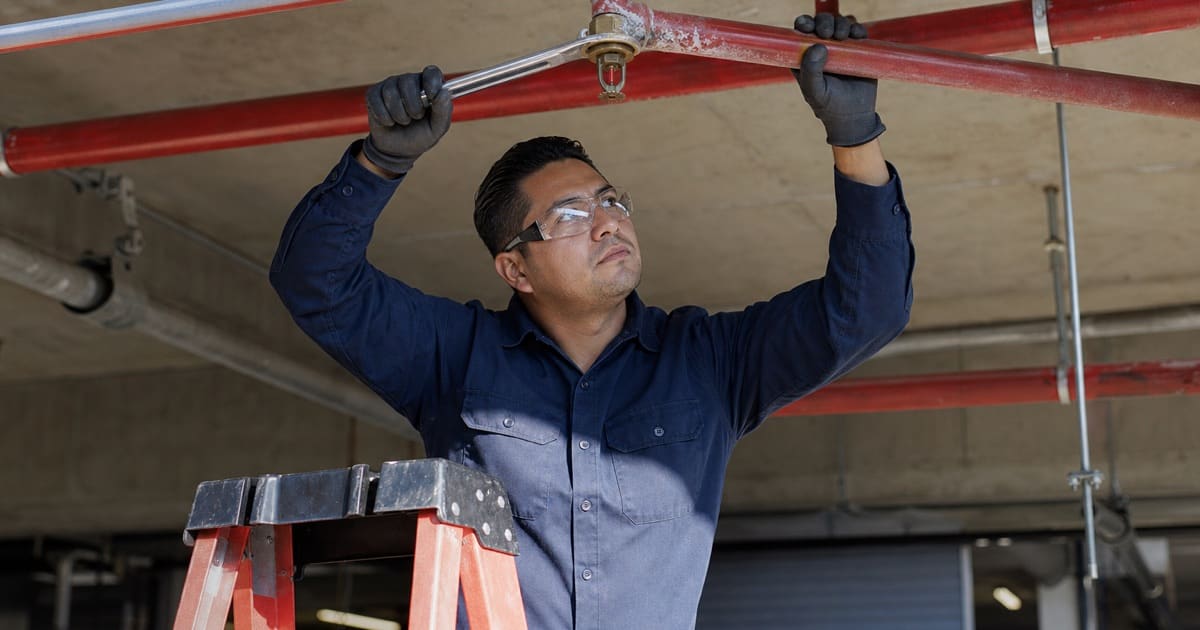
Heads account for the largest share of deficiencies in occupied buildings, and physical damage is the leading cause. Forklifts strike them in warehouses, contractors paint them during tenant improvements, and ceiling work leaves them recessed, blocked, or removed entirely. A painted head is not a cosmetic problem: the coating interferes with the thermal element the head relies on to activate at the correct temperature. We replace damaged, painted, corroded, and loaded heads with the correct type and temperature rating for the location, which is not always the type that was there — a head replaced by a previous contractor with whatever was on the truck is a common finding. Marine air accelerates corrosion on exposed heads and hardware, so coastal properties see this class of repair sooner than inland ones. Loading is the quieter version of the same problem: dust, grease, and lint accumulate on a head until the thermal element is insulated from the air it is supposed to sense. Kitchens, woodworking shops, and textile operations generate this faster than a general commercial space, and it is the reason head condition is assessed against what the room actually does rather than on a fixed replacement interval.
Control Valves, Trim, and Supervisory Devices
Valve problems are the most serious category because they can render an entire system inoperative while everything downstream looks normal. We repair and replace OS&Y valves and post indicator valves that won’t seat or won’t fully open, tamper switches that fail to supervise, and flow switches that don’t actuate or signal within the required time. Gauges reading incorrectly get replaced rather than noted, since an inaccurate gauge quietly invalidates every reading taken from it. Retard chamber and time delay adjustment falls here as well, because a flow switch that trips on pressure surges produces false alarms until someone disables it — which is how a building ends up with an unsupervised system. Valve repairs also carry the highest coordination burden of any sprinkler work, because most of them require the system to be drained and refilled. We sequence these to minimize how long protection is down and confirm the system is fully restored and back in supervision before leaving, rather than assuming an open valve means a working system.
Piping, Leaks, and Internal Corrosion
Leaks in a charged system need immediate attention, but the visible leak is frequently the symptom rather than the problem. Internal corrosion, scale, and microbiologically influenced corrosion develop inside piping over years and appear at the weakest point first. Where a five-year internal obstruction investigation identifies significant buildup, the repair scope is a flushing and remediation project rather than a pipe patch. We also repair and replace hangers, bracing, and supports, which are commonly disturbed by other trades working in a ceiling and rarely put back correctly. Piping that has been cut and extended for a tenant improvement deserves particular attention, since unpermitted modifications are common and frequently leave the hydraulic design invalid even where the workmanship looks acceptable. Where we find work that was never submitted for approval, we say so, because it will surface at the next inspection regardless.
Dry Pipe and Pre-Action System Components
Dry systems have more that can fail. Air compressors that cycle constantly or fail to maintain pressure, low-point drains that trap water and freeze or corrode, and dry pipe valves that won’t trip within the required time all require repair rather than adjustment. Trapped water is the most common underlying issue in a dry system, and it compounds invisibly until a drain is finally opened. Pre-action systems add detection and release panel components, where a fault can leave the system unable to admit water at all — a failure mode that produces no leak, no alarm, and no outward sign. Because these faults are silent, they are found through testing rather than observation, which is an argument for keeping the trip test interval rather than deferring it as a routine expense.
Emergency Repairs and System Impairments
Response When a System Is Out of Service
An impaired sprinkler system is a building without its primary fire protection, and the exposure lasts until protection is restored. We respond on an emergency basis for systems that have been shut down due to failure, damage, or a leak that forced a valve closed. The immediate objective is restoring protection to as much of the building as possible, even where a full repair will take longer — isolating a damaged branch and returning the balance of the system to service is often achievable the same day.
Impairment Handling and Documentation
Taking a system out of service carries its own code obligations, not just practical ones. Impairments must be managed, communicated, and documented, and interim measures may be required depending on duration and occupancy. We handle that process rather than leaving it to the owner, coordinating with property managers, tenants, and where required the fire authority. Proper documentation matters most in the situation nobody plans for, which is an incident occurring while a system is down.
After-Hours and Off-Peak Repair Work
Most repair work does not need to close a business. We schedule around operating hours so kitchens, warehouses, and storefronts keep running, performing shutdown-dependent work before shifts start or after service ends. In multi-tenant buildings we coordinate access and shutdown windows directly with management and affected tenants, so the impaired area and the restoration time are known in advance rather than discovered.
Correcting Deficiencies After a Failed Inspection
Working Against a Re-Inspection Date
A failed inspection comes with a correction deadline, and in serious cases the fire authority can restrict occupancy until the system is restored. We prioritize these buildings and work the deficiency list against the date rather than against a routine schedule. Where the list is long, we sequence corrections so the items that carry occupancy consequences are cleared first.
Deficiencies Priced Individually
A correction list arriving as a single lump sum gives an owner no way to distinguish what is mandatory from what is advisable. We price each deficiency separately, which makes it possible to correct what must be corrected now and stage the remainder across budget cycles. It also makes the quote auditable — you can see what each item costs and why.
Repairs by the Crew That Found the Problem
When inspection and repair sit with different companies, the repairing contractor arrives without context and re-diagnoses findings that were already diagnosed, and sometimes disputes them. Our crews correct the deficiencies they identify. On systems inspected by someone else, we verify the findings before pricing them, because a deficiency list from an unfamiliar vendor occasionally includes items that are not actually deficiencies. That verification protects you from paying to correct a condition that was written up in error, and it occasionally uncovers the reverse — a genuine problem that was recorded as minor.
Why Choose Long Beach Fire Suppression for Fire Sprinkler Repair
Diagnosis Before Replacement
Replacing the component that failed does not always address why it failed. A head damaged twice in the same location needs a guard or a relocation, not a third replacement. A flow switch producing false alarms may be reporting a genuine pressure problem upstream. We look for the cause where the symptom suggests one exists, which is what keeps the same repair from recurring annually.
One Provider Across Every System in the Building
Repairs frequently cross system boundaries — a flow switch is a sprinkler component that reports to the alarm panel, a kitchen hood system interlocks with gas and electrical shutoffs. We service sprinklers, alarms, extinguishers, and kitchen suppression, so those interfaces stay within one scope instead of becoming a dispute between vendors about whose side the fault is on.
Documentation That Closes the Loop
Every repair is documented against the deficiency that prompted it, with photographs of the corrected condition. That record is what you provide to the fire authority to clear a citation, and what a future owner or manager relies on to understand the system’s history. For operators with multiple locations, corrections across sites stay in one consolidated record rather than scattered across individual invoices.
Available When the System Fails, Not Just When It’s Scheduled
Sprinkler failures do not respect business hours, and a building sitting impaired overnight is carrying real exposure. We respond on an emergency basis, restore partial protection where full repair will take longer, and keep property management informed about what is protected and what is not while the work proceeds.
- Commercial & Industrial Only
- Code-Cited Inspection Reports
- Emergency Impairment Response