
Long Beach Fire Suppression provides commercial fire extinguisher service throughout Long Beach, CA, serving surrounding cities including Signal Hill, Rossmoor, Lakewood, Wilmington, and Seal Beach. We inspect, maintain, recharge, hydrostatically test, and replace portable extinguishers in warehouses, restaurants, offices, retail centers, schools, auto shops, and industrial facilities.
Portable extinguishers are governed by NFPA 10, which sets requirements for selection, placement, inspection, maintenance, and testing. They are the most visible fire protection equipment in a building and the most consistently neglected, largely because they appear to require nothing. An extinguisher sitting on a bracket looks identical whether it was serviced last year or eleven years ago, and the difference only becomes apparent when someone pulls the pin.
Getting extinguishers right is less about the units themselves than about matching type to hazard and keeping coverage intact as a building changes. We inspect commercial and industrial properties exclusively, and extinguisher work is frequently where we find the widest gap between what a building has and what its actual operations require.
Extinguisher Types and Where They Belong
ABC Dry Chemical
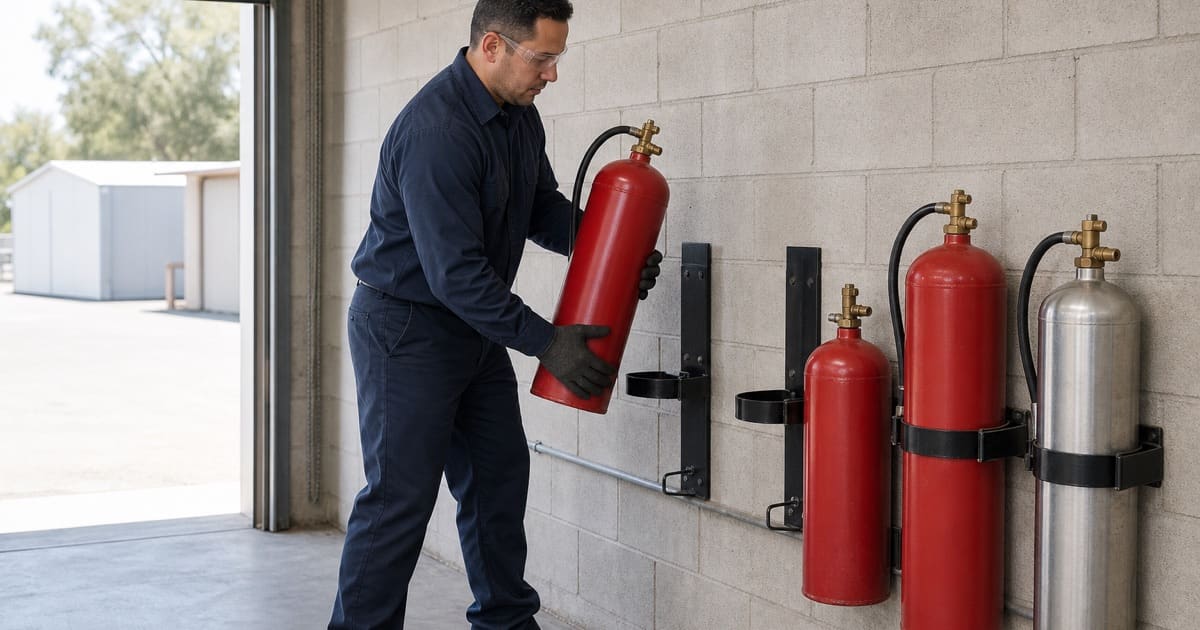
ABC dry chemical is the general-purpose extinguisher found throughout most commercial buildings, rated for ordinary combustibles, flammable liquids, and energized electrical equipment. Its versatility is why it dominates: a single unit covers the majority of hazards in an office, a retail suite, or a warehouse aisle. The tradeoff is residue. The agent is corrosive to electronics and difficult to clean up, which is why it is a poor choice in a server room even though it is technically rated for electrical fires. We size and place these according to the hazard classification of the area rather than distributing identical units evenly through a building, since travel distance requirements and hazard level both affect how many are needed and what rating they must carry. Rating is the detail most often misunderstood, since two units of identical physical size can carry very different numerical ratings depending on agent quantity and construction. A building that satisfies its unit count but not its rating requirement is still deficient.
Class K for Commercial Kitchens
Class K extinguishers use a wet chemical agent designed for cooking oils and fats, working by the same saponification principle as a hood suppression system. They exist because cooking oil fires reflash — smothering alone is insufficient without cooling the fuel below its ignition temperature, which standard dry chemical does not accomplish. A Class K unit is required in commercial kitchens in addition to the hood system, not as a substitute for it, and it must be mounted where a cook can reach it without passing the appliance line. We verify placement against the actual traffic pattern in the kitchen, not just the wall it happens to be on. A Class K unit mounted on the far side of the cook line satisfies a drawing and fails the person who needs it, and that distinction is exactly what an inspection is meant to catch.
CO2 for Electronics and Equipment
Carbon dioxide extinguishers discharge a gas that leaves no residue, which makes them appropriate around electrical equipment, laboratory instruments, and server hardware where a dry chemical discharge would cause as much loss as a small fire. They are less effective on ordinary combustibles and have a short effective range, so they complement rather than replace ABC units in most facilities. CO2 units are also noticeably heavier than dry chemical of equivalent rating, which matters for mounting height and for who is expected to use them. Their discharge is also loud and produces a visible cloud, which is worth knowing in advance, since an operator startled into dropping the unit has effectively not used it at all.
Specialty Units for Specific Hazards
Some operations need something other than the standard three. Class D units address combustible metals in machine shops and certain manufacturing processes, water mist units serve environments where contamination is a concern, and clean agent portables protect sensitive equipment where CO2 is impractical. These are the units most often missing entirely, because a building outfitted generically at construction rarely gets revisited when a tenant introduces a process the original selection never contemplated. Identifying that gap is part of what an extinguisher survey should produce. Auto shops, machine shops, laboratories, and paint operations are where this comes up most, because the hazard arrived with the tenant rather than with the building.
NFPA 10 Service Intervals
Monthly Visual Inspections
NFPA 10 requires a monthly visual inspection confirming each extinguisher is in its designated location, unobstructed, correctly mounted, showing adequate pressure, and free of visible damage or tampering. This is an owner responsibility that can be performed by staff rather than a service company, and it is the requirement most often left undone. We set up the documentation so the monthly check is a short, repeatable task with a record behind it, because an inspector asking for twelve months of monthly records is asking a question most buildings cannot answer.
Annual Maintenance
Annual maintenance is a hands-on examination performed by a service company, covering the mechanical parts, the agent, and the expelling means. It goes considerably beyond the monthly look — verifying agent condition, checking the hose and nozzle, examining the shell for corrosion or damage, and confirming the pressure gauge reads accurately rather than merely reading something. Units that fail any element are recharged, repaired, or removed from service. This is also the visit where coverage across the building gets reassessed against how the space is currently used.
Six-Year Maintenance and Hydrostatic Testing
Longer cycles are where compliance most often lapses. Stored-pressure dry chemical units require six-year internal maintenance, emptying and examining the interior before recharging. Hydrostatic testing follows its own schedule depending on the unit type, commonly five years for CO2 and wet chemical cylinders and twelve years for dry chemical. Extinguishers also reach an age past which testing is no longer economical and replacement is the better decision. We track these dates per unit rather than per building, since a facility typically holds extinguishers purchased across many different years. Treating them as a single fleet with one date is how buildings end up either testing equipment early or missing units entirely, and both cost money in different ways.
Placement, Coverage, and Common Deficiencies
Travel Distance and Hazard Classification
Coverage is determined by maximum travel distance to an extinguisher and by the hazard classification of the area, which together set how many units a space needs and what minimum rating each must carry. Higher-hazard areas require shorter travel distances and larger units. This is why square footage alone is a poor guide, and why a warehouse conversion or a new spray operation frequently leaves a building under-equipped without anything having been removed.
Mounting, Signage, and Accessibility
Extinguishers must be mounted at the correct height, secured properly, and visible or clearly marked. In practice the recurring deficiency is obstruction — units disappear behind pallets, stock, rolling equipment, and seasonal storage as a building fills up. Missing pull pins and tamper seals, damaged hoses, and units removed from their brackets and left on the floor round out the most frequent findings. None of these require a failure to occur to matter; they simply mean the extinguisher will not be found or usable when it is needed.
Coverage Gaps After Building Changes
Buildings change faster than their fire protection does. New walls create rooms with no coverage, a tenant introduces a hazard requiring a unit type the building does not have, and remodels leave brackets on walls that no longer face occupied space. Because extinguisher placement is rarely revisited during tenant improvement work, these gaps accumulate quietly between inspections. We reassess coverage against the current floor plan rather than the one the units were originally placed against.
Why Choose Long Beach Fire Suppression for Fire Extinguisher Service
Coverage Assessed Against What the Building Actually Does
Servicing the units you already have is the easy half. The harder and more useful half is determining whether the right types are in the right places for current operations, which is where the meaningful risk usually sits. We survey against present use rather than the original placement, and we tell you where coverage is thin, where a unit type is wrong for the hazard, and where you are carrying units you do not need.
Every System Under One Provider
Extinguishers sit alongside sprinklers under NFPA 25, kitchen suppression under NFPA 96 and NFPA 17A, and alarms under NFPA 72, each on separate intervals. Splitting them across vendors is how requirements fall into gaps between contracts. We handle all of them, which consolidates the schedule, the records, and the invoicing, and it means the Class K extinguisher in your kitchen is verified by the same visit that services the hood system above it.
Per-Unit Tracking, Not Per-Building Guesswork
A building’s extinguishers were almost never purchased at the same time, so their six-year and hydrostatic dates fall in different years. We track service and testing history per unit so nothing lapses and you are not paying to test equipment ahead of schedule. For operators running several sites, that history stays consolidated rather than scattered across individual location files.
Documentation Built for Inspections
Findings are documented with photographs and the code reference behind them, and corrections are priced individually so you can separate what must be addressed now from what can be scheduled. Service records and tags are left current at the time of the visit, which is what turns a fire or health inspection question into a document rather than a search.
- Commercial & Industrial Only
- Code-Cited Inspection Reports
- Emergency Impairment Response