
Long Beach Fire Suppression performs commercial fire sprinkler inspection throughout Long Beach, CA, serving surrounding cities including Signal Hill, Rossmoor, Lakewood, Wilmington, and Seal Beach. We inspect wet pipe, dry pipe, pre-action, and ESFR systems in warehouses, restaurants, offices, retail centers, hotels, and industrial buildings.
Sprinkler inspection is governed by NFPA 25, which sets what has to be checked and how often for water-based fire protection systems. It is not a single annual event, despite being discussed that way. Different components carry different intervals, ranging from quarterly through five-year cycles, and a building that has only ever had an annual visit is almost certainly carrying uncompleted requirements it doesn’t know about.
Responsibility for all of it sits with the building owner, not the inspection company. That distinction matters when a property changes hands or management, because the obligation transfers with the building while the records frequently do not. We inspect commercial and industrial properties exclusively, and part of what we deliver is a clear picture of which requirements apply to your specific systems and when each one comes due.
What an NFPA 25 Inspection Actually Covers
Control Valves, Gauges, and Water Supply
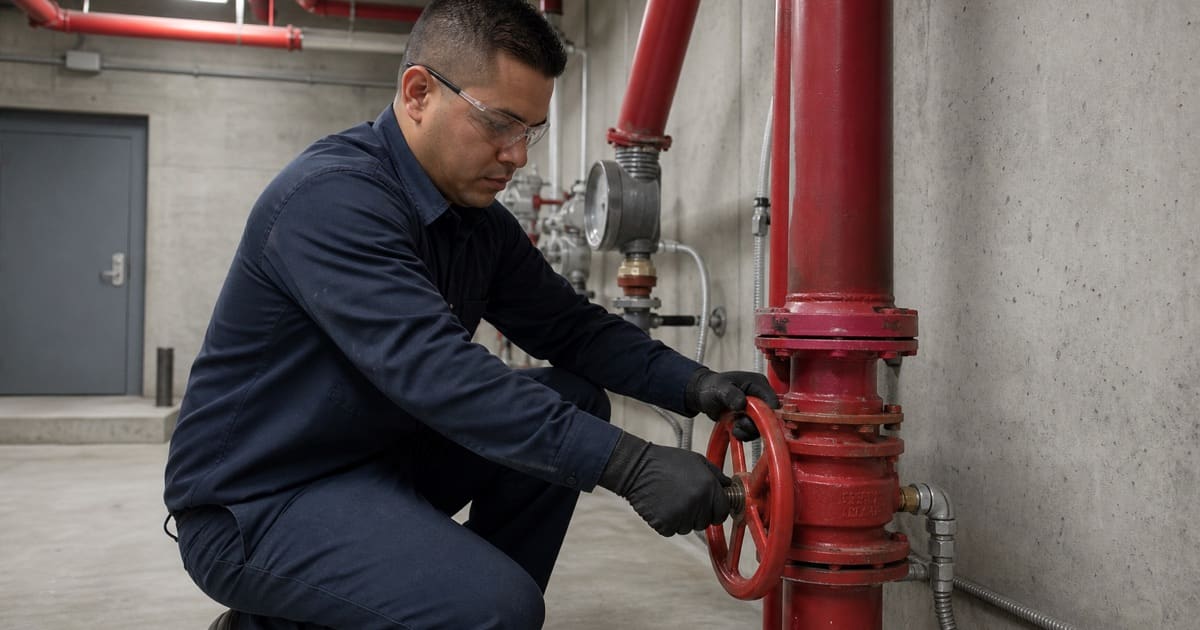
Every inspection starts at the riser, because a sprinkler system that is closed at a valve protects nothing regardless of how good the rest of it is. We verify that OS&Y valves and post indicator valves are open and properly supervised, check that tamper switches signal correctly, and confirm gauge readings against expected supply pressure. Main drain testing follows, which is how we detect whether the water supply feeding the building has degraded since the last visit. A falling main drain result over successive inspections is one of the more useful early warnings available, because it usually means an upstream valve is partially closed or the supply itself has changed. We record the reading against prior results rather than in isolation, because the trend carries more information than any single number. Buildings that have had several different inspection vendors often have no comparable history at all, which is its own finding worth surfacing.
Flow Switches, Alarms, and Supervisory Devices
A sprinkler system has to announce itself when it operates, and the devices that do that are tested rather than merely looked at. We conduct waterflow testing to confirm the flow switch actuates and that the signal reaches the alarm panel and monitoring within the required time. Tamper and supervisory devices are tested the same way. Because we also service fire alarm systems under NFPA 72, we can verify both sides of that interface in one visit rather than confirming the switch works and leaving the panel side to a different vendor. Timing matters as much as function here, since a switch that actuates but signals late still constitutes a deficiency. Retard chambers and time delays are set to prevent nuisance alarms from pressure surges, and when they drift out of adjustment the result is either false alarms or delayed notification, neither of which is acceptable.
Sprinkler Heads, Piping, and Internal Condition
Head inspection covers physical damage, corrosion, paint, loading, and obstruction, along with confirming that spare heads and the correct wrench are on site. Coverage is checked against the space as it exists now, not as it was drawn, which is where most findings in tenant-occupied buildings originate. Beyond what is visible, NFPA 25 requires a five-year internal obstruction investigation, because corrosion products and scale accumulate inside piping where no external inspection can see them. That internal condition is the failure mode owners are least aware of and the one most likely to matter when a system is actually called on. Buildings near the coast see this sooner than inland properties, since exposed piping and hardware corrode faster in marine air. Obstruction findings also tend to cluster in older systems and in systems that have been extended piecemeal over the years, where dissimilar metals and stagnant branch lines accelerate the process.
Inspection Intervals and What Falls Due When
Quarterly and Semi-Annual Requirements
Shorter-cycle items are mostly supervisory. Gauges, alarm devices, and certain valve types are checked on quarterly intervals, and hydraulic nameplates and supervisory signal devices fall on similar cycles. These are quick checks individually, but they are also the ones most often skipped by a building running on an annual-only schedule. Dry pipe systems add their own short-interval items, including air pressure verification and, in cold weather conditions, priming water level. None of these individually take long, which is exactly why skipping them is easy to rationalize and easy to overlook until an inspection record is reviewed by someone who knows what should be in it.
Annual Requirements
The annual inspection is the substantial one, covering the full sprinkler system, hangers and bracing, piping condition, head condition and coverage, main drain testing, and waterflow testing. Buildings with fire pumps carry annual flow testing on top of this, and backflow assemblies protecting the system typically require annual certification through the water purveyor. This is also where the year’s accumulated changes surface — new walls, relocated racking, ceiling work, and equipment added without anyone considering sprinkler coverage. In multi-tenant buildings, the annual is effectively an audit of every tenant improvement completed since the last visit, and it is common for the majority of findings to trace back to work no one told the fire protection vendor about.
Five-Year Requirements
Every five years the system requires an internal obstruction investigation, opening the piping to examine for corrosion, scale, and foreign material that restricts flow. Standpipe systems carry their own five-year hydrostatic testing requirement. These are the intervals most commonly missed entirely, partly because five years exceeds the tenure of many facility managers and partly because nothing about the system’s exterior suggests the work is due. We track these dates against the building rather than against whoever is currently managing it. When an owner has no record of a five-year item ever being performed, we treat that as due now rather than assuming a previous vendor handled it quietly.
Our Step-by-Step Fire Sprinkler Inspection Process
1. Scope Confirmation Before We Arrive
We establish what systems the property has, what intervals apply to each, and what is actually due at this visit. On a first inspection, that includes reviewing whatever prior records exist and identifying gaps where a required interval appears never to have been performed. Knowing this in advance is what prevents a visit that completes the easy items and leaves the five-year work for another trip.
2. Access and Impairment Planning
Testing puts systems temporarily out of service, so we plan the window with property management before work starts rather than after arrival. Occupied buildings, tenant suites, and locked mechanical rooms all get arranged ahead of time. Where an impairment is unavoidable, it is limited to the affected area, communicated to the people who need to know, and documented as the code requires.
3. Field Inspection and Testing
We work the system from the supply inward — valves and gauges, main drain, waterflow and supervisory devices, then piping, hangers, and head condition and coverage throughout the protected area. Findings are photographed as they are identified rather than reconstructed afterward, which is what makes the report usable to someone who was not on site.
4. Reporting With Code References
Each deficiency is documented with a photograph and the code section behind it, so the report explains not just what is wrong but why it was written up. Findings are separated by severity, because a painted head and a closed valve are not the same problem and should not be presented as though they are.
5. Correction Planning
Where deficiencies exist, we price each one individually rather than issuing a single figure. That lets an owner address what must be corrected immediately and stage the remainder against budget. Because our crews perform the corrections as well, the repair does not begin with a second company re-diagnosing findings that have already been diagnosed.
Why Choose Long Beach Fire Suppression for Fire Sprinkler Inspection
Reports Written to Be Used, Not Filed
Most inspection reports are a list of deficiencies with no explanation and no priority. Ours attach a photograph and a code citation to each finding, which means an owner reviewing three properties remotely can tell what actually needs attention without a site visit or a phone call. It also means that when the fire authority asks what was found and what was done about it, the documentation answers the question.
Every System on One Schedule
Buildings rarely have only sprinklers. Extinguishers under NFPA 10, kitchen suppression under NFPA 96 and NFPA 17A, and alarm systems under NFPA 72 all carry their own intervals, and splitting them across vendors is how requirements fall through gaps. We cover all of them, so one schedule and one set of records replaces four. Operators with multiple locations get sites grouped rather than treated as unrelated accounts.
Due Dates Tracked Against the Building
Compliance intervals outlast staff turnover, and the five-year requirements outlast most facility managers’ tenure at a single property. We hold the schedule so annual, semi-annual, and long-cycle work comes due on our calendar rather than depending on someone remembering. When a building changes hands or management, the inspection history stays intact.
Inspection and Correction From the Same Crew
An inspection that finds problems is only half of the job. Our crews correct the deficiencies they identify, which removes the handoff where a second contractor arrives without context and bills for re-diagnosis. For buildings that have already failed an inspection and are working against a re-inspection date, we respond on an emergency basis and schedule the corrective work around your operating hours so the building keeps running while it comes back into compliance.
- Commercial & Industrial Only
- Code-Cited Inspection Reports
- Emergency Impairment Response