
Long Beach Fire Suppression performs commercial backflow testing in Long Beach, CA, certifying the backflow prevention assemblies that separate fire sprinkler systems from the potable water supply in warehouses, retail centers, offices, restaurants, hotels, and industrial facilities.
Backflow testing sits slightly outside the rest of fire protection work. It is required because of what the water supply needs, not because of what the sprinkler system needs, and it is generally enforced by the water purveyor rather than the fire authority. That split is why it is so frequently missed — a building can be current on every NFPA 25 requirement and still be out of compliance on backflow certification, because the two obligations come from different places and arrive on different notices.
We test and certify assemblies and handle the repairs when one fails, and because we also perform the sprinkler inspection, both can be completed on the same visit rather than requiring two vendors and two site trips. For properties with several assemblies across a campus or a portfolio, that consolidation is the difference between one coordinated schedule and a series of unrelated appointments.
Why Fire Systems Require Backflow Prevention
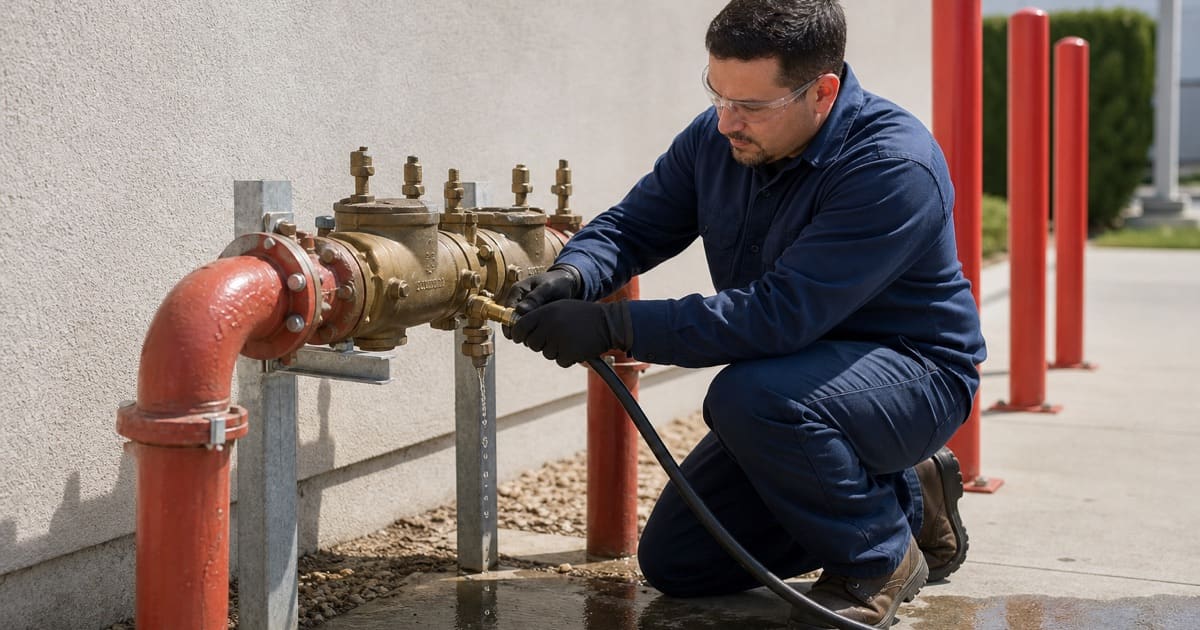
Water sitting in a fire sprinkler system is stagnant for years at a time. It is not treated, it is not circulated, and it sits in contact with metal piping where it picks up corrosion products, scale, and in some systems antifreeze or other additives. That water is entirely appropriate for firefighting and entirely inappropriate for drinking. A backflow prevention assembly is a mechanical barrier ensuring water can move from the supply into the fire system but never in the reverse direction. Reverse flow occurs more easily than people expect. A water main break, a hydrant opening, or heavy draw elsewhere in the system can drop supply pressure below the pressure in the building’s piping, and without a functioning assembly, system water moves back toward the main. Because the consequence is contamination of a public water supply, enforcement is handled by the water purveyor, and certification is generally required annually regardless of what any other inspection found. Building owners frequently discover the requirement through a delinquency notice rather than through their fire protection vendor, which is a poor way to learn about it and an avoidable one.
Types of Backflow Assemblies
Double Check Valve Assemblies
A double check valve assembly, or DCVA, uses two independently acting check valves in series with shutoff valves and test cocks. It is the standard assembly on fire sprinkler systems where the hazard is classified as non-health — that is, where the water in the system is objectionable but not toxic. Most conventional wet pipe systems without additives fall into this category. The assembly is relatively compact and does not discharge water in normal operation, which makes installation straightforward and location flexible. Because a DCVA introduces less pressure loss than the alternative, it is also easier to accommodate in a system whose hydraulic calculations leave little margin. Where a system qualifies for one, it is nearly always the better choice.
Reduced Pressure Zone Assemblies
A reduced pressure zone assembly, or RPZ, adds a relief valve between two check valves that opens and discharges water to atmosphere if the pressure differential fails. It provides higher protection and is required where the system presents a health hazard — most commonly where antifreeze or other chemical additives are present in the piping. Because an RPZ can discharge substantial water when it operates, it requires a drain capable of handling that flow and it cannot be installed in a location where a discharge would cause damage. RPZ assemblies also produce a greater pressure loss than a DCVA, which has to be accounted for in the hydraulic calculations for the sprinkler system. Retrofitting an RPZ into a system originally designed around a DCVA can push a marginal design below its required performance, which is why the change is treated as a design question rather than as a component swap.
Selecting and Locating the Assembly
Which assembly a system requires is determined by hazard classification, and that classification can change. Adding antifreeze to a system that previously had none can move it from non-health to health hazard and require the assembly to be replaced rather than merely retested. Location matters as well, since assemblies need clearance for testing and repair, protection from freezing and vehicle traffic, and in the case of an RPZ, adequate drainage. Assemblies installed in pits or tight closets are a recurring problem, because testing them properly is difficult and repairing them is worse. When an assembly has to be relocated to be serviceable, that work is usually cheaper over the life of the system than absorbing the added cost of every future test and repair.
Annual Testing and Certification
Backflow assemblies require testing by a certified tester, typically annually, with results reported to the water purveyor. The test uses a calibrated differential pressure gauge to verify each check valve holds against reverse flow and, on an RPZ, that the relief valve opens at the correct differential. Testing requires the assembly to be isolated, which means the sprinkler system is briefly out of service — a short impairment, but one that should be planned and documented rather than treated as incidental. Because the reporting deadline is set by the purveyor rather than by the building, a missed test generates a notice and, if unresolved, potential penalties or service action. We track these dates alongside NFPA 25 intervals so both schedules sit in one place, and we perform the certification on the same visit as the sprinkler inspection where the timing allows. Consolidating the two also means the building takes one impairment rather than two, which matters more in occupied properties than the scheduling convenience does.
Common Failures and Repairs
Backflow assemblies fail in predictable ways. Debris on a check valve seat prevents it from closing fully, which is the most common cause of a failed test and often the easiest to correct. Worn or deteriorated rubber components — seats, discs, and diaphragms — degrade on a predictable schedule and are addressed through rebuild kits rather than assembly replacement. Rebuilding is almost always the economical path unless the assembly body itself is damaged or the unit has reached an age where parts are no longer available. We carry kits for the common assemblies so a failed test can often be corrected on the same visit rather than scheduled as a return trip. Relief valves on RPZ assemblies fail either by not opening when they should or by discharging continuously, and continuous discharge is frequently misdiagnosed as a plumbing leak by someone unfamiliar with the equipment. Shutoff valves that will not fully open or close are their own problem, since they prevent proper testing and can restrict the water supply to the sprinkler system without any other symptom. This is the failure worth taking seriously, because a partially closed supply valve upstream of a sprinkler system reduces available water without triggering any alarm or visible indication. Where an assembly fails, it must be repaired and retested rather than simply noted, because a failed assembly is a compliance problem with the water purveyor and a potential restriction on the fire system at the same time.
- Commercial & Industrial Only
- Code-Cited Inspection Reports
- Emergency Impairment Response