
Long Beach Fire Suppression handles commercial fire alarm system installation in Long Beach, CA, covering detection, notification, monitoring, and the interfaces between the alarm system and the suppression equipment it supervises. We work in offices, warehouses, retail centers, restaurants, hotels, schools, and industrial facilities.
Fire alarm work is governed by NFPA 72, which covers system design, installation, testing, and maintenance. The alarm system occupies a different role from suppression: it detects and notifies rather than acting on the fire, and it is also the component that tells the outside world something is happening. A sprinkler system that operates without a functioning alarm still fights the fire, but nobody is alerted and nobody is dispatched.
Because we service sprinklers, extinguishers, and kitchen suppression as well, the connections between those systems and the alarm panel stay within one scope. That matters more than it sounds — flow switches, tamper switches, and kitchen hood releases are all suppression components that report to the alarm system, and in the usual multi-vendor arrangement no one owns the connection between them.
Conventional and Addressable Systems
Conventional Panels
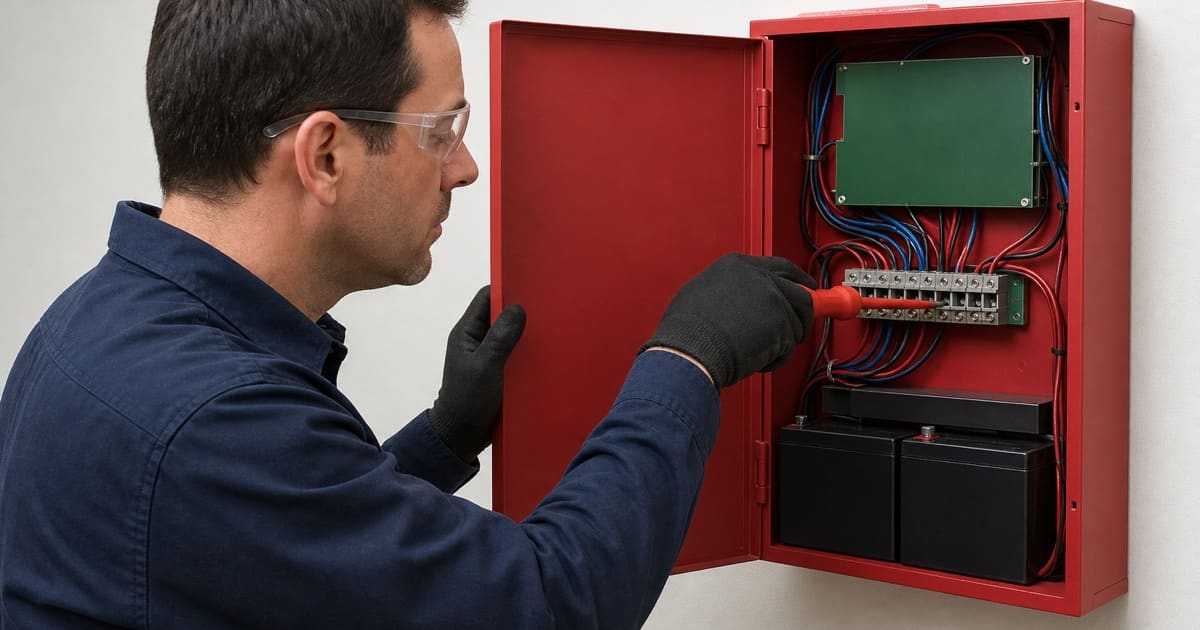
Conventional systems divide a building into zones, with devices wired in loops that report by zone rather than individually. When a device activates, the panel identifies the zone but not which device within it. They remain appropriate for smaller buildings with straightforward layouts, where a zone corresponds closely enough to a location that the distinction does not matter. Installation cost is lower, and the equipment is simpler to work on. The limitation shows up during troubleshooting rather than during normal operation, since a trouble condition on a conventional loop tells you a problem exists somewhere in the zone without narrowing it further. In a small suite that is a minor inconvenience; across a warehouse floor it is an afternoon.
Addressable Panels
Addressable systems assign each device its own identifier, so the panel reports exactly which detector or module activated and where it is. In a building of any size this is the difference between responding to a location and searching a zone. Addressable systems also report device-level trouble conditions, including dirty detectors approaching the point of nuisance alarms, which makes maintenance predictive rather than reactive. For multi-story or multi-tenant properties, addressable is generally the practical choice regardless of the cost difference at installation. The reporting detail also changes what an inspection can accomplish, because device-level history reveals which detectors are drifting before they start causing nuisance alarms. Over the life of a system that visibility usually outweighs the higher equipment cost.
Detection and Notification Devices
Smoke and Heat Detection
Smoke detection is the default in occupied space, using photoelectric or ionization sensing depending on the fire profile expected. Heat detectors are used where smoke detection would produce constant false alarms — kitchens, mechanical rooms, parking structures, and dusty industrial areas. Selecting the wrong type for the environment is the leading cause of nuisance alarms, and nuisance alarms are the leading cause of systems being ignored or disabled. Duct detectors are a separate category, mounted in air handling systems to shut down fans and stop smoke from being distributed through a building. Detector placement is governed by ceiling height, airflow, and obstructions, and all three change during tenant improvement work. Detectors that were correctly placed under an open ceiling can end up above a new dropped ceiling protecting nothing, which is a finding we encounter in nearly every building that has been reconfigured without the fire protection scope being revisited.
Notification Appliances
Horns, strobes, speakers, and combination devices deliver the audible and visible alerting that gets occupants out. Coverage requirements govern both sound level relative to ambient noise and strobe placement and synchronization for visibility. A warehouse or manufacturing floor with high ambient noise needs substantially more notification capability than an office of the same size, which is a common source of deficiencies in buildings converted from one use to another. Voice evacuation systems replace tone-based notification in larger and higher-occupancy buildings, allowing specific instructions rather than a general alarm. Strobe synchronization matters as well, since unsynchronized strobes within sight of one another can produce a flash rate that is both non-compliant and genuinely hazardous for some occupants. This is checked at installation and re-checked whenever devices are added.
Manual Pull Stations
Pull stations provide manual activation and are placed along egress paths so someone leaving can trigger the alarm on the way out. The recurring deficiency is obstruction rather than failure — stations disappear behind storage, display fixtures, and equipment as a space fills up. Placement is verified against current conditions rather than the original drawings, since a station that satisfied a plan and a station that is reachable are not always the same thing. Stations also need to be identifiable, which becomes an issue in buildings with heavily branded interiors where a red station is deliberately made less visible for aesthetic reasons.
Monitoring and Signal Transmission
Most commercial fire alarm systems are required to transmit signals to a monitoring facility that dispatches emergency response. How that signal leaves the building has changed considerably, with traditional phone lines giving way to cellular and IP communicators. This matters practically, because buildings that abandoned copper phone service sometimes did so without confirming what their alarm communicator depended on, leaving a system that alarms locally and reports nowhere. Communication paths are tested as part of routine inspection rather than assumed to work, and supervisory and trouble signals are verified alongside alarm signals — a system that reports a fire but never reports its own trouble condition will eventually fail silently.
Integration With Suppression Systems
The alarm panel is where the building’s fire protection systems converge. Sprinkler waterflow switches signal the panel when water moves, tamper switches supervise valve position, kitchen hood systems report activation, and clean agent systems both take input from detection and report their discharge. Each of those connections crosses a boundary between what is usually a different vendor’s equipment. We test both sides — that the switch actuates and that the panel receives it, within the required time. This is the single most common place where two individually compliant systems produce a non-compliant building, because each vendor verifies their own equipment and neither verifies the interface.
Inspection and Testing Under NFPA 72
Fire alarm systems carry recurring inspection and testing obligations that vary by device type and building. Annual testing covers detectors, notification appliances, pull stations, panel functions, batteries and secondary power, and the transmission of signals to monitoring. Smoke detectors require periodic sensitivity testing rather than functional testing alone, since a detector can respond to test smoke while operating far outside its rated sensitivity. Battery capacity is a routine failure point, as secondary power has to carry the system for a defined period and batteries degrade on a predictable schedule whether or not they have ever been called on. Records of testing are as much a part of compliance as the testing itself, and they are what an inspector asks for first. Panel programming is worth verifying alongside the devices, since changes made over the years to silence a problem device or accommodate a renovation are often left in place permanently. A panel with zones disabled in software passes a visual inspection and fails to function, and that condition is only found by testing.
- Commercial & Industrial Only
- Code-Cited Inspection Reports
- Emergency Impairment Response