
Long Beach Fire Suppression performs commercial fire pump testing in Long Beach, CA, along with standpipe inspection and testing, for high-rise buildings, warehouses, industrial facilities, hotels, and any property where the municipal water supply alone cannot meet the demand of the fire protection system.
Fire pumps and standpipes are the equipment most commercial buildings never think about, because they sit in mechanical rooms and stairwells rather than in occupied space. That is precisely why they need scheduled testing. A sprinkler head that is painted over is visible to anyone who looks up. A fire pump that will not start under load, or a standpipe with a damaged fire department connection, gives no outward sign at all until the moment it is needed.
Both fall under NFPA 25, which sets the intervals and the test procedures. The requirements are more demanding than for sprinkler piping alone, because these are mechanical systems with moving parts, power supplies, and controllers that degrade whether or not the system is ever called on.
Fire Pump Systems and Components
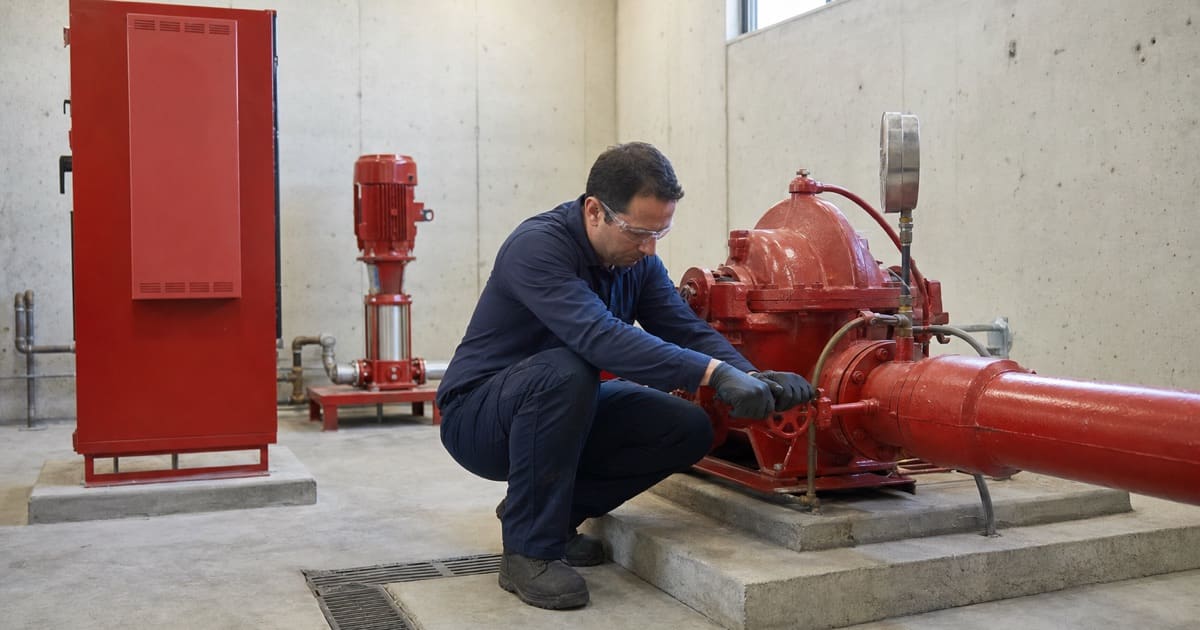
Why a Building Needs a Fire Pump
A fire pump exists when the available water supply cannot deliver the pressure and flow the sprinkler or standpipe system requires. That gap is usually a function of building height, since water pressure falls with elevation, but it also occurs in large-footprint buildings and in high-demand storage occupancies where design flow exceeds what the street can provide. The pump does not create water — it adds pressure to what the supply delivers, which is why the supply itself is tested alongside the pump rather than treated as a given. This is why a pump that tested acceptably for years can begin failing without any change to the pump itself, since municipal supply conditions shift as surrounding infrastructure and demand change.
Pump Drivers and Controllers
Fire pumps are driven by electric motors or diesel engines, and the choice affects both the testing regime and the failure modes. Electric pumps depend on a reliable power supply and, in many installations, on a backup source or generator, since a fire that interrupts building power must not also disable the pump. Diesel pumps carry their own maintenance obligations — fuel condition, battery banks, cooling, and exhaust — and are common where a dependable electrical supply cannot be guaranteed. The controller is a component in its own right, and controller faults are a frequent finding, particularly where a unit has been left in a manual or bypassed condition after service work. Transfer switches and alternate power arrangements are tested as part of the same scope, because a pump with a perfectly serviceable motor and no available power is not a working pump.
Jockey Pumps and System Pressure
A jockey pump maintains system pressure so the main fire pump does not start on small pressure fluctuations. When a jockey pump fails or is undersized, the main pump cycles unnecessarily, which causes wear and often prompts someone to intervene in a way that leaves the system compromised. A main pump that starts frequently is reporting a problem elsewhere — usually a small leak or a failing jockey pump — and diagnosing that cause is more useful than resetting the condition. Pressure-maintenance problems are among the least expensive findings to correct and among the most expensive to ignore, since the wear they cause accumulates on the main pump rather than on the jockey.
Fire Pump Testing Requirements
Weekly and Monthly Churn Testing
Fire pumps require frequent no-flow, or churn, testing to confirm the pump starts and runs. The interval depends on the driver type and installation, with diesel units generally requiring more frequent attention than electric ones. These tests verify the automatic start sequence, run the pump for a defined period, and check for correct pressure, packing condition, and the absence of overheating. Most churn testing can be performed by trained building staff with proper documentation, and we set up that process where an owner prefers it. What matters is that the results are recorded consistently, because the value of frequent testing lies in the trend rather than in any individual run.
Annual Flow Testing
The annual flow test is the substantive one, running the pump at churn, at rated capacity, and at peak flow to confirm it still performs to its nameplate curve. This requires flowing significant volumes of water, either through a test header or with hoses and flow measuring equipment, and it produces the data that shows whether the pump has degraded since installation. Comparing the current curve against the original acceptance test is what makes the result meaningful — a pump can start reliably and still be delivering materially less than its design output. We schedule these around building operations and coordinate discharge so the test does not create a drainage or nuisance problem on the property. In dense sites without a suitable discharge point, testing may require flow meters in a closed loop rather than open discharge, which changes the setup but not the requirement.
Common Fire Pump Findings
The most frequent findings are not dramatic. Controllers left in manual after service, closed or partially closed suction valves, failed or failing batteries on diesel units, packing that has not been adjusted, and pressure-maintenance problems account for most deficiencies. A significant share of pump rooms also contain storage that does not belong there, which is both a code issue and a practical obstruction to anyone servicing the equipment under pressure. Pump rooms accumulate stored material precisely because they are out of the way, and clearing one is usually the simplest deficiency on any report we issue.
Standpipe Systems and Testing
What Standpipes Do
Standpipes deliver water to hose connections throughout a building so firefighters do not have to run hose from street level to an upper floor. They are classified by intended user and hose size, and in many buildings the standpipe and sprinkler systems share risers and supply. The fire department connection on the exterior allows apparatus to pressurize the system from outside, which makes it one of the few pieces of fire protection equipment whose failure is discovered by the fire department rather than by the building.
Inspection and Five-Year Testing
Standpipes require routine inspection of valves, hose connections, caps, gaskets, and signage, along with a five-year hydrostatic test that pressurizes the system to verify integrity. Flow testing of the hydraulically most remote connection is also required on a five-year cycle, confirming the system can actually deliver pressure and volume where it matters most. These longer-cycle requirements are among the most commonly missed items in NFPA 25, because five years exceeds the tenure of most facility managers and nothing about the system suggests the work is due.
Fire Department Connections
The FDC is inspected for accessibility, visibility, cap presence, gasket condition, and obstruction, and the connection is checked to confirm it is not damaged or blocked internally. Missing caps allow debris to enter the piping, and obstructed or overgrown connections delay response at the worst possible time. Because the FDC sits outside the building envelope, it is also the component most exposed to weather, vehicle contact, and landscaping changes made by contractors with no knowledge of what it does. Landscaping, parked vehicles, and construction staging are the routine causes, and the deficiency is nearly always cheap to correct once someone identifies it.
- Commercial & Industrial Only
- Code-Cited Inspection Reports
- Emergency Impairment Response