
Long Beach Fire Suppression installs and services clean agent fire suppression in Long Beach, CA, protecting data centers, server rooms, control rooms, laboratories, and equipment spaces where a water discharge would cause as much loss as the fire itself.
Clean agent systems discharge a gaseous agent that extinguishes fire without leaving residue and without conducting electricity. That property is the entire point. A sprinkler discharge over a server rack ends the fire and ends the equipment, and in many facilities the water damage from an incident in an adjacent space is the larger exposure. Clean agent systems are designed to stop combustion early, at the detection stage, before either the fire or a sprinkler operation causes irreversible loss. For most operations the governing number is not the replacement cost of the hardware but the length of the outage that follows.
These are engineered systems rather than catalog products. Agent quantity is calculated for the specific volume and conditions of the protected space, and the enclosure itself is part of the design. A clean agent system installed correctly into a room that cannot hold the agent will discharge fully and still fail to extinguish.
Clean Agent Types
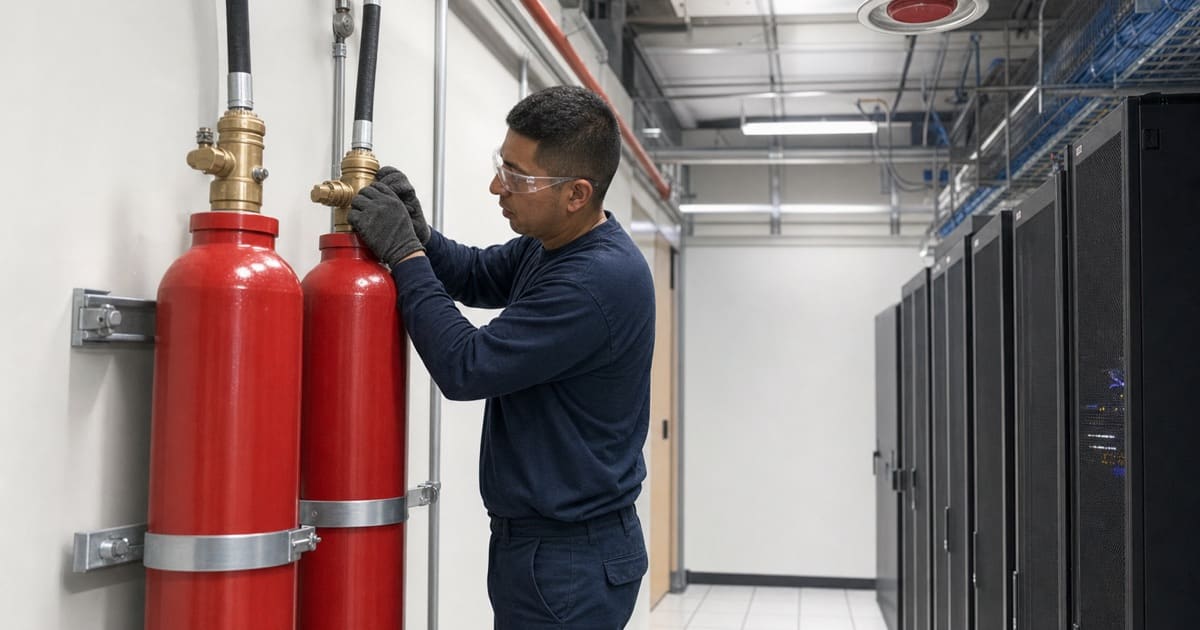
FM-200
FM-200 is a halocarbon agent that extinguishes primarily by absorbing heat, and it has been the most widely installed clean agent in commercial equipment spaces for many years. It discharges rapidly, typically within ten seconds, and reaches extinguishing concentration quickly enough to stop a fire before equipment damage spreads. It is approved for use in occupied spaces at design concentrations, which is why it is common in rooms where staff may be present. Its long installed base also means replacement parts and recharge capability are widely available, which matters for a system expected to last decades. Regulatory pressure on halocarbons is the main consideration for new work, since agents facing phase-down schedules can become expensive to recharge long before the equipment reaches the end of its service life. For an existing FM-200 installation that is not usually a reason to replace the system, but it is a reason to know what a recharge will cost before you need one.
Novec 1230
Novec 1230 is a fluoroketone agent that performs comparably to FM-200 while carrying a substantially lower environmental profile, with negligible global warming potential and a short atmospheric lifetime. It is stored as a liquid and vaporizes on discharge, which allows more agent to be stored in a given cylinder footprint — a practical advantage where mechanical space is limited. For new installations, environmental regulation of halocarbons has made Novec the more common specification, and organizations with sustainability reporting obligations often select it for that reason alone. Performance in the room is effectively equivalent to FM-200, so the decision is generally driven by regulation, agent availability, and cylinder space rather than by extinguishing capability. Existing FM-200 systems cannot simply be filled with Novec, since the two require different design concentrations and nozzle configurations.
Carbon Dioxide Systems
CO2 extinguishes by displacing oxygen rather than by absorbing heat, which makes it effective and also makes it dangerous to people. CO2 systems are used for normally unoccupied hazards — generator enclosures, industrial process equipment, paint mixing rooms, and similar spaces — and they require pre-discharge alarms, time delays, and lockout provisions to protect anyone who might be inside. They remain the right answer for certain industrial applications where a halocarbon is impractical, but they are not interchangeable with FM-200 or Novec, and treating them as equivalent is a serious error. Any space protected by CO2 needs clear signage, functioning pre-discharge alarms, and a documented lockout procedure for maintenance work, because the failure mode here injures people rather than equipment.
Where Clean Agent Systems Are Used
Data centers and server rooms are the most common application, but the same reasoning applies wherever the contents are worth more than the structure or where downtime is the real cost. Telecommunications and network equipment rooms, building control and SCADA rooms, medical imaging suites, laboratory instrument rooms, museum and archive storage, and switchgear rooms all fall into this category. Clean agent is also used to protect specific equipment rather than whole rooms, with a system designed around a single enclosure. In most buildings the clean agent system supplements rather than replaces sprinkler coverage, since the building code generally still requires sprinklers in the space. When both are present, the sequence between them has to be verified — the clean agent system needs its opportunity to work first, and a sprinkler head activating early defeats the purpose of having installed one. Sprinkler heads in these rooms are frequently specified at a higher temperature rating for exactly that reason, giving the clean agent system time to work before water is introduced.
Room Integrity and Enclosure Requirements
Room integrity is the aspect of clean agent systems most often overlooked and the one most likely to render a healthy system ineffective. The agent has to reach design concentration and hold it long enough to extinguish, which depends entirely on the enclosure retaining it. Every penetration matters: cable trays, conduit, plumbing, ductwork, door undercuts, and gaps above dropped ceilings all allow agent to escape. The problem is that these rooms are modified continuously. Equipment is added, cabling is pulled, and each change punches another hole in an enclosure that was verified once at commissioning and never again. Room integrity testing measures enclosure leakage and predicts hold time, and it is worth repeating rather than assuming the original result still applies. Dampers and door closures are part of the same system and must operate on discharge, because a room that seals correctly with the door open is not sealed. Over-pressurization is the counterpart concern, since discharging a large volume of agent into a tightly sealed room can damage the enclosure itself. Pressure relief venting is part of the design, and it is worth confirming that relief paths have not been blocked or sealed over during subsequent construction work.
Detection, Release, and Maintenance
Clean agent systems depend on early detection, typically through cross-zoned smoke detection requiring two devices to activate before discharge, which prevents an expensive false release. Aspirating detection is used where very early warning is needed, sampling air continuously rather than waiting for smoke to reach a ceiling device. The release panel controls the sequence — alarm, pre-discharge warning, time delay, then discharge — and includes abort provisions for staff present in the space. Maintenance covers cylinder weight and pressure to confirm the agent is present, detection and panel function, discharge nozzles, and the interfaces to dampers, door releases, and the building fire alarm system. Agent quantity is verified by weight rather than by gauge, since a cylinder can indicate pressure while having lost agent. Systems are also inspected for the changes that accumulate around them, because the most common finding in an equipment room is not a fault in the system at all — it is that the room has been altered around a system that was correct when installed. Cooling equipment added to a server room changes airflow and enclosure conditions together, and it arrives without anyone consulting the fire protection design. We look at the room and the system as one thing rather than testing the hardware in isolation.
- Commercial & Industrial Only
- Code-Cited Inspection Reports
- Emergency Impairment Response