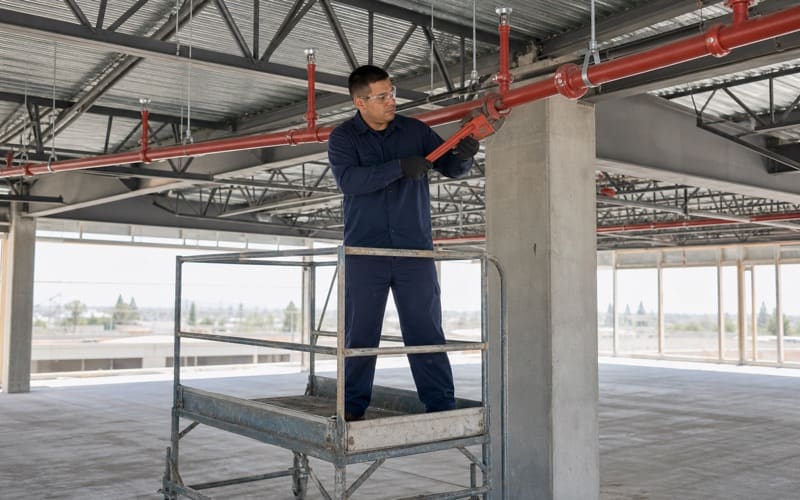
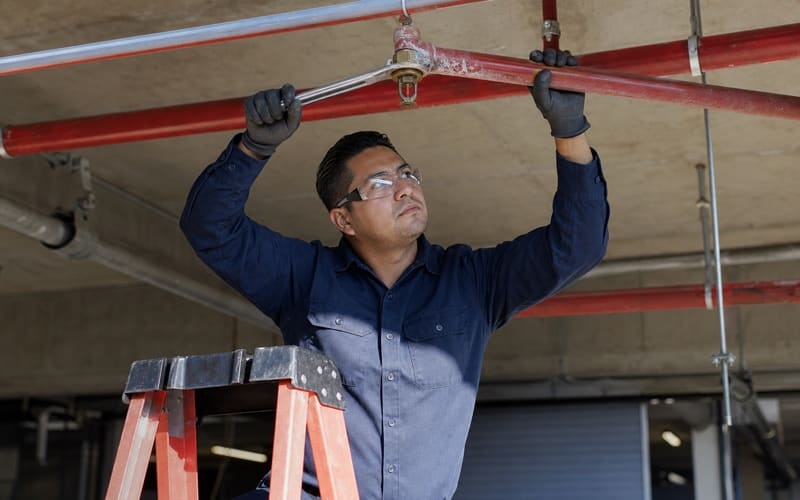
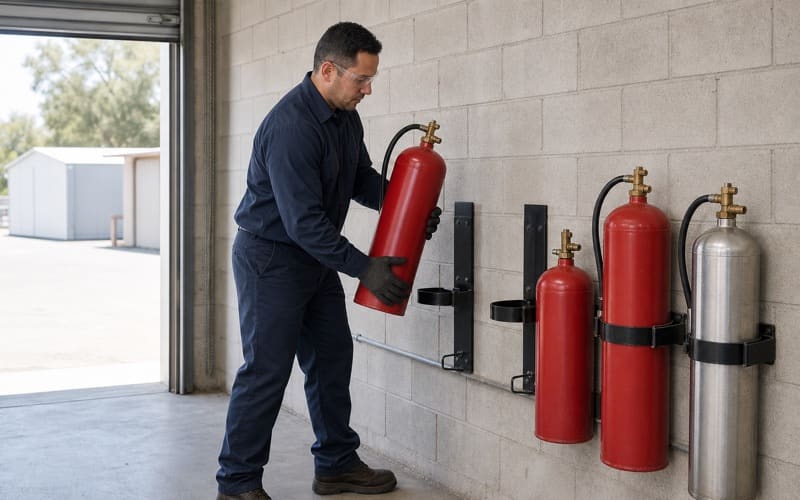
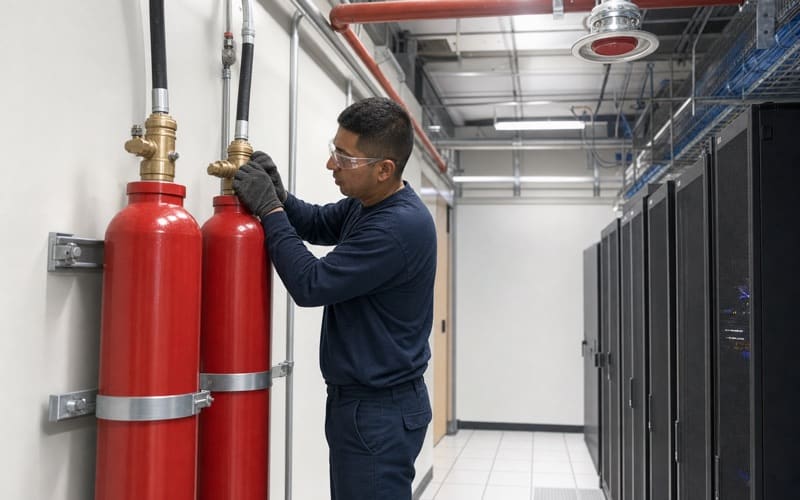
Long Beach Fire Suppression handles fire suppression in Bell for commercial and industrial buildings, covering sprinkler systems, fire alarms, portable extinguishers, and kitchen hood suppression as one combined scope. An owner dealing with a single provider gets one deficiency list covering the whole building, which is a materially different thing from four vendors each reporting on their own portion and none of them looking at how the pieces interact. Commercial and industrial property is the only work we take.
A sprinkler system is only as good as the water behind it, and that is the part of an installation most often assumed rather than verified. Heads, pipe, and valves are visible and get attention; the supply feeding them is underground, outside the building, and easy to treat as somebody else’s responsibility. When a system underperforms, the cause frequently sits upstream of anything a walkthrough inspection would ever examine.
We test and record the supply on every visit rather than confirming a system holds pressure and moving on. Alongside that, each deficiency we note carries photo documentation and the code section behind it, and correction plans price items separately so an owner can order the work sensibly. Impaired systems and buildings under a correction deadline get emergency response ahead of scheduled testing.
Water Supply and What Feeds the System
Everything downstream of the supply depends on assumptions made when the system was designed: available pressure, available flow, and an unobstructed path from the main to the riser. None of those hold permanently. Municipal work, deteriorating underground pipe, and valves left in the wrong position all change the picture quietly, and the system gives no indication that anything is different until it is asked to perform.
Main Drain Testing and Trending
A main drain test takes a few minutes and produces two numbers, and those numbers are close to worthless in isolation and genuinely valuable as a series. Comparing static and residual pressure across successive inspections is what reveals a gradual restriction developing somewhere in the supply. We record actual readings every time rather than marking a pass, and we compare them against previous results so a downward trend becomes visible while there is still time to investigate the cause.
Hydrant and supply arrangements around a property form part of the same picture. Where private hydrants serve a site, they need testing and maintenance of their own, and access to them has to remain clear of parking, landscaping, and stored material that accumulates gradually over the years. We record their condition and accessibility alongside the building systems, since supply that exists on a drawing but cannot be reached or operated on the day contributes nothing to the protection of the property.
When readings drop noticeably between inspections, the possibilities are limited and worth chasing down: a partially closed valve somewhere in the supply, a change on the municipal side, an obstruction forming in the underground lead-in, or a failing backflow device. We report the change plainly with the numbers attached rather than burying it, since a supply problem discovered during an annual inspection is an inconvenience and the same problem discovered during a fire is something else entirely.
Underground Lead-Ins, Valves, and Backflow
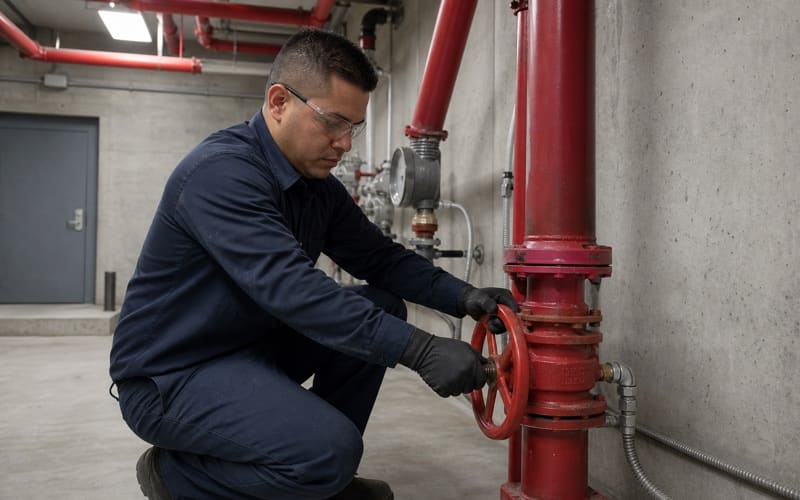
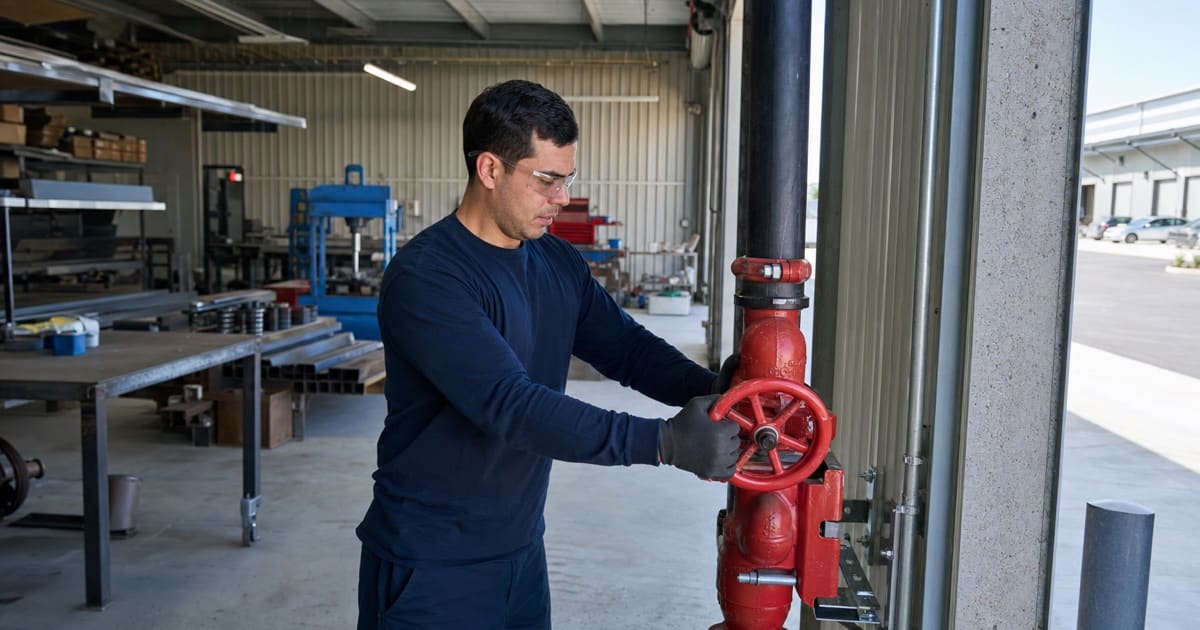
Control valves are the single most consequential item on a water-based system, because a closed valve renders everything downstream ornamental. We exercise OS&Y valves and post indicator valves, verify each one sits in the position the system requires, and confirm that tamper switches genuinely report a change to the panel rather than merely existing. A tamper switch that has been disconnected or bypassed is a common finding and a serious one.
Valve supervision extends beyond the tamper switches themselves to the arrangement around them. Chains and locks left off, valve rooms standing open, and access doors propped for convenience all make it easier for a valve to be closed by somebody with no idea what depends on it. We note the physical security of control valves during the inspection, because the overwhelming majority of sprinkler systems that fail to deliver water fail for this reason rather than through any mechanical defect in the system.
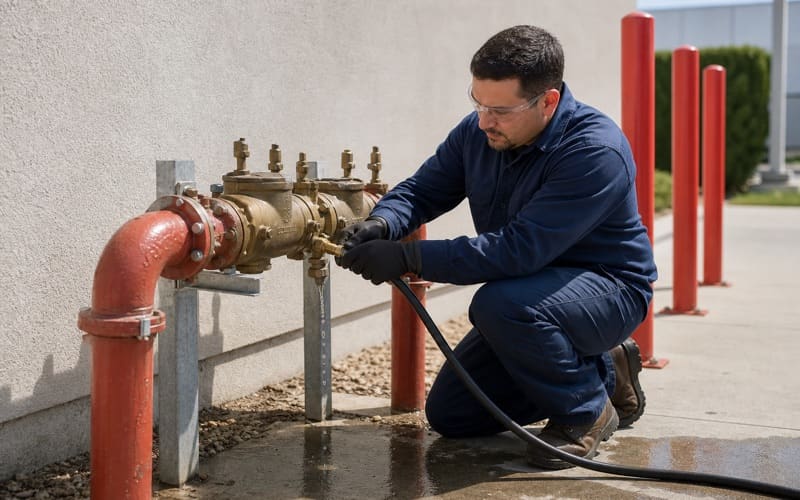
Backflow preventers protecting a fire line need annual testing, and double check valve assemblies and reduced pressure zone assemblies both fail in predictable ways as their internal components age. We test and tag them, and where a device is past the point of being worth rebuilding we say so rather than passing it for another twelve months. Where a backflow device is creating more pressure loss than the system was designed to absorb, that belongs in the report as a finding rather than a footnote.
Fire Pumps and Pressure Maintenance
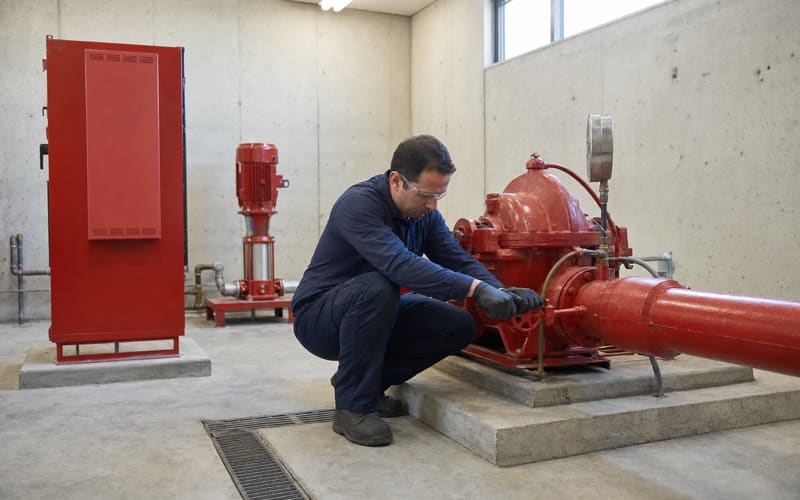
Where a building depends on a fire pump, the pump and its jockey pump are tested under the conditions the installation allows, with churn and flow readings recorded against the pump’s rated performance rather than against a general impression that it ran. Controller function, alarm signals, and the transfer arrangement all get exercised. A jockey pump cycling far more often than it should is usually the first evidence of a leak somewhere in the system, and it is worth investigating before it becomes visible in another way.
Pump rooms deserve attention as rooms and not only as equipment. Adequate ventilation, clear access, functioning drainage, and freedom from stored material all bear on whether a pump will run when called upon and whether anyone can service it when it does not. We check the room alongside the equipment inside it, and we flag where a pump room has quietly become a storage space, which is among the most common findings on properties where the equipment itself is in reasonable condition.
Looking for fire suppression closer to Commerce? See Fire Suppression in Commerce.
A Compact Suburb on the River
Bell is an incorporated city in Los Angeles County located near the center of the former San Antonio Township, with a population of 33,559 at the 2020 census, down from 35,477 in 2010. It sits on the west bank of the Los Angeles River as a suburb of the city of Los Angeles, and at 2.5 square miles it is the thirteenth-smallest city in the United States with a population of at least 25,000. A commercial base packed into that footprint tends toward smaller buildings on smaller parcels, frequently held by owners with more than one property nearby.
Small Commercial Buildings and Shared Risers
Much of what we inspect consists of modest buildings divided among several tenants, where one riser protects suites that have been reconfigured repeatedly over the years. We document what the shared system actually covers, identify where a build-out has left an area without a head or obstructed the ones present, and give the landlord and the occupants the same account of the building. Coordinating access and shutdowns with each party directly avoids the standoff that otherwise develops over who authorized what.
Owners holding several buildings within a short distance get them scheduled together rather than as separate arrangements falling due in different months. One visit covering multiple addresses is more efficient for us and considerably cheaper for the owner, and it produces a single consistent set of reports that can be compared against each other to show where attention is genuinely needed.
Restaurants and Retail Frontage
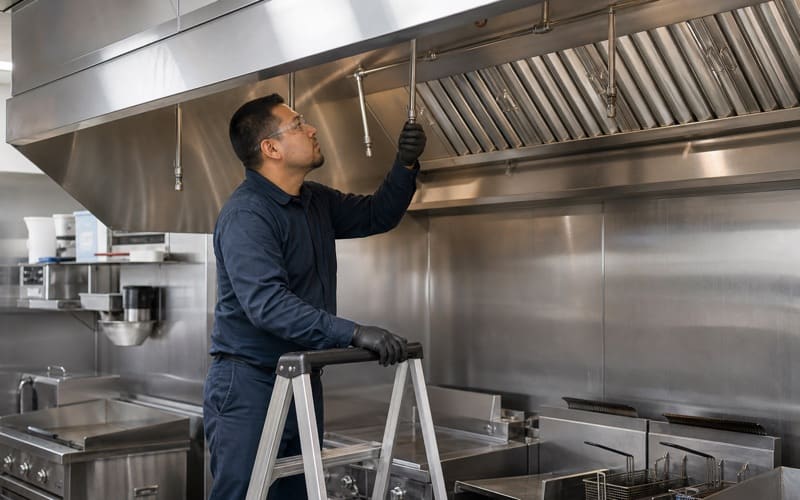
Food service along the commercial corridors runs on NFPA 96 ventilation requirements and NFPA 17A wet chemical suppression, serviced twice a year regardless of the kitchen’s size or volume. We work on Ansul R-102 and Pyro-Chem systems, check that nozzle placement corresponds to the appliances currently under the hood, and test fusible links, manual pull stations, and gas shutoff. Retail tenants alongside them need testing scheduled around trading hours, since a shutdown during business is a direct cost to an operator working on thin margins.
Warehouse and Service Buildings
The industrial property here runs small and has usually been adapted rather than purpose-built, so the installed protection reflects an occupancy the building may no longer have. Storage height, rack arrangement, and what is actually being stored determine whether the design remains adequate, and a tenant who added a level of racking has changed the basis without touching the system. We measure clearance beneath the heads, look at how the space is genuinely used, and document where protection and occupancy have separated.
Unit heaters, added mezzanines, and interior structures built after the sprinkler system went in create a particular kind of hidden gap. A mezzanine installed beneath an existing head shields everything underneath it, and unless sprinklers were extended below, that space carries no protection at all while the building still appears fully covered from the floor. We look specifically for added structure of this kind, because it is among the most consequential deficiencies a building can carry and one of the easiest to walk directly past.
Alarm Systems, Detection, and Monitoring
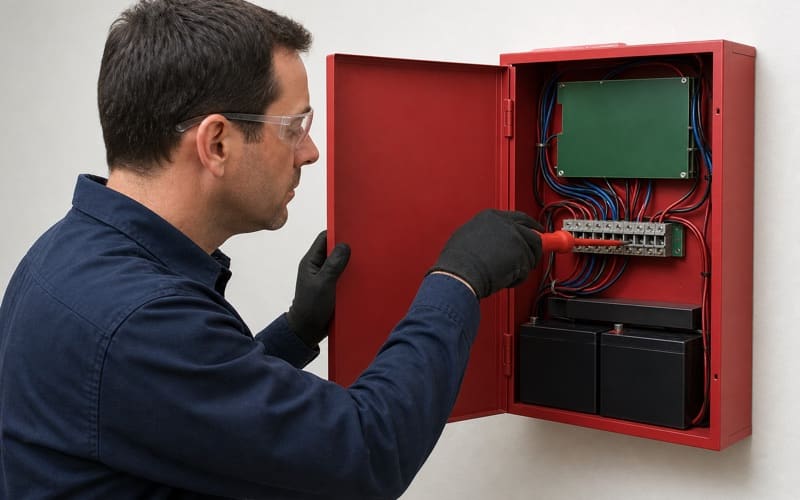
Fire alarm work follows NFPA 72, and the annual covers considerably more than confirming the panel powers up. Initiating devices, notification appliances, duct detectors, and the interface between the alarm and the sprinkler system’s flow and tamper switches all get exercised individually, and the results recorded device by device rather than summarized as a pass.
Verifying the Monitoring Path
The monitoring connection is the part most likely to fail silently, because a path that stopped reporting looks entirely normal from the front of the panel. We confirm with the central station that signals actually arrived, testing each type rather than a single representative alarm. Where a building has changed telephone or network arrangements since the system was installed, that is frequently where the break occurred, and nobody discovers it until somebody checks deliberately.
Obsolete Panels and Discontinued Parts
Older alarm panels reach a point where replacement boards and devices are no longer available, and a system in that condition is one failure away from an unplanned full replacement. We document obsolescence in advance of failure, so an owner can budget for a change on their own timetable instead of reacting to a dead panel and a fire watch. Saying this early is more useful than being right about it later.
Records, Correction, and Scheduling
California Fire Code and Title 19 state fire marshal requirements place the burden of proof on the property owner, and the proof has to be a record rather than a tag. We track recurring due dates for the properties we service so annual and semi-annual obligations arrive as scheduled work, and we produce documentation in the form an inspector expects.
Findings and Correction
Each deficiency carries a photograph and the code section behind it, ranked by consequence so an owner can distinguish what puts a system out of service from what is deterioration worth correcting before it escalates. Repairs are carried out by the crew that performed the inspection, working from firsthand knowledge of the building rather than a repeated diagnosis, and itemized pricing lets urgent items be cleared now with the balance phased across a budget cycle.
- Commercial & Industrial Only
- Code-Cited Inspection Reports
- Emergency Impairment Response