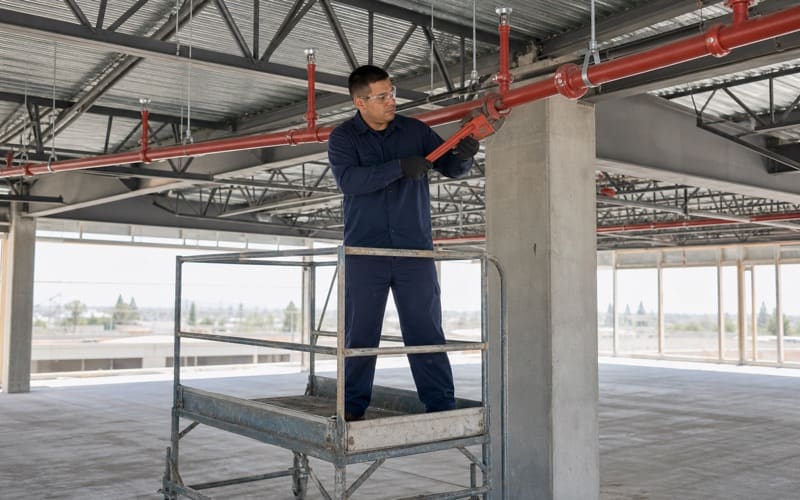
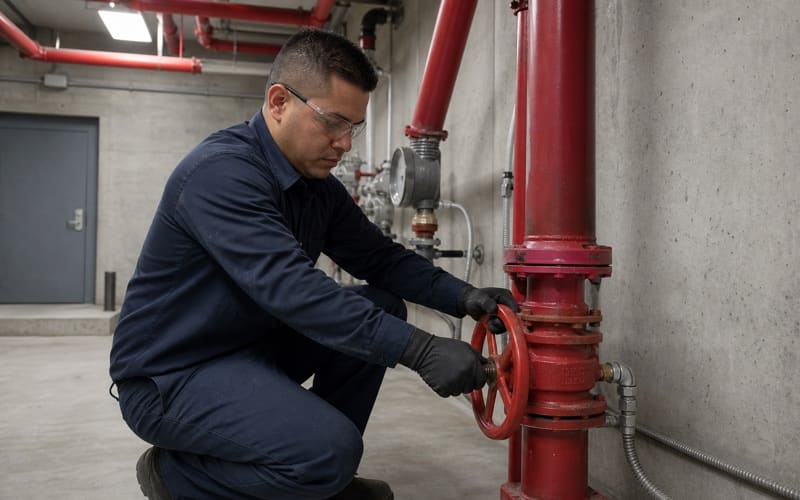
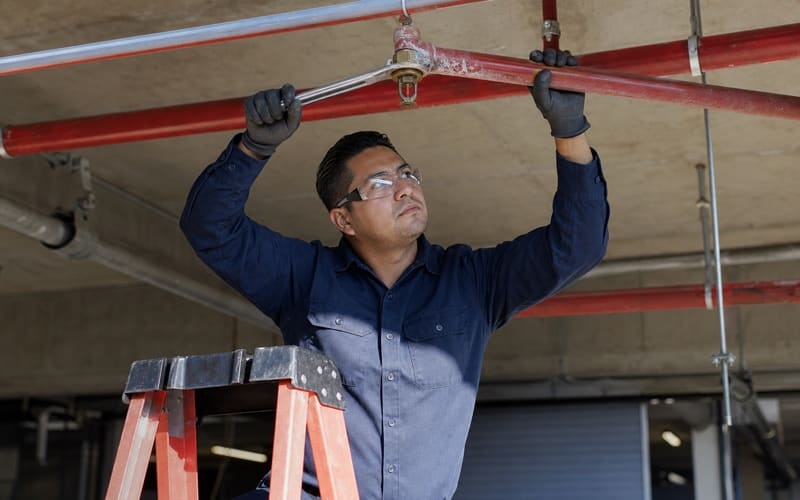
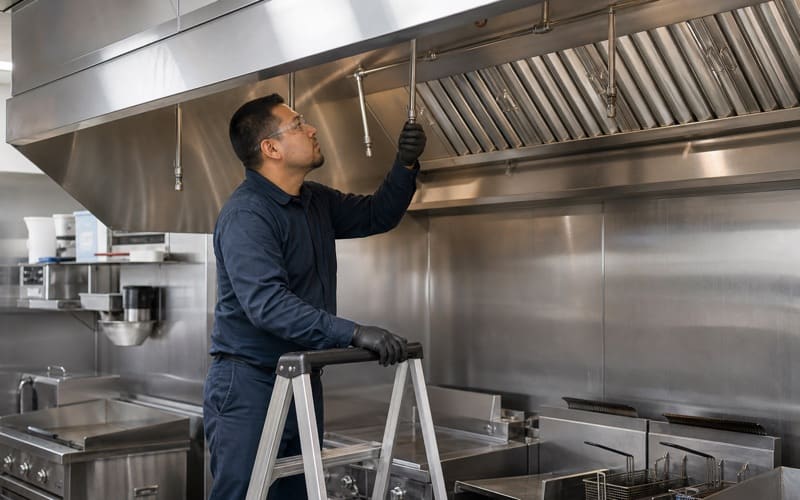
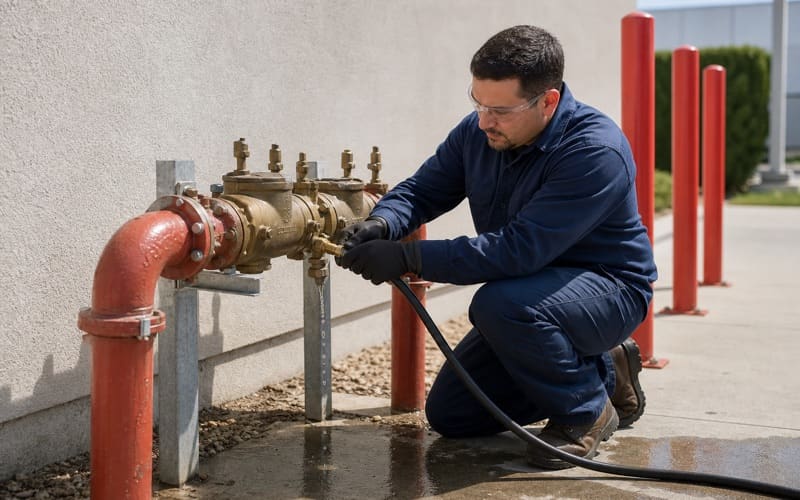
Long Beach Fire Suppression provides commercial fire suppression in Bellflower for retail centers, restaurants, medical and dental offices, professional buildings, apartment properties, schools, and light commercial space. We install, inspect, service, and repair sprinkler systems, kitchen hood suppression, fire alarms, portable extinguishers, and backflow assemblies. All of it sits with one provider, so a property carries one deficiency list rather than several partial ones.
We handle commercial and industrial properties exclusively. Keeping residential work off the schedule means crews stay in the building types and system types they see daily, and it means the parts they carry match what they will actually find. A retail sprinkler riser, a restaurant hood line, and an apartment garage dry system are unrelated problems that happen to share a code. It also means a booked commercial inspection date is not traded away for a house call.
Compliance deadlines drive the work more than failures do. NFPA 25 sets inspection and testing intervals for water-based systems, NFPA 96 and NFPA 17A cover commercial kitchen suppression, NFPA 10 covers extinguishers, and NFPA 72 covers alarms, with the California Fire Code and Title 19 placing all of it behind an enforced inspection. We inspect, document the findings, and correct them, so the compliance record and the repair work stay together. Recurring due dates are tracked against each property, so a semi-annual obligation does not quietly slip past its month.
Fire Protection in a Dense Commercial Market
Multi-Tenant Retail and Strip Centers
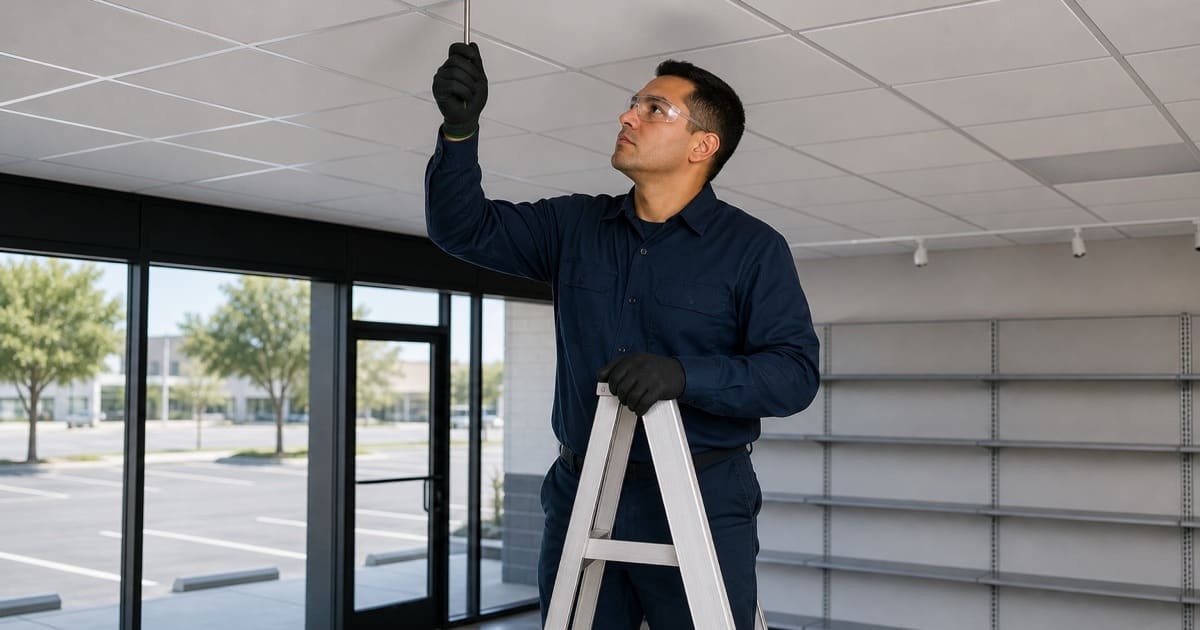
Multi-tenant buildings split fire protection responsibility in a way that causes more compliance trouble than any technical problem. The landlord typically holds the riser, the base building sprinkler system, and the alarm panel, while individual tenants hold extinguishers and any suppression equipment inside their suites. We document findings by suite so the responsible party is identifiable rather than disputed. Where a tenant’s work has affected coverage in a neighbouring suite, we state that explicitly rather than leaving it to be argued.
That matters because the fire authority is indifferent to whose obligation a deficiency is — the building is compliant or it is not, and a correction deadline runs regardless of who is negotiating. Tenant improvements are the usual source of findings, since new demising walls, dropped ceilings, and reconfigured layouts routinely leave sprinkler coverage that no longer matches the space beneath it. Concealed heads painted over during a refit are the version of this that costs least to fix and is missed most often.
Restaurants and Food Service
Any tenant cooking under a hood carries a wet chemical suppression system requiring service roughly twice a year, the shortest interval of any system in a commercial building. We service and recharge Ansul R-102 and Pyro-Chem systems, replace fusible links on schedule, verify detection cable tension and travel, and test the gas shutoff, electrical interlock, and manual pull station as a functioning sequence rather than as isolated parts. Nozzles serving the duct and plenum are checked alongside those over the appliances, since a fire carried into the duct is how a contained incident stops being contained.
Nozzle coverage is checked against the appliance line as it currently sits, because a kitchen that swaps a fryer or moves a griddle can put nozzles out of coverage without touching the suppression system. Cylinders also carry hydrostatic testing on a separate longer cycle, and those dates lapse more often than any other kitchen requirement because nothing about the system indicates they are due. Grease loading in the hood, filters, and accessible duct is noted at the same visit, and sealed-over access panels prevent proper cleaning entirely.
Apartment and Multifamily Properties
Multifamily buildings combine dwelling unit sprinkler coverage with commercial requirements in corridors, garages, trash rooms, laundry facilities, and amenity spaces, each carrying different obligations. Parking structures commonly use dry pipe systems needing air pressure monitoring and low-point drainage attention that wet systems do not require, and trapped water at low points is the most frequent underlying cause of dry system trouble. Standpipes, fire department connections, and extinguisher cabinets through the common areas are inspected alongside the sprinkler system rather than as separate line items.
Trash and recycling rooms generate recurring findings, since they combine a genuine ignition risk with heads that are easy to obstruct. Unit and common area access is usually harder than the technical work, so we coordinate with property management well ahead of the visit rather than arriving and improvising a schedule. Bicycle storage, package rooms, and added amenity space create the same problem wherever they were carved out of an area protected for something else.
Looking for fire suppression closer to Artesia? See Fire Suppression Services in Artesia.
A Dense Suburban City
Bellflower was founded in 1906 and incorporated on September 3, 1957, with a population of 79,190 at the 2020 census, up from 76,616 in 2010. That made it the 65th most densely populated city in the United States among cities over 50,000 residents. Density shapes the fire protection work directly: commercial buildings sit close together, parking and access are constrained, and a substantial share of the building stock is older commercial and multifamily property rather than modern purpose-built facilities. Constrained sites also leave little room to stage equipment, which is why the approach is agreed before the day rather than improvised on arrival.
Older Buildings and Accumulated Modifications
Commercial buildings in service for decades carry systems extended, repaired, and modified repeatedly by successive contractors with inconsistent documentation. As-built drawings frequently do not match what is installed, and unpermitted modifications turn up often enough to expect rather than to be surprised by. Riser tags, head types, and valve positions are better evidence of what a building holds than any drawing in a file.
We inspect against actual conditions rather than the paperwork on file, and we report work that was never submitted for approval, because it surfaces at the next inspection regardless of who performed it. Older systems also accumulate internal corrosion and scale that restricts flow without any visible exterior sign, which is what the five-year internal obstruction investigation exists to detect and the requirement buildings miss most often. Where an alteration cannot be reconciled with any approval on record, we say so plainly rather than leaving it to emerge during a sale.
Constrained Access and Scheduling
Dense commercial property makes access the practical constraint rather than the work itself. Shared driveways, limited parking, tight service corridors, and buildings that back directly onto one another all affect how a crew reaches a riser room or a roof-mounted component. Fire department connections obstructed by parked vehicles, stored material, or added structure are a routine finding on a crowded parcel.
We plan access with property management ahead of the visit rather than discovering the problem on arrival, which is what keeps a routine inspection from becoming a return trip. Where a system must be taken out of service, the window is agreed in advance and confined to the affected area rather than applied across a whole property. Every occupant the work will touch gets notice, not only the party who booked the appointment.
Coverage That Drifts With Turnover
Commercial space in a dense market turns over regularly, and each build-out is an opportunity for coverage to fall out of alignment. New walls create areas the original head layout never contemplated, dropped ceilings leave heads above them protecting nothing, and extinguisher placement stops matching the floor plan. We compare what is installed against the walls standing today and describe exactly which areas a change has left short.
Contractors performing that work are a routine source of damage, painting heads during finish work or striking them during ceiling changes, and neither is typically reported to anyone. A painted head cannot be cleaned and returned to service, because the coating interferes with the thermal element it relies on to activate at its rated temperature. Escutcheons and cover plates get mismatched during the same work, and a plate from a different manufacturer will not release at the temperature the assembly was listed for.
Inspection Schedules, Records, and Correction
Establishing What Is Due
NFPA 25 is not a single annual event, and treating it as one is the most common gap we find. Requirements run on quarterly, semi-annual, annual, and five-year cycles depending on the component, so a property with only an annual history is almost certainly carrying uncompleted items it does not know about. Nothing about a riser announces that an internal inspection is overdue, and five years outlasts most people’s time at one building.
We establish which intervals apply to the systems actually present, review whatever records exist, and identify requirements that appear never to have been performed. The obligation sits with the building owner regardless of who occupies the space, and it transfers with the property when it changes hands even though the records frequently do not. Where no evidence exists that a long-cycle item was ever performed, we schedule it rather than assume a predecessor did it quietly.
Reports Built to Support a Decision
Every deficiency is documented with a photograph and the code section behind it, so a finding is intelligible to an owner who was not on site or a manager comparing several properties. Severity is separated rather than presented as a flat list, because a painted sprinkler head and a partially closed control valve are not equivalent problems. Ordering by consequence lets an owner reviewing remotely act without first arranging a site visit to see the condition.
Corrections are priced individually rather than bundled into a single figure, which lets an owner clear what must be corrected immediately and stage the remainder across budget cycles. That itemization also makes a quote auditable, since each line traces back to the finding that produced it. It also draws a line between what the code compels and what we would merely recommend.
Correction and Emergency Response
The crew that performs the inspection performs the repairs, eliminating the gap where a second contractor arrives without context, re-diagnoses findings already documented, bills for the trip, and occasionally disputes the original report. For properties working against a re-inspection date we respond on an emergency basis and sequence the list so items carrying occupancy consequences clear first. Repairs therefore begin from firsthand knowledge of the building rather than a second diagnosis billed before anything is fixed.
Where a repair requires a system to be impaired, we plan and document the window with property management, keep it confined to the affected area, and restore protection as soon as the work permits rather than leaving a building unprotected overnight for scheduling convenience. Impairment periods are documented from the moment they begin through the confirmed return to service, with a fire watch recommended where duration and occupancy call for one.
- Commercial & Industrial Only
- Code-Cited Inspection Reports
- Emergency Impairment Response