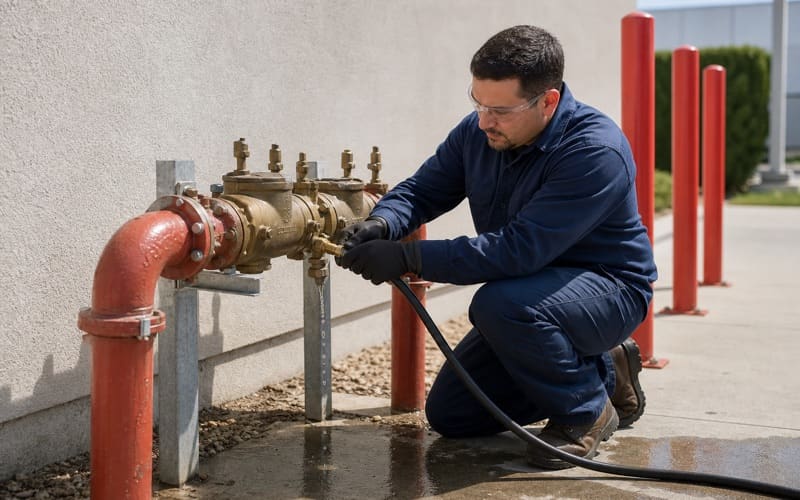
Long Beach Fire Suppression provides commercial fire suppression in Cerritos for retail centers, automotive dealerships and service facilities, office buildings, medical and dental practices, restaurants, hotels, schools, and light industrial space. We install, inspect, service, and repair sprinkler systems, cooking equipment suppression, fire alarms, portable extinguishers, and the backflow assemblies that isolate a fire system from the potable supply. Holding all of it under one agreement gives a property one compliance position rather than four partial ones.
Commercial and industrial property is all we take, and the reason matters more than it sounds. A retail sprinkler riser, a dealership service bay, a hotel kitchen line, and a medical imaging suite are four unrelated problems that happen to be governed by the same family of standards. Crews that spend every week in those buildings recognise a coverage or classification problem on sight, which is where most of the value in a commercial inspection actually sits rather than in confirming that heads are undamaged. Each of those buildings is judged against the same standards, but almost none of them fail in the same way.
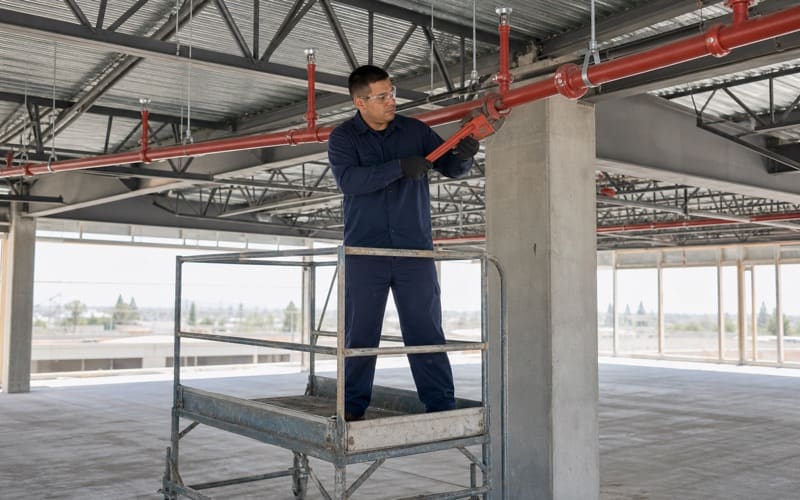
Almost everything begins with an interval rather than an incident. Water-based systems fall under NFPA 25 for inspection and testing and NFPA 13 for design, cooking equipment under NFPA 96 and NFPA 17A, portable extinguishers under NFPA 10, and detection and notification under NFPA 72, all enforced through the California Fire Code and Title 19. We inspect, document each finding against the provision behind it, and complete the corrections ourselves, so closing a deficiency never depends on two companies agreeing about what a third one wrote down. Recurring due dates are tracked against the property, so an obligation arrives as scheduled work rather than a notice.
Retail, Automotive, and Hospitality Property
Large-Format and Multi-Tenant Retail
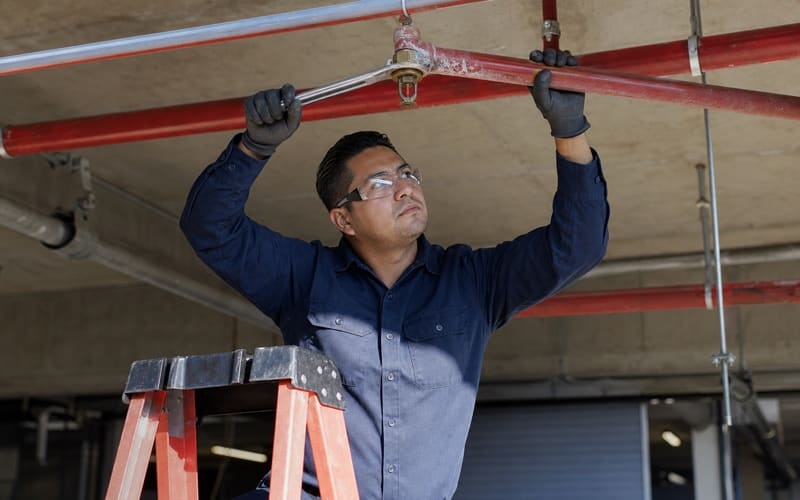
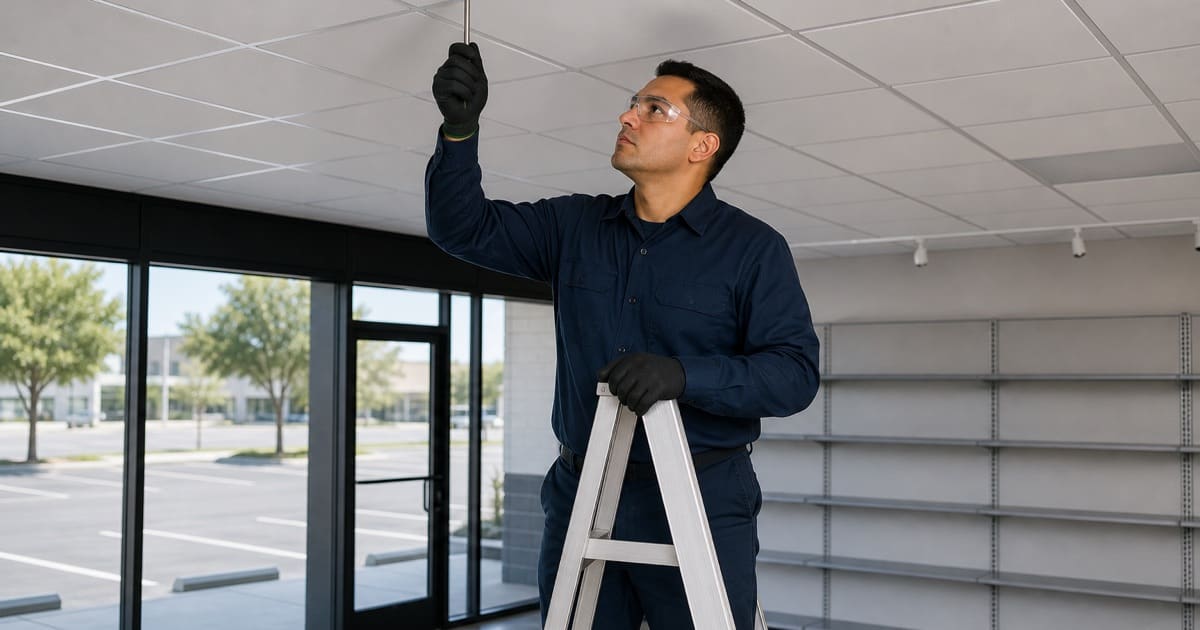
Retail buildings concentrate their fire protection risk in change rather than in inherent hazard, because the occupancies are comparatively light but the interiors are reconfigured constantly. Every build-out is an opportunity for sprinkler coverage to fall behind the floor plan, as new demising walls create areas the original head layout never contemplated and dropped ceilings leave heads stranded above them protecting nothing at all. Extinguisher placement drifts the same way, since requirements follow hazard classification and travel distance rather than square footage. New demising walls create areas with no head in them, and dropped ceilings strand the heads already present.
Responsibility typically divides between an owner holding the riser, base building system, and alarm panel and tenants holding whatever sits inside their demised space. We record findings suite by suite so that division stays legible, which matters because a correction deadline continues to run whether or not the parties have settled who owns the item. A report that separates base building findings from tenant findings gives both sides something they can act on without negotiating first. A report separating base building findings from tenant findings gives both sides something they can act on immediately.
Automotive Sales and Service Facilities
Dealership and service property combines showroom, office, parts storage, and service bays behind one address, and those areas rarely share a hazard classification. Bays bring flammable liquids, hot work, and vehicles together under one roof and typically require more extinguisher coverage than their floor area implies, while paint and spray operations are treated as a separate hazard warranting dedicated protection rather than absorption into the shop’s general coverage. Parts inventory introduces a storage question of its own, since commodity classification rather than shelf count determines what the sprinkler system must deliver. Parts storage in particular tends to carry a hazard classification nobody revisited after the inventory changed.
We classify area by area rather than averaging across a building, which prevents a compliant showroom from concealing a service area that stopped matching its own requirements. Vehicle traffic also damages heads and exposed piping frequently enough to be an expected finding, and where the same location takes repeated damage the durable answer is a guard or a relocation rather than a third identical replacement. Travel distance is measured along the route somebody would actually walk, not the straight line across a floor plan.
Hotels, Restaurants, and Assembly Space
Hospitality property puts guest rooms, commercial kitchens, laundry facilities, and assembly areas into a single structure, which places several different suppression and alarm requirements under one roof on unrelated schedules. We test guest floors in blocks arranged with housekeeping rather than attempting a floor cold, and service kitchen and laundry systems on their own cycles. Documentation carries unusual weight here, because these properties are inspected frequently and change management often enough that a missing record is treated exactly as missing work would be. Laundry and mechanical rooms are the areas furthest from anyone’s routine walkthrough and the ones we inspect deliberately.
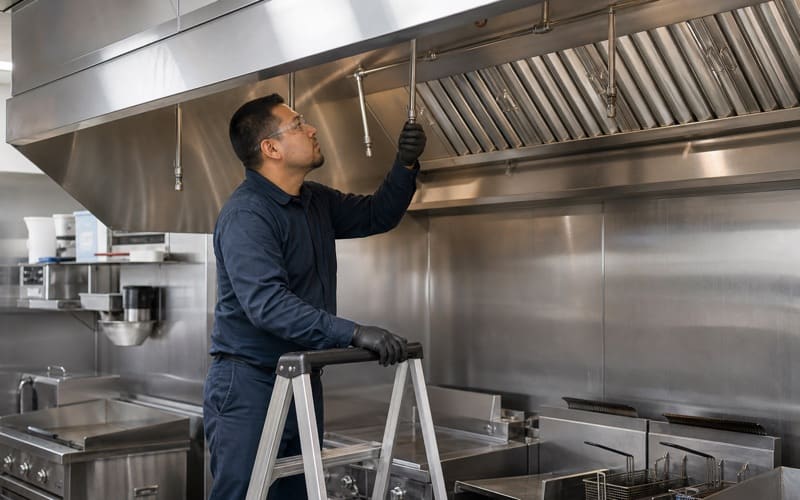
Cooking equipment suppression runs on the shortest interval of anything we service, generally twice yearly, covering cylinder charge, nozzle position against the appliance line as it currently stands, blow-off caps, fusible links, detection cable travel, and functional testing of the fuel shutoff and pull station together. Nozzle position is the finding that recurs everywhere, because appliances get replaced and shifted far more often than anyone reviews the system above them. Appliances get swapped and shifted along a line far more often than the nozzles above them are ever revisited.
Looking for fire suppression closer to Compton? See Fire Suppression Services in Compton.
A Planned Gateway City
Cerritos was incorporated on April 24, 1956 and is one of the Gateway Cities of southeast Los Angeles County, with a population of 49,578 as of 2020. It sits within the Los Angeles–Long Beach–Anaheim metropolitan statistical area. A city planned and developed on that timeline produces a commercial base built around large-format retail, automotive, office, and light industrial property rather than the older mixed industrial stock found in cities that grew up around rail or manufacturing. Purpose-built stock is easier to assess precisely because the original design intent is still legible in the building.
Purpose-Built Stock and Its Own Failure Modes
Buildings designed for their current use start with protection engineered for it, which removes an entire category of problem we encounter constantly elsewhere. What replaces it is a subtler one: systems installed correctly decades ago against a use that has since shifted underneath them, with no permit ever filed because nothing structural changed. A retail suite converted substantially to stockroom, or an office bay taken over for storage, alters the hazard classification without altering the building. What replaces it is a slower drift, as fit-outs and equipment changes accumulate against a design nobody re-examines.
Purpose-built systems also age on a predictable schedule, and internal corrosion, scale, and debris accumulate inside piping while producing no external sign at all. The five-year internal obstruction investigation exists precisely to find that condition, and it remains the requirement buildings skip most reliably, since nothing about a healthy-looking riser suggests it is due and the interval outlasts most facility managers’ tenure at one property. Opening the pipe at the prescribed points is the only way to find restriction no external test would reveal.
Larger Buildings and Supporting Equipment
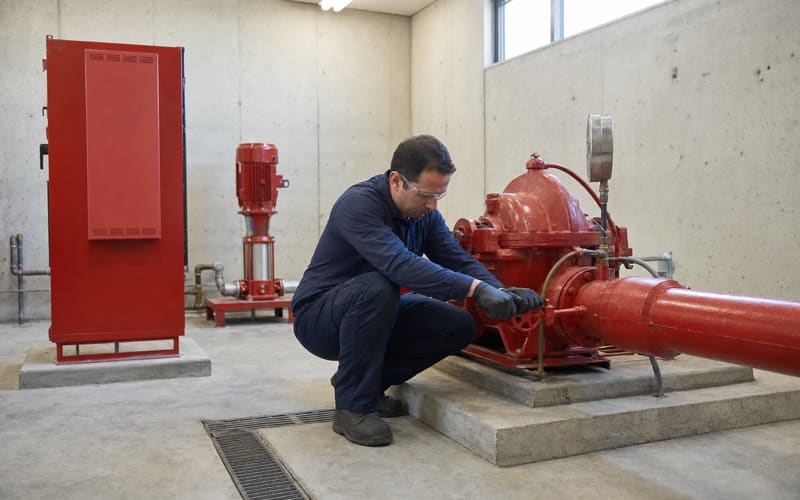
Buildings of scale depend on equipment sitting upstream of the sprinkler heads, and it lives in mechanical rooms where nobody looks between scheduled tests. Fire pumps supply pressure where the municipal supply cannot meet design demand on its own and require frequent no-flow churn testing plus annual flow testing at churn, rated capacity, and peak flow. A pump can start dependably every week and still deliver materially less than its design output, which nothing short of a flow test will reveal. A jockey pump cycling far more than it should is usually the first evidence of a leak somewhere in the system.
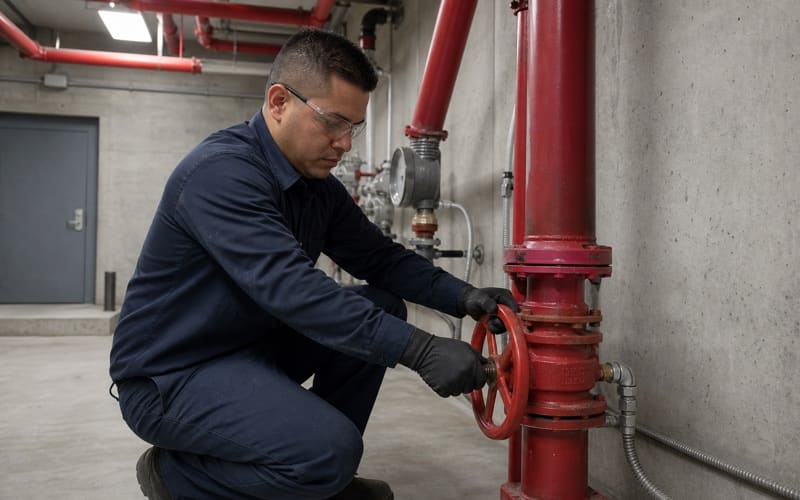
Controllers left in manual after service work, suction valves closed or partially closed, failing batteries on diesel drivers, and pressure-maintenance faults account for most of what we write up. Backflow assemblies add a separate obligation administered by the water purveyor rather than the fire authority, which is exactly why buildings lose track of it — a property can satisfy every requirement in NFPA 25 and still be delinquent, because the two obligations arrive as different letters from different agencies. We record readings against the pump’s rated performance rather than noting simply that the equipment started.
Schools, Medical, and Professional Buildings
Educational property combines classrooms, kitchens, shops, laboratories, and assembly space under shared alarm infrastructure, with different suppression needs in each and system age varying widely across a campus assembled over decades. We concentrate disruptive testing into breaks and off-hours, and we expect findings to cluster in the oldest structures rather than distribute evenly. Kitchens running on an academic calendar fall behind easily, since a quiet summer makes an overdue service easy to miss.
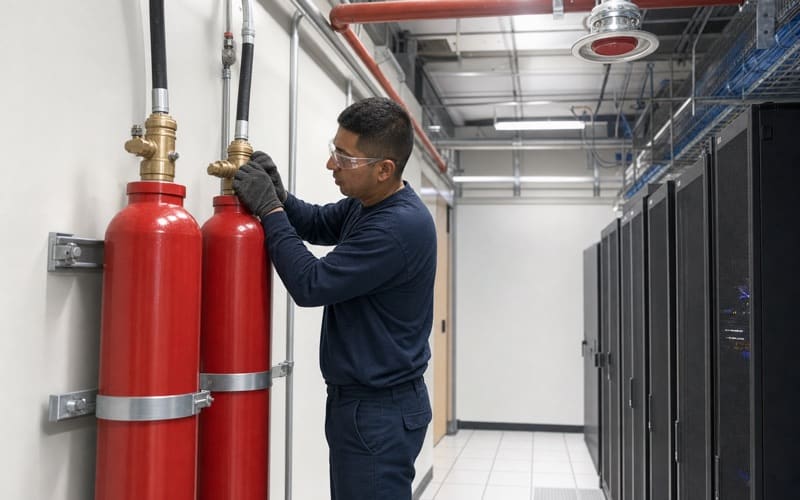
Clinical buildings are judged more strictly on system reliability and on how long protection may be interrupted, and portions of them cannot be taken offline during treatment hours under any arrangement. We sequence these properties in zones agreed with clinical staff rather than proposing one continuous window, accepting that a full inspection may span two visits. Equipment-dense spaces inside them frequently warrant gaseous protection instead of water, since a discharge across imaging or server hardware substitutes one loss for another. Testing that requires notification appliances to sound is placed in a window agreed with clinical staff beforehand.
Records, Correction, and Response
Establishing the Real Schedule
The standard attaches its intervals to components rather than to buildings, which is why a single annual visit leaves most properties carrying obligations they do not know about. Quarterly, semi-annual, annual, and five-year requirements run concurrently on one system, and the short ones are easiest to let slide because each costs minutes. We set the applicable intervals against the equipment actually installed, review whatever history exists, and name the gaps rather than assuming a predecessor closed them quietly. Where no record exists of a five-year requirement, we treat it as due rather than assume it was quietly completed.
Findings an Owner Can Weigh
Each deficiency carries a photograph and the governing code section, ordered by consequence so a cosmetic observation never appears beside one that disables a system as though they were equivalent. That ordering is what lets an owner holding several properties act from the report itself instead of arranging a site visit to interpret it. Pricing follows the same logic, with every correction quoted separately so the compulsory work can be released immediately and the remainder scheduled deliberately rather than deferred by omission. That ordering is what lets an owner act from the report itself rather than arranging a visit to interpret it.
Repairs and Urgent Situations
Whoever performs the inspection performs the corrections, which removes the familiar sequence in which a second firm arrives without context, re-examines what has already been examined, and invoices for reaching the same conclusion. Buildings working against a re-inspection date move ahead of routine scheduling, with the list ordered so anything bearing on occupancy clears first. Repairs therefore begin from firsthand knowledge of the building rather than a second diagnosis billed beforehand.
Work requiring a shutdown is arranged with management beforehand, held to the smallest practical area, and documented as the code expects. Where a complete repair will run long, the unaffected portion of the system returns to service rather than an entire building sitting unprotected while one section is addressed, and we schedule around trading hours so retail, service, and food operations keep running throughout. The return to full service is confirmed in writing, which is what an owner needs if the period is questioned.
- Commercial & Industrial Only
- Code-Cited Inspection Reports
- Emergency Impairment Response