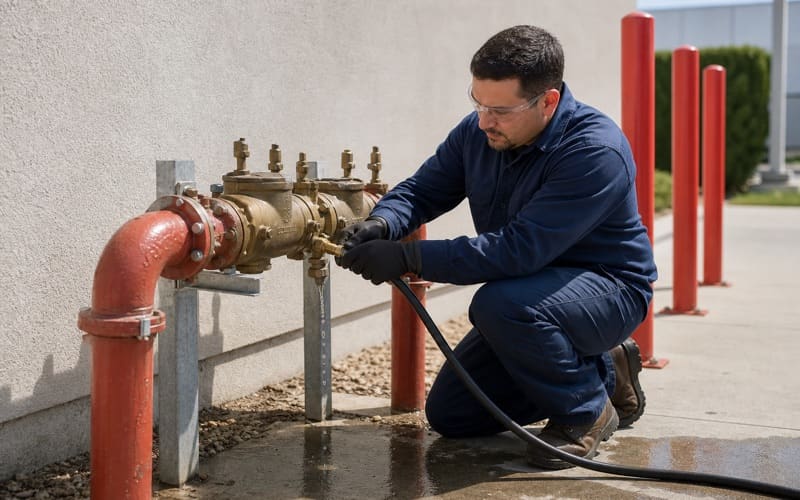
Long Beach Fire Suppression provides fire suppression in Commerce for commercial and industrial buildings, covering sprinkler systems, fire alarms, portable extinguishers, and kitchen hood suppression through a single provider. On large buildings that consolidation matters more than it does on small ones, because a warehouse typically carries several systems that have to work together, and separate contractors reporting on separate portions rarely examine the connections between them. We take no residential work at all.
Storage buildings are governed by a design basis rather than by a general standard, and that basis rests on specific assumptions: what is stored, how high it is stacked, how the racking is arranged, and how much clearance sits beneath the sprinkler heads. Every one of those assumptions can be changed by an operations decision made without any reference to fire protection. A building fully compliant when it was commissioned can be seriously underprotected two tenants later without a single component having failed.
That is why an inspection here means examining the occupancy, not only the equipment. We compare what is installed against what the building is actually doing today, record each deficiency with a photograph and the code section behind it, and price corrections individually so an owner can stage the work. Impaired systems and buildings under an active correction order get emergency attention.
Storage Occupancies and the Design Basis
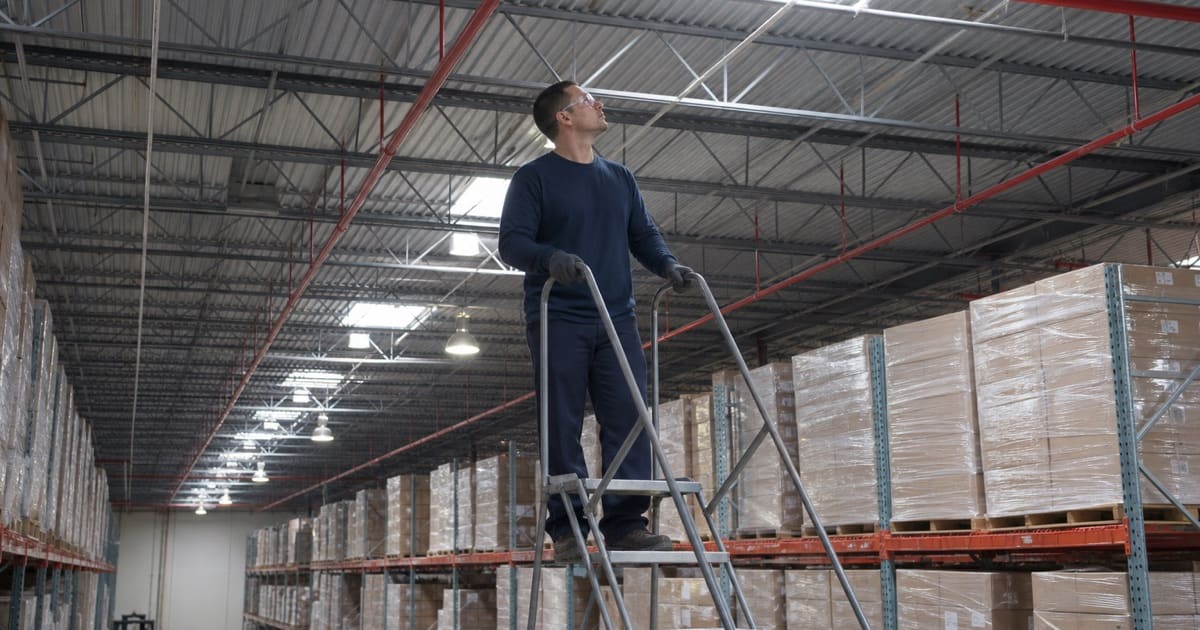
The gap between a system’s design assumptions and a building’s real operations is the most consequential thing we look for in this kind of property, and it is invisible from the equipment itself. Nothing about a sprinkler head indicates what commodity it was sized for. Establishing whether the protection still fits requires looking at the racks, the product, and the clearances as they exist on the day of the visit.
Commodity Classification and What Changes It
What a building stores determines how much water the system has to deliver, and a change in product category can move a building into a higher hazard class overnight. Plastics, aerosols, and packaging materials all behave differently from ordinary palletized goods, and an incoming tenant rarely announces a change in commodity to anyone but their own logistics team. We ask what is actually being stored, compare it against what the system was designed to protect, and state plainly in the report when the two no longer correspond.
Idle pallets and packaging accumulating in a corner deserve specific mention, since they are among the most hazardous things commonly found in a warehouse and almost never appear in anyone’s plan for the space. Stacks of empty pallets stored indoors create a fuel load well beyond what surrounding protection was intended to handle. We note where they have collected, how high, and what protection covers that area, because this is a finding an operator can usually correct the same week at no cost.
Seasonal peaks compound the problem in a predictable pattern. Buildings that fill beyond their normal capacity during a busy period end up storing product in aisles, against walls, and in areas the protection scheme never contemplated, and the arrangement usually persists well past the peak that caused it. We record what we find with photographs and dates, which gives an operator something concrete to work from when setting rules about where overflow product may and may not be placed.
Storage Height, Clearance, and ESFR
ESFR protection works only within the conditions it was designed around, and clearance between the top of storage and the sprinkler head is the condition most frequently violated. Adding a level of racking or simply stacking higher than intended narrows that gap until the system can no longer perform as listed. We measure the clearance that actually exists rather than accepting the racking’s nominal height, and we document specific locations where storage has encroached on the space the design requires.
Obstruction is the companion problem. Lighting, ductwork, cable trays, and building services installed after the sprinklers frequently sit directly beneath heads, interrupting the discharge pattern in exactly the place it matters. We inspect for obstructions at ceiling level throughout the building rather than sampling a few bays, since a change made during one tenant improvement can affect a substantial area without anyone recognizing what it did.
Draft curtains, roof vents, and smoke control arrangements form part of the same design in many large buildings, and they are frequently modified or removed during a reconfiguration by contractors who have no reason to know what they contribute. We check that these elements remain intact and operable where the design depends on them, and we document alterations we find, since a change to smoke control affects how quickly heads activate and therefore how the sprinkler system was expected to perform.
Rack Configuration and In-Rack Protection
Where ceiling-level protection alone cannot cover the storage arrangement, in-rack sprinklers carry part of the load, and they sit precisely where forklifts operate. Impact damage, bent piping, and heads knocked out of position are routine rather than exceptional findings. We inspect in-rack piping along its full length instead of spot-checking it, photograph physical damage, and identify locations where repeated impacts indicate a need for guarding rather than another annual repair to the same head.
Aisle width and rack orientation both form part of the design basis, and reconfiguring a warehouse floor to fit more product changes them. A layout revised for throughput without any review of the protection scheme is one of the more common ways a compliant building quietly stops being one. We record the configuration we find so there is a baseline to compare against after the next reorganization.
Looking for fire suppression closer to Hermosa Beach? See Fire Suppression Services in Hermosa Beach.
A City Served by Freeways and Rail
Commerce is a city in southeast Los Angeles County with a population of 12,378 at the 2020 census, down from 12,823 in 2010, and it is usually referred to as the City of Commerce to distinguish it from the common noun. It is bordered by Vernon, Los Angeles, East Los Angeles, Montebello, Downey, Bell Gardens, and Maywood, with the Los Angeles River forming part of its southwestern boundary and the Rio Hondo separating it from Downey. The city is served by the Long Beach and Santa Ana freeways as well as Metrolink commuter rail at the Commerce station.
Large-Footprint Buildings and Their Systems
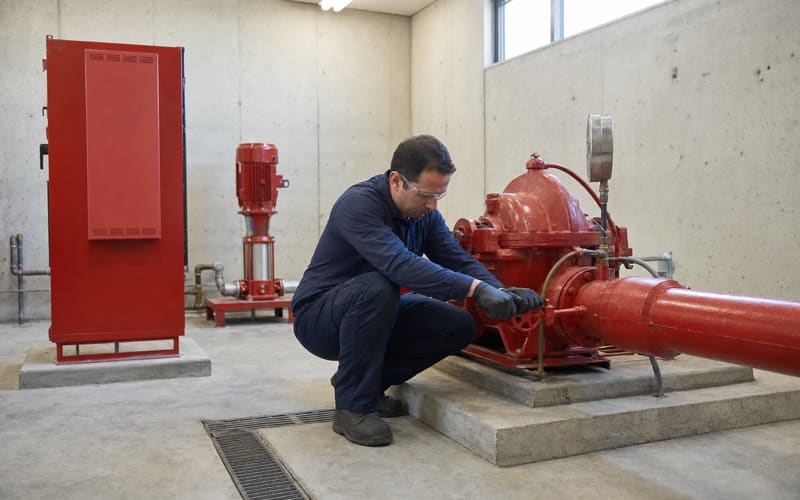
Buildings of significant size carry more than a sprinkler system. Fire pumps, standpipes, fire department connections, and multiple risers all form part of the protection, and each needs testing on its own schedule. We test pumps under the conditions the installation allows and record readings against rated performance, check standpipes and connections for caps, gaskets, threads, and obstruction, and verify that every riser serving the building is accounted for rather than only the one nearest the office.
Zoning and isolation matter on a building of significant size. Knowing which riser serves which portion of the structure determines whether a repair requires shutting down the entire building or only one section, and that information is frequently missing or inaccurate on older properties. We map what each riser and control valve actually serves and recommend clear permanent labeling, which turns a future repair from a full shutdown into a contained one and shortens every impairment that follows.
Manufacturing and Processing Space
Where a building houses production rather than storage, the hazards shift toward the processes themselves: heat, dust, finishing operations, and machinery that has been repositioned since the system was laid out. Sprinkler heads over a process area may carry a temperature rating suited to conditions that no longer exist. We check ratings against what is actually happening beneath them, and where dedicated suppression protects a specific piece of equipment, we verify that its interlocks and shutdown sequences still function rather than assuming they do.
Offices, Break Rooms, and Food Service
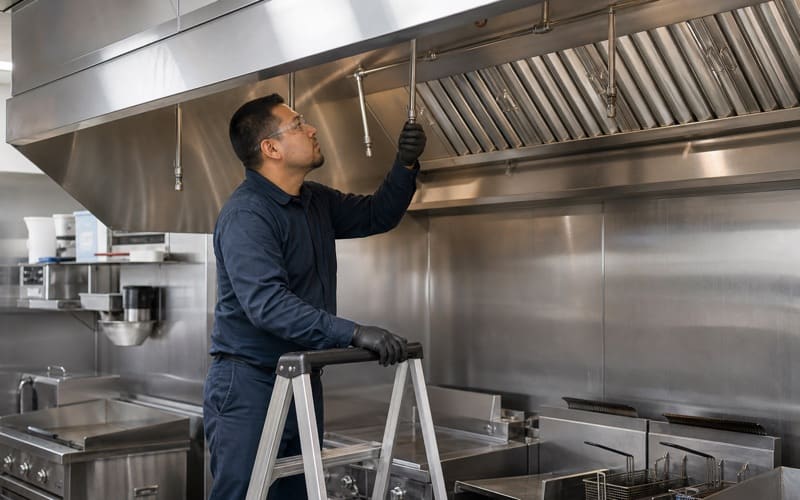
Most industrial buildings contain office space, break areas, and sometimes a full commercial kitchen, all with requirements of their own inside a structure everyone thinks of as a warehouse. Where a cooking line exists, NFPA 96 ventilation requirements and NFPA 17A wet chemical suppression apply exactly as they would in a restaurant, with semi-annual service on Ansul R-102 or Pyro-Chem systems. Portable extinguishers under NFPA 10 are matched to each area, with Class K in kitchens, ABC dry chemical across general space, and CO2 near electrical equipment.
Buildings That Do Not Close
Distribution and production operations frequently run across multiple shifts, which removes the after-hours window most commercial inspections rely on. That constraint has to be planned for rather than discovered, and it changes how a shutdown is approached.
Scheduling Around Shifts
We arrange work around operating hours, which in a continuously running building means identifying the genuine low point in the cycle rather than assuming an evening is quiet. Testing that requires notification appliances to sound is scheduled with the operator so it does not land during a shift change or a peak outbound period. Where a portion of a building can be isolated and worked on while the rest continues, we plan the sequence that way instead of taking the whole system down at once.
Impairments in an Operating Building
When a system goes out of service the building is in an impairment, and in an occupied warehouse that condition carries immediate consequences for insurance and for the fire authority. We document the impairment from the moment it begins, advise where a fire watch is required for the duration, and work to return the system to service in the shortest practical window. Emergency response covers systems that have failed outright and buildings working against a correction deadline after a failed inspection.
Records, Reporting, and Correction
California Fire Code and Title 19 state fire marshal requirements place the burden of proof on the property owner, and on large industrial buildings that record is also what an insurer will ask to see. We track recurring due dates for the properties we service so quarterly, semi-annual, and annual obligations arrive as scheduled work, and five-year internal obstruction inspections are booked against the documented installation date.
Findings an Operator Can Act On
Each deficiency carries a photograph and the code section behind it, ranked by consequence so a facilities manager can distinguish what leaves a system unable to perform from what is wear worth correcting before it escalates. Repairs are completed by the crew that performed the inspection, working from direct knowledge of the building rather than a second billed diagnosis, and itemized pricing lets urgent items be cleared immediately with the remainder phased across a budget cycle. Operators running several sites across the metro receive one consolidated schedule covering all of them.
- Commercial & Industrial Only
- Code-Cited Inspection Reports
- Emergency Impairment Response