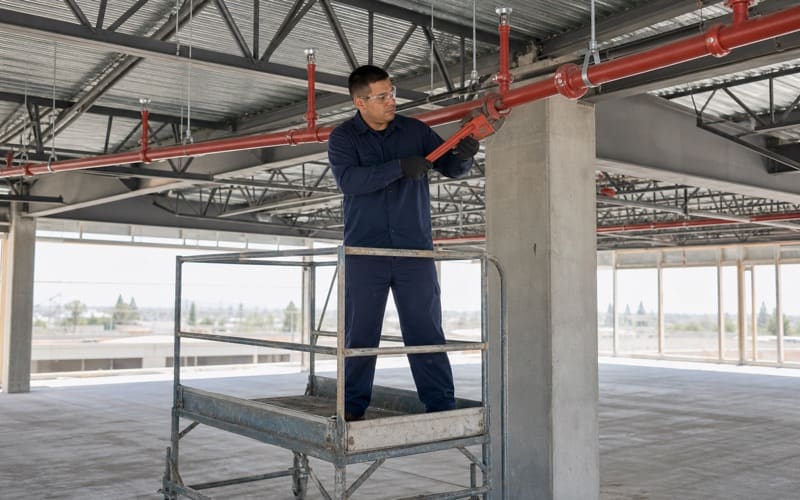
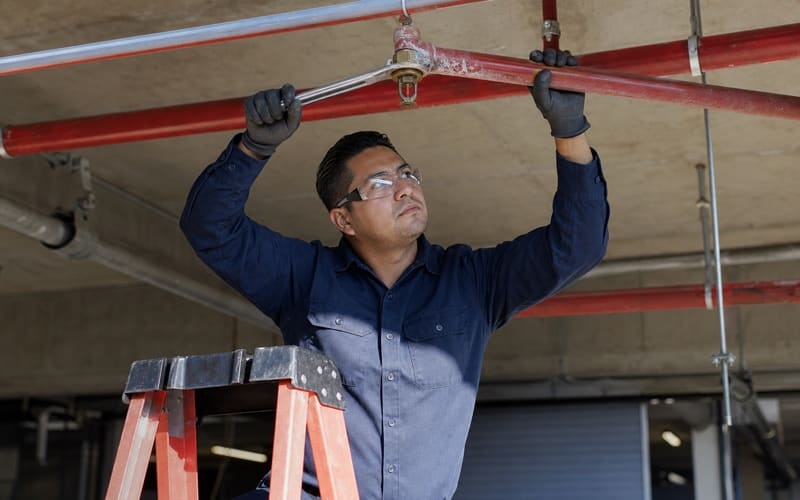
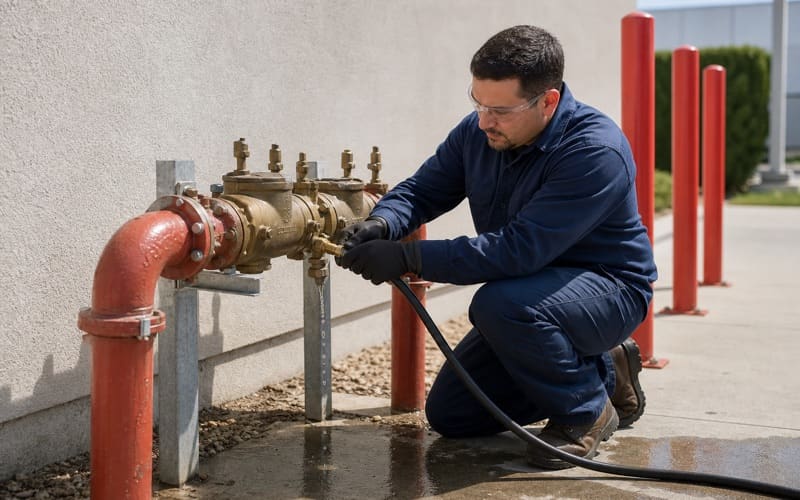
Long Beach Fire Suppression provides commercial fire suppression in Compton for warehouses and distribution buildings, manufacturing and fabrication plants, truck and equipment yards, auto and fleet service facilities, retail property, restaurants, and multifamily buildings. We design, install, inspect, service, and repair sprinkler systems, fire pumps, standpipes, cooking equipment suppression, alarms, extinguishers, and backflow assemblies. All of it sits with one provider, so a property carries one deficiency list rather than several partial ones.
Industrial and commercial work is the whole of our practice, and in a market weighted toward logistics and manufacturing that focus describes competence rather than positioning. What a sprinkler system must deliver in a distribution building is decided by stored commodity, stack height, and rack configuration, and what it must deliver in a fabrication shop is decided by the process running inside it. Neither question has a residential counterpart, and getting either wrong produces a building that passes a walkthrough and fails when it matters. No residential work competes for the same crews, which is also why a booked commercial date holds.
The calendar generates most of what we do. Water-based systems answer to NFPA 25 for inspection and testing and NFPA 13 for design, cooking equipment to NFPA 96 and NFPA 17A, portable extinguishers to NFPA 10, and detection and notification to NFPA 72, with California enforcing the whole set through its Fire Code and Title 19. We inspect, record each finding against the provision behind it, and complete the corrections ourselves, so closing a deficiency never requires an owner to broker agreement between two companies who each believe the other holds the context. Recurring due dates are tracked against the property so an obligation arrives as scheduled work, not as a notice.
Warehouse, Logistics, and Manufacturing Protection
Storage Occupancies and Commodity Classification
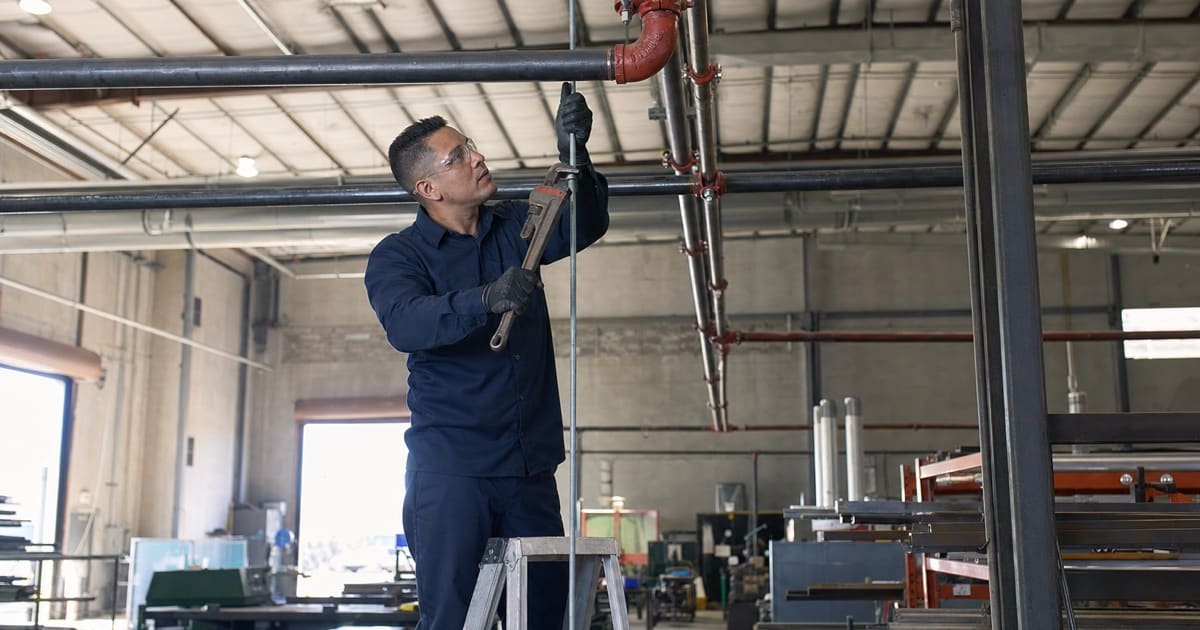
Sprinkler design in a storage building follows commodity classification, stack height, and rack arrangement rather than floor area, which is why two identical shells require substantially different systems under different tenants. A building engineered around one commodity class can be materially short for another, and that shift happens when a product mix changes rather than when anyone files a permit. Where protection depends on maintained clearance between the heads and the top of stored goods, stacking into that clearance defeats the design outright while every component remains in working order. An incoming tenant rarely announces a change of commodity to anyone outside their own logistics team.
We therefore assess what is actually stored and how it is arranged against the assumptions the system was built on, instead of confining a visit to hardware condition. In-rack arrangements draw particular attention, since they sit within reach of moving equipment and absorb damage ceiling heads never see. Where a current storage profile exceeds what the installed system can protect, that finding outweighs anything else on the report, and we state it plainly rather than filing it among routine observations. Idle pallets stacked indoors create a fuel load well beyond what the surrounding protection was sized to handle.
Process Hazards and Dedicated Systems
Manufacturing introduces exposures ceiling sprinklers were never intended to answer, including flammable and combustible liquids, dust-producing operations, hot work, spray and coating booths, and individual machines warranting protection independent of the room around them. Depending on what is running, the appropriate answer may be a deluge arrangement over a high-hazard area, a foam system where plain water would spread a liquid fire rather than control it, or suppression dedicated to a single piece of equipment. Dust collection and finishing equipment may warrant suppression of their own rather than relying on the ceiling system.
The problem we meet most often is not a broken component but a system that has quietly stopped matching its building. A line converted to a different solvent, a booth added into an existing bay, or a change in what gets stored between shifts can move a space into a classification the installed protection was never engineered to cover. None of those changes involve touching fire protection equipment, so nothing prompts a review, and we assess whether what is installed still answers what the building now does. We check head temperature ratings against the conditions actually present rather than against the original drawing.
Fire Pumps, Standpipes, and Supporting Equipment
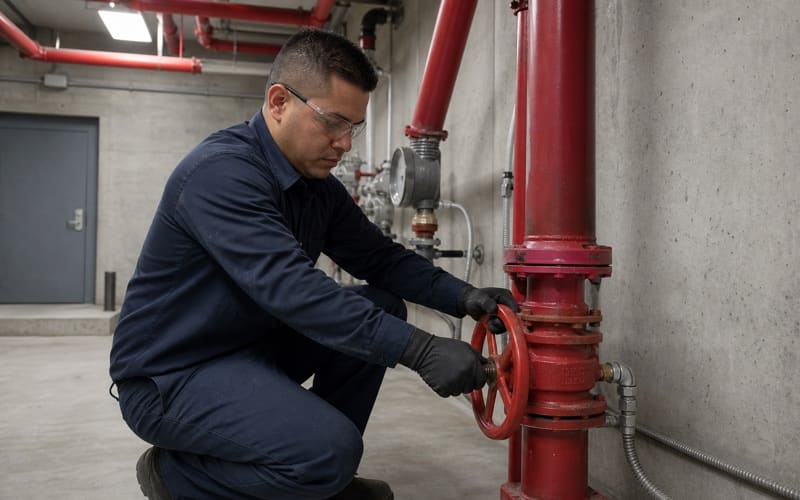
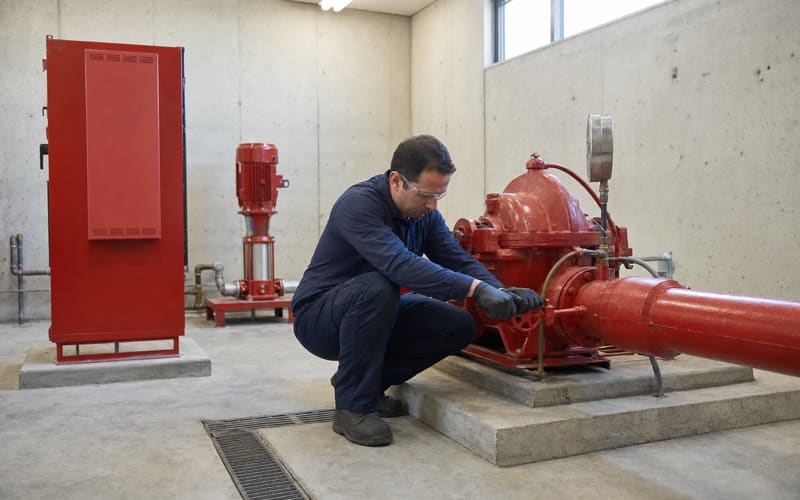
Buildings of scale depend on equipment upstream of the sprinkler heads, and it sits in mechanical rooms nobody enters between scheduled tests. Fire pumps supply pressure where the municipal supply cannot meet design demand alone and require frequent no-flow churn testing plus annual flow testing at churn, rated capacity, and peak flow. A pump can start dependably every week and still deliver materially less than its design output, and nothing short of a flow test will reveal it. Pump rooms are assessed as rooms too, since ventilation, drainage, and clear access all bear on whether a pump runs.
Controllers left in manual after service, suction valves closed or partially closed, failing batteries on diesel drivers, and pressure-maintenance faults account for the majority of findings. Fire department connections are inspected for access, caps, gaskets, and internal obstruction, because that component’s failure is discovered by the fire department rather than by the building, and landscaping, parked vehicles, and construction staging are the routine causes. We record readings against the pump’s rated performance rather than noting simply that the equipment started.
Looking for fire suppression closer to Lomita? See Lomita Fire Suppression.
One of the County’s Oldest Cities
Compton sits in the Gateway Cities region of southern Los Angeles County, south of downtown Los Angeles, and had a population of 95,740 at the 2020 census. It is among the oldest cities in the county, having incorporated in May 1888 as the eighth city in Los Angeles County to do so. That depth of history produces a commercial and industrial building stock assembled across more than a century, in which purpose-built modern distribution space sits alongside structures that have served three or four different uses. A building stock of that age means very few systems still match the drawings filed when they were installed.
Layered Alterations and Missing Documentation
Buildings that have carried several occupancies over decades hold protection extended, patched, and rerouted by a succession of contractors whose record-keeping varied considerably. Drawings on file frequently describe something other than what is physically installed, and alterations that never passed plan review are common enough to anticipate rather than to be surprised by. We inspect the building in front of us rather than the paperwork describing it, and unapproved work is reported because it surfaces at the next inspection regardless of who performed it. Riser tags, head types, and valve positions are better evidence of what a building holds than any drawing on file.
Older water-based systems also accumulate internal corrosion, scale, and debris that restrict flow while producing no external sign whatsoever. The five-year internal obstruction investigation exists precisely to find that condition, and it remains the requirement buildings skip most reliably, partly because the interval outlasts most people’s tenure at one property and partly because nothing about a sound-looking riser suggests it is due. Where no evidence exists that one was ever performed, we schedule it rather than assume a predecessor quietly did.
Physical Damage in Working Buildings
Facilities with forklift and truck traffic sustain damage to heads, drops, and exposed piping often enough that it is an expected finding rather than a notable one. The durable remedies are guards, relocation, or a head type better suited to the traffic in that aisle, because replacing an identical head in an identical position for a third time schedules the next repair rather than addressing what keeps striking it. We photograph each location so a recurring pattern of damage becomes visible rather than being rediscovered annually.
Dry systems serving unheated docks, canopies, and covered yards contribute their own faults, including compressors running continuously without holding pressure, low-point drains collecting water, and dry pipe valves that will not trip within the required time. Trapped water is the usual root cause and accumulates entirely out of view until a drain is opened, which is why these systems reward scheduled trip testing rather than visual reassurance. Trip times are measured against the system’s design instead of accepted because air pressure held overnight.
Support Commercial and Food Service
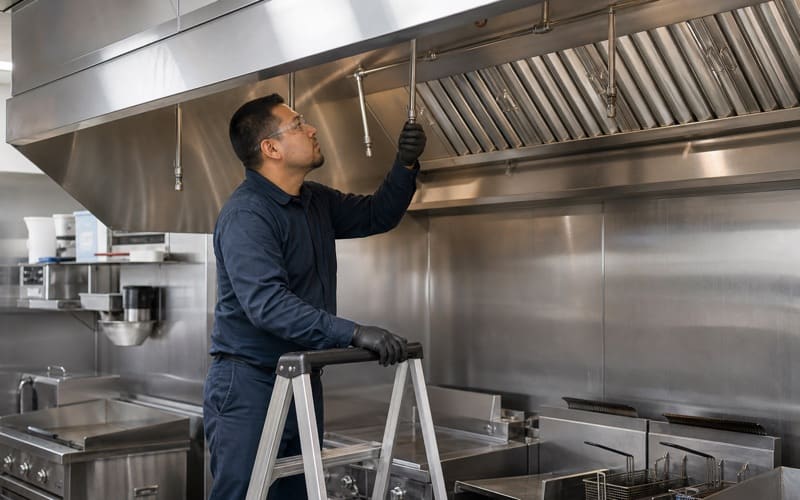
The commercial property serving an industrial base carries obligations of its own, and cooking equipment suppression runs on the shortest cycle of anything we service. Each visit covers cylinder charge, nozzle position against the appliance line as it currently stands, blow-off caps, fusible link replacement, detection cable travel, and functional testing of the fuel shutoff and pull station together rather than separately. Class K units belong on the cooking line and are serviced during the same visit rather than as a separate trip.
Nozzle position is the perennial finding, because appliances are replaced and shifted far more often than anyone reviews the system hanging above them. Auto and fleet facilities combine flammable liquids, hot work, and vehicles under one roof and typically need more extinguisher coverage than their floor area implies, with spray operations treated as a separate hazard requiring dedicated protection. Missing or sealed-over access panels prevent proper cleaning of the duct entirely, and we identify those specifically.
Compliance, Records, and Response
Reconstructing What Is Owed
A property with only annual visits behind it is almost certainly carrying incomplete obligations, because the standard staggers requirements across quarterly, semi-annual, annual, and five-year cycles running concurrently on one system. We establish which intervals attach to the equipment present, review whatever history exists, and name what appears never to have been performed rather than assuming a predecessor handled it without documenting it. We hold the schedule against the property, so a change of ownership does not silently reset the record. The short-cycle items are the easiest to skip precisely because each one takes only a few minutes to complete.
Reporting Built for Review
Each deficiency carries a photograph and the governing code provision, ordered by consequence so a partially closed control valve never appears beside a cosmetic observation as though the two were equivalent. That ordering allows an owner reviewing several properties remotely to act from the report rather than arranging a visit to interpret it. Corrections are priced individually instead of arriving as one figure, making it possible to release compulsory work immediately and schedule the balance deliberately against a budget. Every line traces back to the finding that produced it, so nothing in the total is left unaccounted for.
Emergency Work and Impairments
A system out of service leaves a building without primary protection for the duration, and in a warehouse holding inventory that exposure is substantial rather than theoretical. We respond urgently to systems shut down by damage, failure, or a leak that forced a valve closed, and the first objective is restoring protection to as much of the building as circumstances permit rather than waiting on a complete repair. We respond to those on an emergency basis and document the impairment from the moment it begins.
Isolating a damaged branch and returning the remainder to service is frequently achievable within the same day. Planned shutdowns are arranged with management beforehand, confined to the smallest workable area, and documented as the code requires, with interim measures where duration and occupancy call for them. In buildings running production or distribution shifts we schedule around changeovers rather than imposing a window. Where an outage must run past a single shift, interim measures are agreed with management in advance.
- Commercial & Industrial Only
- Code-Cited Inspection Reports
- Emergency Impairment Response