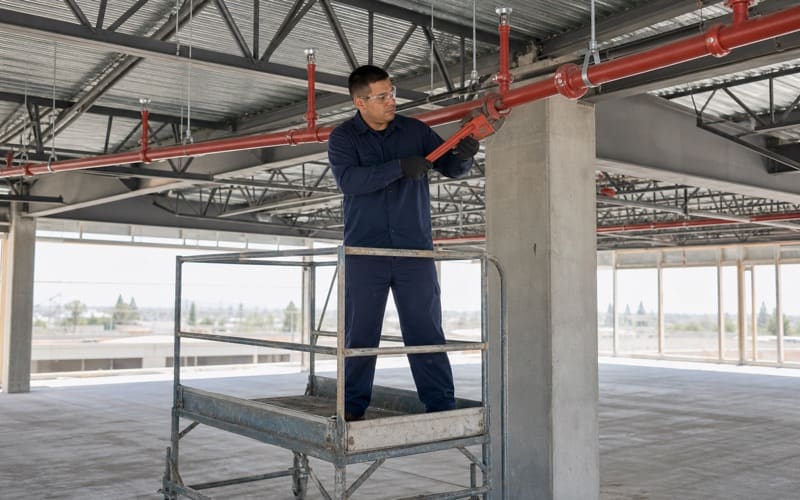
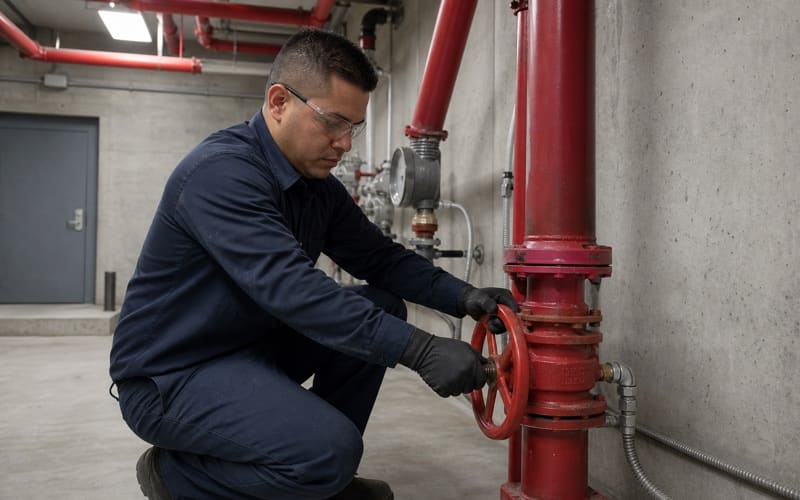
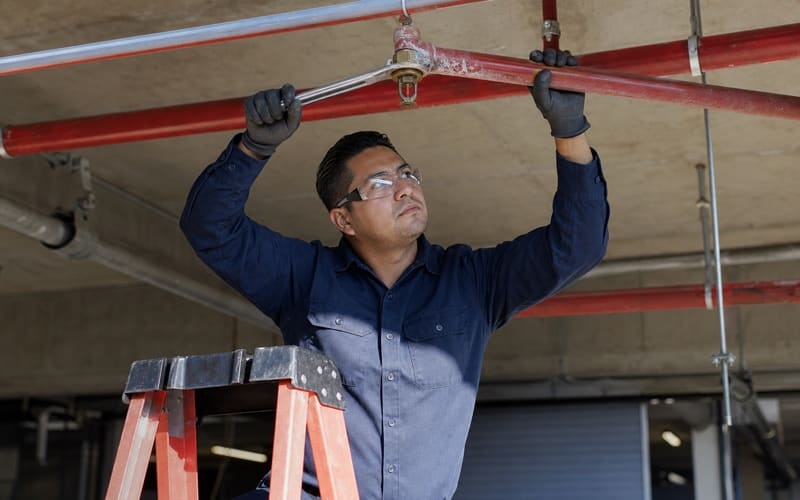
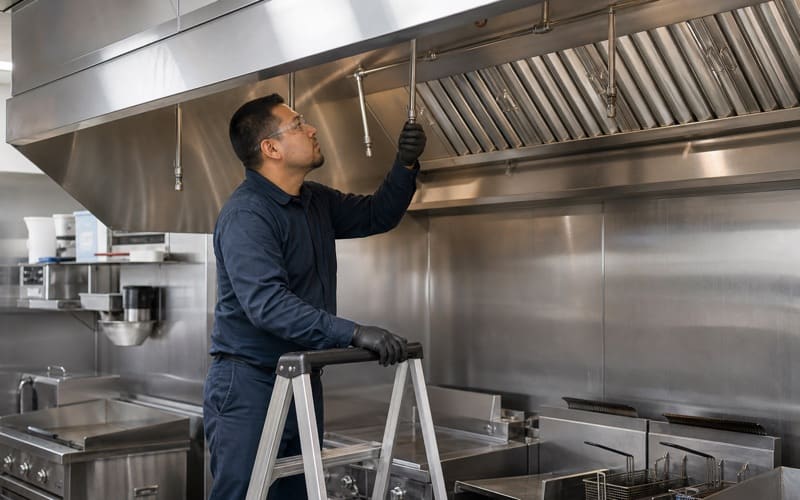
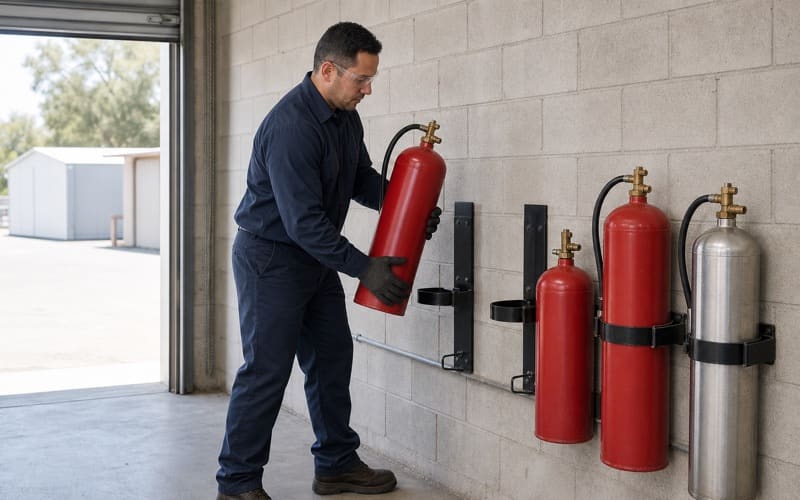
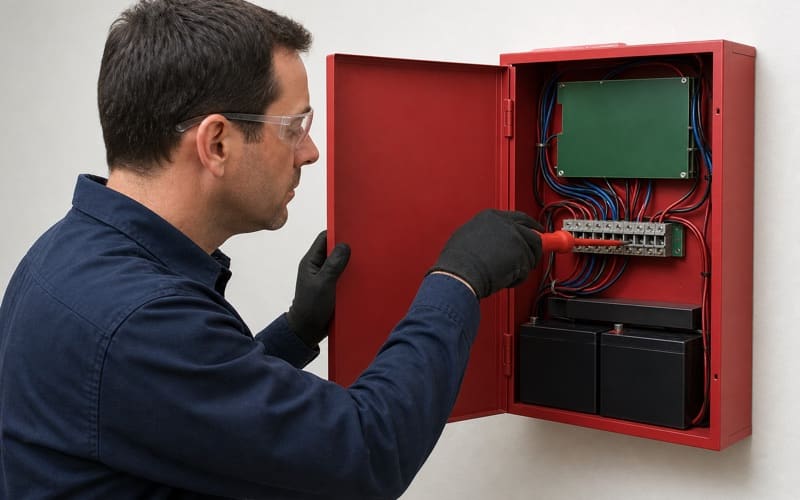
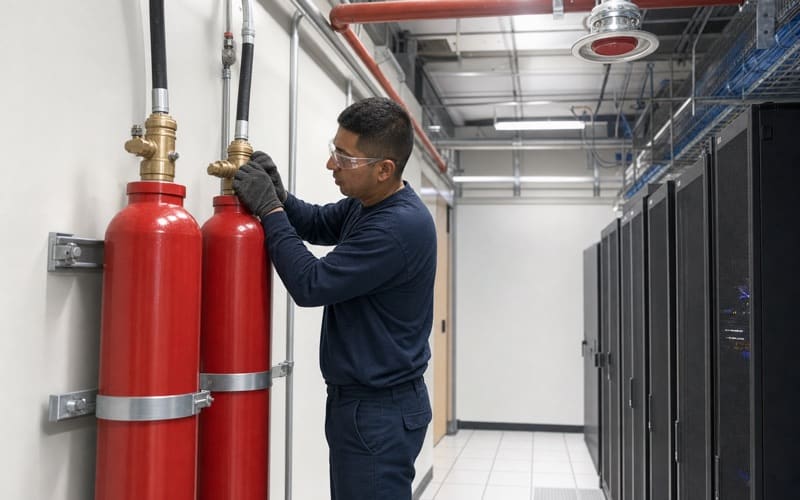
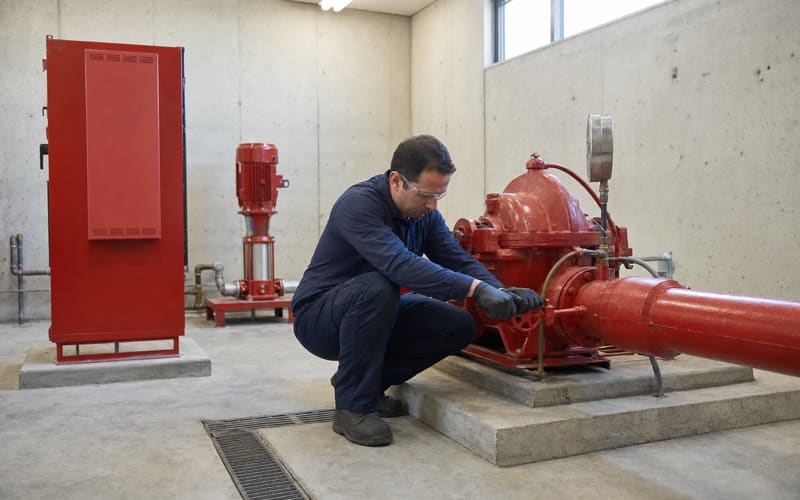
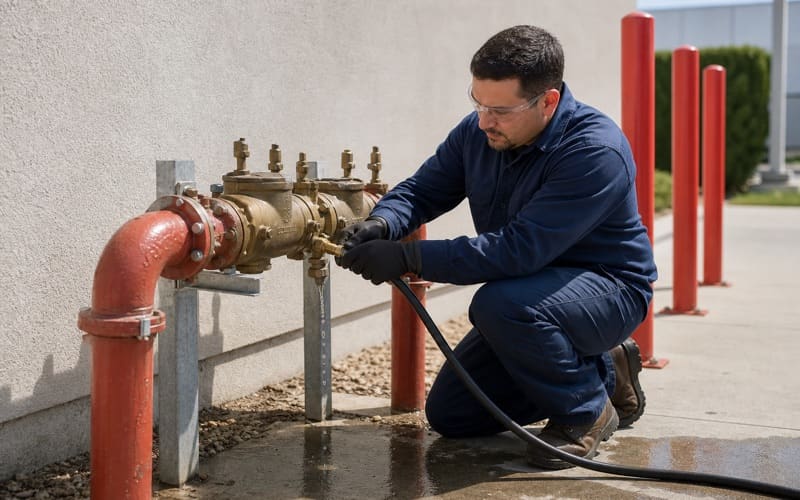
Long Beach Fire Suppression provides fire suppression in Cudahy for commercial and industrial property, covering sprinkler systems, fire alarms, portable extinguishers, and kitchen hood suppression under one agreement. Keeping all four together means a building has a single deficiency list and a single company answerable for it, rather than four partial pictures that never quite add up. We do no residential work, so nothing on the commercial calendar gets displaced.
The practical challenge on much of the property here is not the systems themselves but the conditions around them. Buildings sit tight to their property lines and to each other, parking is limited, and there is very little room to stage equipment or work without affecting somebody adjacent. A contractor who plans a job the way they would on an open suburban lot ends up blocking access, extending a shutdown, and creating problems for occupants who had no part in scheduling it.
We plan around those constraints rather than treating them as an obstacle discovered on arrival. Work is scheduled around operating hours, required outages are kept short and predictable, and access is arranged directly with property managers, owners, and tenants ahead of the day. Every deficiency we record carries photo documentation and the code section behind it, priced individually so an owner can stage corrections against a real budget.
Working on Fully Built, Constrained Sites
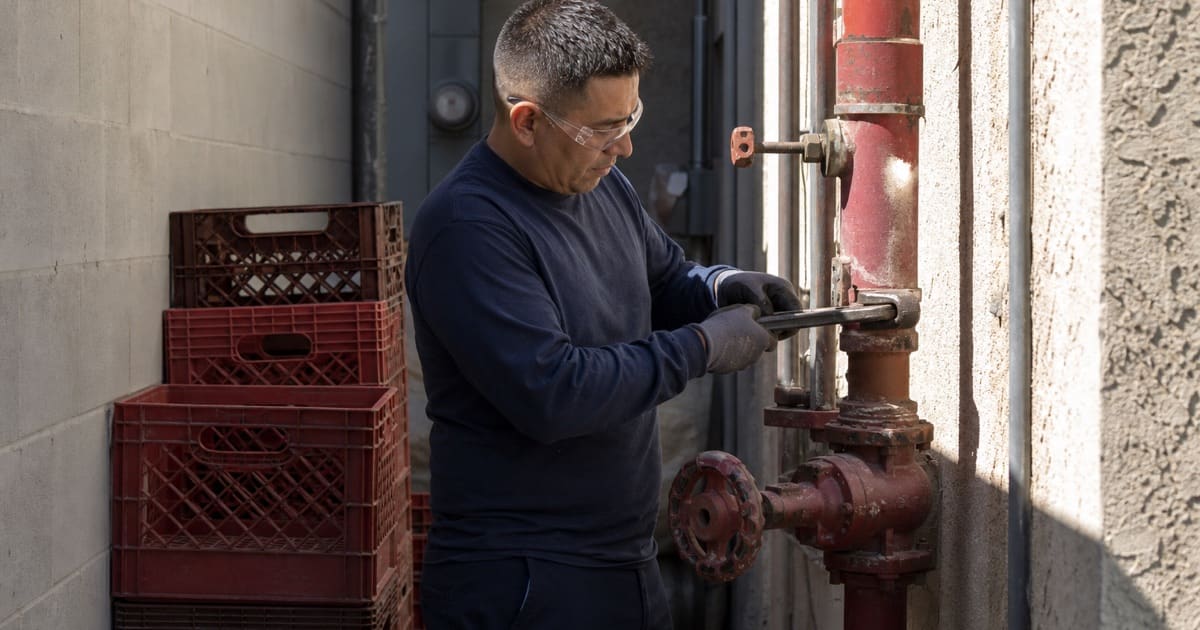
Density changes the mechanics of fire protection work in ways that do not show up on a checklist. Every stage of a job — getting equipment in, reaching a riser, draining a system, testing an alarm — involves someone else’s space, someone else’s customers, or someone else’s parking. Planning for that is the difference between a two-hour outage and a day lost by every business on the block.
Access, Staging, and Reaching the Equipment
Risers in this kind of building turn up in back rooms, closets, stairwells, and spaces that have since been shelved over or converted to storage by a tenant who had no idea what was behind the wall. Reaching the equipment is frequently the longest part of the visit. We identify where a control valve, riser, or panel has been enclosed or obstructed and document it as a finding, because equipment that cannot be reached during an inspection also cannot be reached during an emergency.
Labeling is the companion problem and costs almost nothing to fix. Where a building has been subdivided over the years, valves and risers frequently carry no indication of which portion of the building they serve, which turns an emergency shutdown into a guessing exercise at the worst possible moment. We identify what each valve controls during the inspection and recommend permanent identification where it is missing, since a correctly labeled riser saves time for every fire officer, contractor, and tenant who deals with the building afterward.
Getting a lift or ladder into position raises its own problems where ceilings are high and floor space is fully occupied. We work out the approach before the day rather than arriving and improvising, which keeps a business from losing its floor for an afternoon. Where overhead work genuinely requires clearing an area, we tell the occupant which part and for how long, so the disruption can be planned around rather than absorbed.
Deliveries, waste collection, and customer parking all compete for the same limited frontage we need in order to work. Arriving without having thought about that produces a blocked service lane and a business unable to receive stock, which is a cost we created rather than one the building had. We agree the approach and the timing in advance, and where a job genuinely requires occupying a loading area or a section of parking, we say which part and for how long before the day arrives.
Shutdowns Where There Is No Slack
Draining a system takes a building out of service, and on a densely occupied property that affects more people than the one who called us. Where an outage will run long enough to require a fire watch, we say so at the point of scheduling rather than announcing it once the water is already off. Impairment periods are documented from the moment they begin through the confirmed return to service, which is what an owner needs if a question about coverage arises later.
Buildings Close to Their Neighbors
When structures sit within a few feet of one another, a fire in one is a direct threat to the next, and the systems protecting each become the neighborhood’s problem rather than one owner’s. That raises the stakes on findings people are otherwise tempted to defer. We are explicit in the report about which deficiencies carry consequences beyond the property line, because a decision to postpone a repair should at least be made with an accurate understanding of what is being postponed.
Exterior components take on additional importance where buildings sit close together. Fire department connections need to be reachable and usable, which means caps present, threads sound, and the connection clear of the parked vehicles, storage, and added structure that tend to accumulate against a wall on a crowded site. We check access to these as part of the inspection and record obstructions with photographs, because an obstructed connection on a tight parcel is considerably harder to work around than one on an open lot.
Looking for fire suppression closer to Bell? See Bell Fire Suppression.
One of the Country’s Densest Cities
Cudahy is a city located in southeastern Los Angeles County and part of the Gateway Cities region, with a population of 22,811 as of the 2020 U.S. census, and it has one of the highest population densities of any incorporated city in the United States. Commercial property in a setting that compressed is built to the edges of its parcels and works hard for every square foot, and the fire protection inside reflects a long history of buildings being subdivided and adapted rather than replaced.
Small Storefronts and Ground-Floor Commercial
Small tenant spaces are the most common thing we inspect here, and they change hands and configurations often. A single riser may serve a row of suites divided and redivided over the years, leaving a head layout that reflects a floor plan nobody remembers. We compare what is installed against the walls standing today, and we flag areas left without coverage by a partition that went up without the sprinkler layout ever being revisited.
Ceilings in these spaces change as often as the walls do. Dropped ceilings, new soffits, signage, and added ductwork all alter what a head can reach, and concealed heads get painted or covered during a refit far more frequently than anyone reports afterward. We check clearance and coverage rather than only confirming the system holds pressure, and we describe precisely which areas a change has left inadequately protected so the correction can be scoped without a second visit to work out what is needed.
Small businesses also feel a shutdown more sharply than a large one, since a single day closed is a meaningful share of a month’s revenue. We schedule around trading hours wherever the work allows it and give advance notice where it does not. Testing that requires notification appliances to sound is placed in an agreed window rather than dropped into a busy afternoon without warning.
Restaurants and Compact Kitchens
Food service is a substantial part of the commercial base, and NFPA 96 ventilation requirements with NFPA 17A wet chemical suppression apply regardless of how small the kitchen is. We service Ansul R-102 and Pyro-Chem systems on a semi-annual schedule, confirm nozzle coverage matches the appliances actually beneath the hood, and test fusible links, manual pulls, and automatic gas shutoff. In a tight kitchen, equipment gets shifted along a line to make room far more often than in a spacious one, and the nozzles above almost never move with it.
Grease accumulation in the hood, filters, and accessible duct is the companion issue and gets noted during service. A suppression system discharging into a heavily loaded duct is fighting a fire larger than the one it was sized to handle. Where access panels are missing or have been covered during a remodel, proper cleaning becomes impossible, and we identify that specifically rather than leaving it as a general remark about condition.
Commercial Space Alongside Housing
A great deal of the commercial property here shares a wall, a floor, or a parcel boundary with occupied housing, and that raises the consequence of every alarm and suppression deficiency on the commercial side. Notification appliances have to be audible where they are required, separations between occupancies need to remain intact, and penetrations made for cabling or plumbing should be properly sealed rather than left open. We look for those penetrations, since they are easy to create during a remodel and rarely repaired afterward.
Systems, Testing, and Documentation
Inspection intervals come from NFPA 25 for water-based systems and NFPA 72 for fire alarms, running quarterly, semi-annually, annually, and at five-year marks by component. We track recurring due dates for the properties we service, which turns compliance into a scheduled appointment rather than something recalled after a notice arrives.
Water-Based Systems and Their Components
We run main drain tests, exercise OS&Y and post indicator valves, confirm flow and tamper switches report properly to the panel, and inspect pendent, upright, sidewall, and concealed heads for corrosion, paint, loading, and obstruction. Painted and obstructed heads are the routine findings in frequently remodeled tenant spaces. Backflow preventers on the fire line are tested and tagged annually, and five-year internal obstruction inspections are scheduled against the documented installation date rather than estimated from appearance.
Alarms, Monitoring, and Portable Equipment
An NFPA 72 annual covers initiating devices, notification appliances, duct detectors, and the interface with the sprinkler system’s supervisory devices, and we verify signals actually arrive at the central station instead of assuming an intact path. Portable extinguishers under NFPA 10 are handled in the same visit, with Class K in kitchens, ABC dry chemical in general areas, and CO2 near electrical equipment, all checked for placement, access, mounting, and current service dates.
Reports, Repairs, and Response
Every finding carries a photograph and a code citation, ranked by consequence rather than by the order it was encountered, so an owner can see both the condition and the reasoning without taking either on trust. Repairs are performed by the crew that carried out the inspection, which removes a second diagnostic visit before any work starts. Impaired systems and buildings working against a failed inspection get emergency response, with the correction documented in the form the fire authority expects to receive it.
- Commercial & Industrial Only
- Code-Cited Inspection Reports
- Emergency Impairment Response