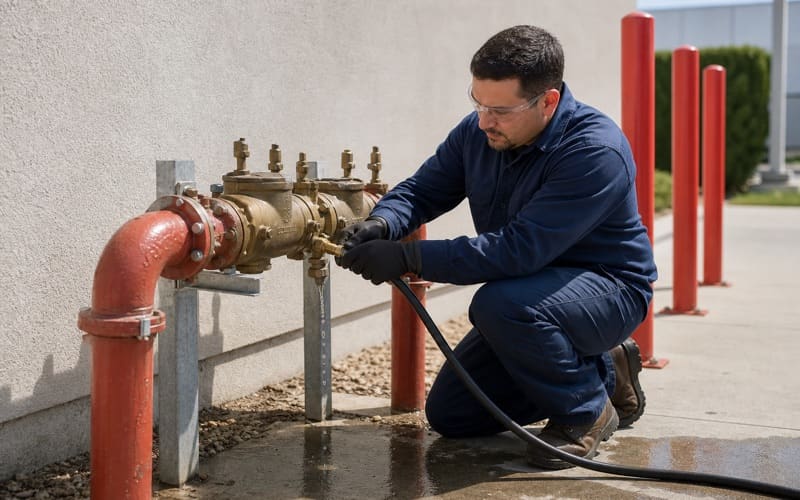
Long Beach Fire Suppression provides commercial fire suppression in East Rancho Dominguez for warehouses, light manufacturing plants, auto and truck service facilities, retail buildings, restaurants, and multifamily property. We install, inspect, service, and repair sprinkler systems, kitchen hood suppression, alarms, extinguishers, standpipes, and backflow assemblies. Handling all of it under one contract means a building carries one deficiency list rather than several partial ones, each held by a different trade. One provider across all of it also means one set of records when an inspector asks.
We take commercial and industrial work exclusively. Where a market runs toward industrial and mixed commercial buildings, that is less a positioning statement than a description of competence: what a sprinkler system has to deliver in a warehouse is decided by stored commodity and rack height, considerations that have no counterpart in residential work. Rack-stored commodity, clearance to the deflector, and the density a system was designed to deliver have no residential equivalent to reason from.
The calendar drives this trade more than incidents do. Water-based systems fall under NFPA 25 for inspection and testing and NFPA 13 for design, cooking equipment under NFPA 96 and NFPA 17A, extinguishers under NFPA 10, and alarms under NFPA 72, all enforced in California through the Fire Code and Title 19. We inspect, we document, and we correct, so a single deficiency does not require two vendors to close. Tracking those due dates against the property is part of the service, since the intervals run concurrently and the short ones lapse quietly.
An Unincorporated Community and County Jurisdiction

East Rancho Dominguez, also known as East Compton, is an unincorporated community and census-designated place in southern Los Angeles County, with a population of 15,114 at the 2020 census, down marginally from 15,135 in 2010. It is an accepted place name for postal purposes. Being unincorporated changes who administers fire protection here, since properties answer to county fire authority jurisdiction rather than to a municipal department. That distinction matters most when a correction has to be signed off, because the office reviewing it is not the one a neighbouring city would use.
What County Jurisdiction Changes
Jurisdiction determines who performs the inspection, what documentation satisfies it, and the route by which a correction is cleared. Its influence is largest on installation and alteration work, where a system cannot be placed in service until drawings have been submitted, reviewed, and approved. A system placed in service ahead of that approval becomes a problem that surfaces later, usually at the worst possible point in a sale or a lease.
Preparing a submittal to what the reviewing office actually expects is the main lever anyone has on a project schedule, because review cycles rather than field labour consume the time. On a modest project the gap between one cycle and three accounts for most of the calendar, and we handle that correspondence instead of handing it back to an owner. We would rather spend an hour on a submittal package than lose a fortnight waiting on a response asking for what should already have been attached. Reinspection benefits from the same preparation, since the evidence is assembled alongside the physical work.
Older Building Stock
Commercial buildings that have served several occupancies over decades carry systems extended and patched by a succession of contractors whose record-keeping varied. Drawings on file frequently describe something other than what is installed, and alterations that never went through approval are common enough to anticipate. Riser tags, head types, and valve positions are more reliable evidence of what a building actually has than any drawing held in a file.
We inspect what is physically present rather than what the paperwork claims, and unapproved work gets reported, because it emerges at the next inspection regardless of who performed it. Pipe that was cut and extended during a build-out warrants particular scrutiny, since sound workmanship tells you nothing about whether the hydraulic design still holds. Where an alteration cannot be reconciled with any approval on record, we say so plainly rather than leaving an owner to discover it mid-transaction. Riser tags and valve positions describe a building more honestly than any drawing held on file.
Mixed Use on Single Parcels
Parcels here often carry more than one use — a shop behind an office, storage behind a counter, service bays alongside parts inventory. Because density, extinguisher type, and travel distance all follow the hazard classification of an area rather than an average across a building, we classify area by area. An office, a workshop, and a storage area under one roof are three classifications, not one averaged across the parcel.
That prevents the common outcome where a compliant front of house conceals a back of house that no longer matches its own requirements. Uses also drift over the years without the protection design being revisited, so what the classification on file says is worth testing against what the space now holds. Asking what a space currently holds takes a minute and regularly contradicts what the file describes. Asking what a space currently holds takes a minute and regularly contradicts the classification on record.
Looking for fire suppression closer to Paramount? See Paramount Fire Suppression.
Industrial and Commercial Systems
Storage and Warehouse Protection
Sprinkler design in a storage building answers to commodity classification, stack height, and rack arrangement rather than to floor area, which is why an identical building can require very different systems under different tenants. A change of product mix can leave a system materially short without anything having been altered. Plastics, aerosols, and packaging all behave differently from ordinary palletised goods, and an incoming tenant rarely announces a change of commodity to anyone outside their own operation.
Where protection depends on maintained clearance between heads and the top of stored goods, stacking into that clearance defeats the design outright. We check what is actually stored and how against the assumptions the system was built on, and say so in writing when they have diverged, since that finding outweighs any individual head or valve on a report. Idle pallets stacked indoors deserve the same attention, since they create a fuel load well beyond what the surrounding protection was sized to handle. We record the arrangement we find so the next inspection has a baseline to compare against.
Process and Vehicle Hazards
Manufacturing and vehicle service introduce exposures that general sprinkler coverage was never intended to handle — flammable liquids, hot work, spray and coating operations, and equipment warranting protection in its own right. Depending on what is present that may mean deluge arrangements, foam, or suppression dedicated to a single machine. Where such a system exists we inspect it on its own terms, including the interlocks that shut equipment down, which are the part most often disabled and never restored.
Service bays in particular usually require more extinguisher coverage than their floor area implies, with spray operations treated as a separate hazard rather than absorbed into a shop’s general protection. Operations change without the fire protection design being reconsidered, so we assess whether what is installed still answers what the building now does. Charging areas and battery equipment fall into the same category, introducing a hazard that general coverage does not address on its own. Charging areas and battery equipment raise the same question in a slightly different form.
Physical Damage and Deterioration
Buildings with forklift and vehicle traffic sustain damage to heads and piping frequently enough that it is an expected finding rather than a notable one. Guards, relocation, or a different head type resolve it; replacing the same head a third time in the same aisle merely books the next repair. We photograph the location each time, because a pattern of damage in one aisle is an argument for guarding rather than for another replacement.
Dry systems serving unheated docks and covered areas add their own faults, including compressors that cycle without holding pressure and low-point drains that collect water. Trapped water is the usual root cause of dry system trouble and it accumulates entirely out of sight until someone finally opens a drain. Trip times get measured against the system’s design rather than accepted as adequate because air pressure held overnight.
Records, Correction, and Response
Working Out What Is Owed
A property with only annual visits behind it is almost always carrying incomplete obligations, because the standard’s requirements are staggered across quarterly, semi-annual, annual, and five-year cycles. We establish which apply to the equipment present, review whatever history exists, and identify what appears never to have been done. Reconstructing that history is slower than maintaining one, and the aim is to reach the point where the paperwork stops being the problem. The short-cycle items are easiest to skip precisely because each one takes only minutes.
Long-cycle items lapse most dependably. Nothing about a riser announces that an internal inspection is overdue, and five years exceeds how long many people stay with one building. We hold the schedule against the property rather than against its current manager, so a change of ownership does not reset the record to zero. Recording actual readings rather than marking a pass is what makes a trend visible across those longer cycles.
Documentation Built for Review
Every deficiency carries a photograph and the code provision behind it, sorted by consequence so a partially closed valve is not presented alongside a cosmetic finding as though they were equivalent. That is what allows an owner reviewing remotely to act without first arranging a site visit. It also separates a code obligation from a recommendation, so nothing gets funded on the assumption that it was compulsory.
Corrections are priced item by item rather than delivered as one figure, which makes it possible to authorise what is compulsory now and schedule the balance against a budget. Every line traces back to the finding that produced it. An owner staging work across a budget cycle can therefore see exactly what is being deferred and what it will cost to address later. An owner staging work across a budget cycle can see exactly what is being deferred and what it will cost.
Emergency Work and Impairments
A system out of service leaves a building without its primary protection, and in a warehouse holding inventory that exposure is considerable. We respond urgently to systems shut down by damage, failure, or a leak that forced a valve closed, with the first objective being to restore protection to as much of the building as circumstances allow. Insurance and the fire authority both take an interest in how long that condition lasts, which makes response time a matter of record rather than goodwill.
Isolating a damaged branch and returning the remainder to service is frequently achievable within the day even where the full repair is not. Impairments are managed, communicated, and documented as the code requires, with interim measures where duration and occupancy warrant them. Where a branch has to stay isolated for longer, we set out plainly what remains unprotected in the meantime.
- Commercial & Industrial Only
- Code-Cited Inspection Reports
- Emergency Impairment Response