Long Beach Fire Suppression provides commercial fire suppression in Hawaiian Gardens for retail buildings, restaurants, professional offices, medical suites, multifamily properties, and light commercial space. We install, inspect, service, and repair sprinkler systems, kitchen hood suppression, fire alarms, portable extinguishers, and backflow assemblies. Holding all of it under one agreement leaves a building with a single deficiency list rather than four partial ones.
Our work is commercial and industrial exclusively. In a market built around smaller commercial buildings, that focus matters in a specific way: small properties are the ones most likely to be handled as an afterthought by a vendor whose schedule is built around large accounts, and they carry identical code obligations regardless of size. A small property with a lapsed five-year requirement stands in exactly the same position as a large one when an inspector asks for records. Size changes the commercial consequences of a shutdown, not the standard the building is judged against.
A four-suite retail building with a sprinkler system, a handful of extinguishers, and an alarm connection is subject to NFPA 25, NFPA 10, and NFPA 72 exactly as a distribution center is. Intervals do not scale down with square footage, and the responsibility sits with the building owner either way. That obligation also transfers with the property when it changes hands, which catches new owners regularly, since the requirement moves with the building even when the inspection records do not. Records rarely travel with a sale, which is why we rebuild the schedule from the equipment rather than from the file.
Fire Protection Systems We Service
Sprinkler Systems in Smaller Buildings
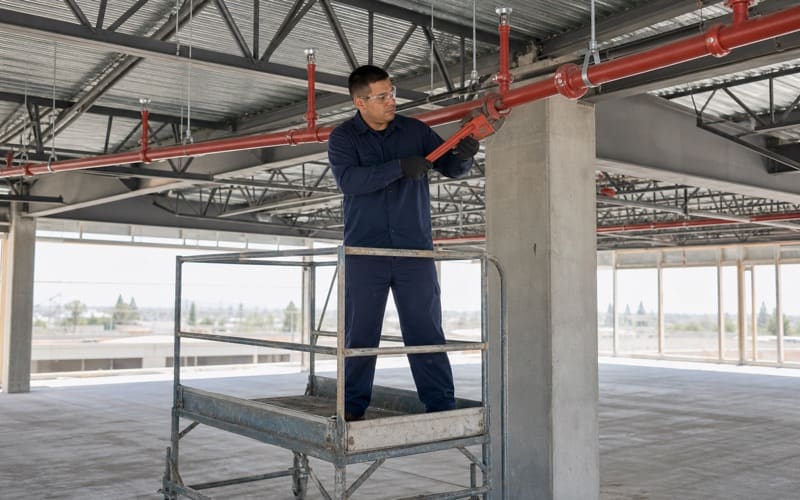
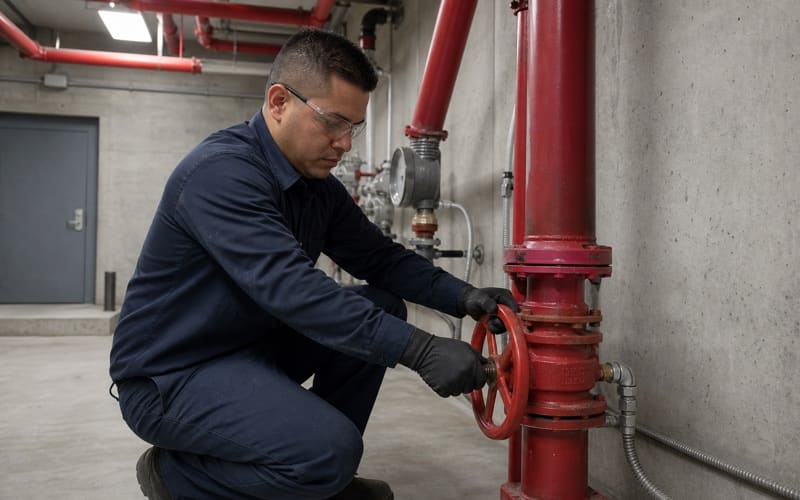
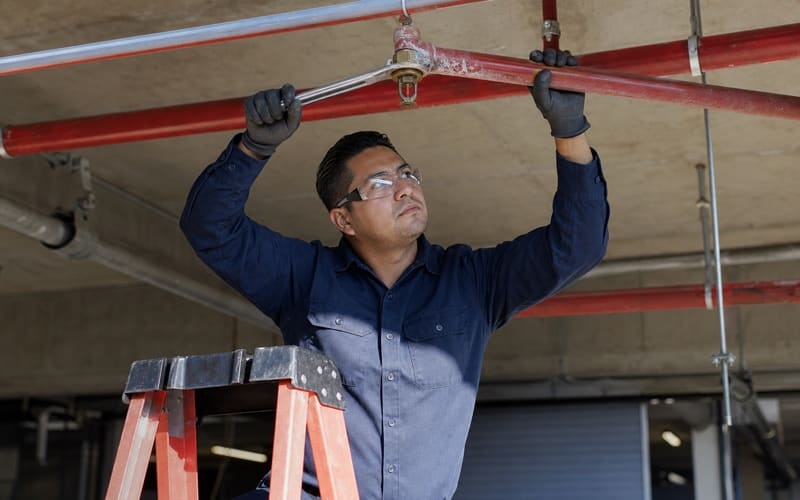
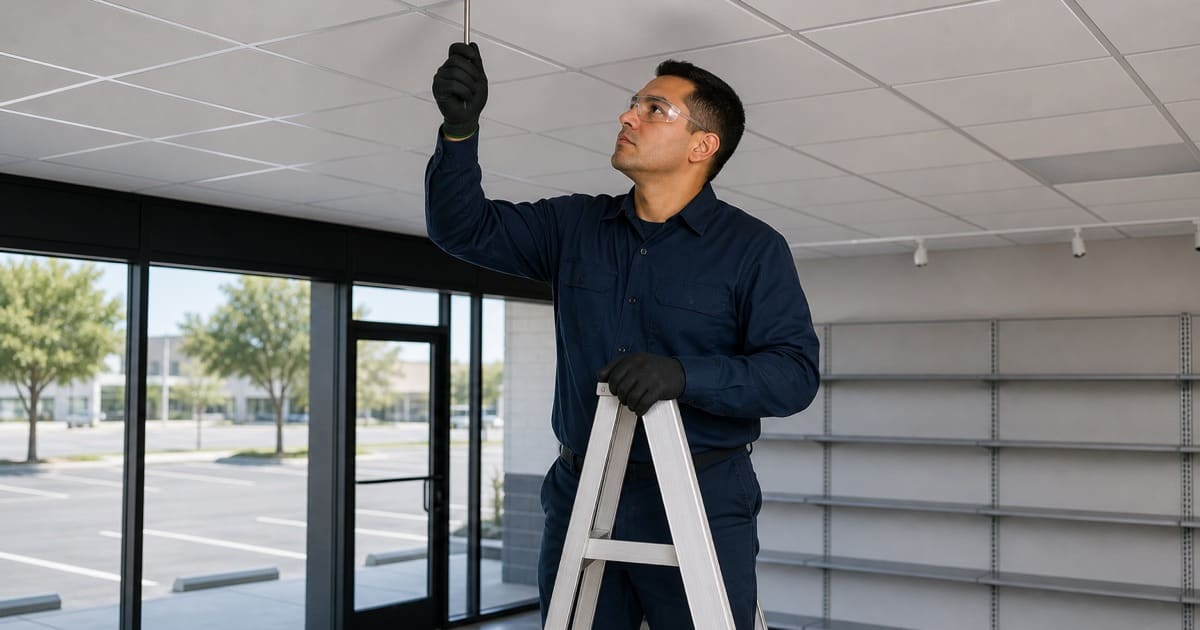
A sprinkler system serving a single-story retail building has fewer components than a high-rise riser, but it is inspected against the same standard. We verify control valves are open and supervised, perform main drain testing to detect whether the water supply has degraded, test waterflow and tamper switches, and examine heads for damage, paint, corrosion, loading, and obstruction. Valve position comes first, because most systems that fail to deliver water fail there rather than in the pipe.
Coverage is the finding that matters most in buildings like these, because it changes without anyone touching the system. We assess it against the space as it currently exists rather than the drawings on file. The five-year internal obstruction investigation applies here as fully as anywhere else, and in smaller buildings it is the requirement most likely never to have been performed at all. Opening the pipe at the prescribed points is the only way to find corrosion and scale that no external test reveals.
Kitchen Hood Suppression
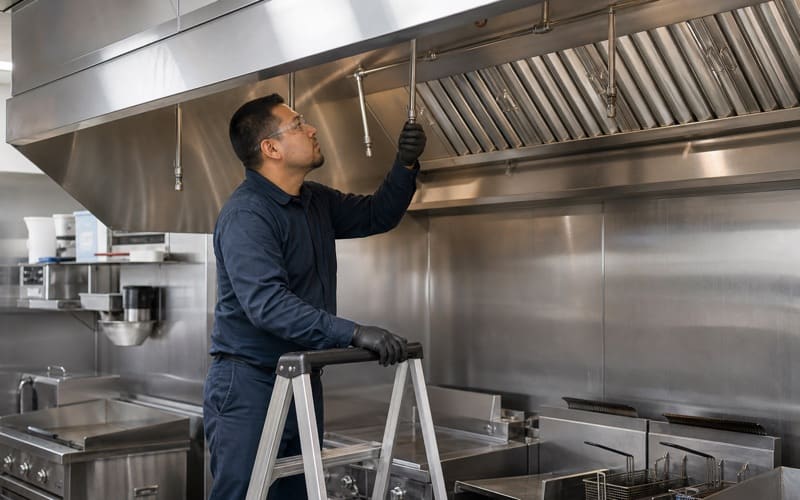
Any tenant cooking under a hood carries a wet chemical system requiring service roughly twice a year, the shortest interval of any system in a commercial building. We service and recharge Ansul R-102 and Pyro-Chem systems, replace fusible links, verify detection cable travel, and test the gas shutoff, electrical interlock, and manual pull station as a functioning sequence rather than as separate components. Ansul R-102 and Pyro-Chem units make up most of what is installed, and each carries its own service particulars.
Nozzle coverage is checked against the appliance line as it currently sits, because kitchens rearrange equipment more often than owners expect and a system correct at installation can be out of coverage a year later. Duct and plenum nozzles receive the same attention as those over the appliances, since a grease fire reaching the duct is the scenario most likely to leave the kitchen. Appliances get swapped and shifted along a line far more often than the nozzles above them are ever revisited.
Cylinders carry hydrostatic testing on a longer cycle separate from the semi-annual service, and those dates lapse more often than any other kitchen requirement because nothing indicates they are due. Grease accumulation in the hood, plenum, and duct is examined during service as well, since it is fuel positioned exactly where a fire would travel and it directly affects how the system performs. Missing or sealed-over access panels prevent proper cleaning of the duct entirely, and we flag those specifically.
Alarms, Extinguishers, and Backflow
Fire alarm systems, portable extinguishers, and backflow assemblies each run on their own intervals under their own requirements. Extinguisher work in particular is treated as a formality more often than it should be, when the useful question is whether the right unit types are in the right places for what the building currently does rather than whether the existing units are in date. Class K on a cooking line, ABC through general areas, and CO2 near electrical equipment is the distinction that matters.
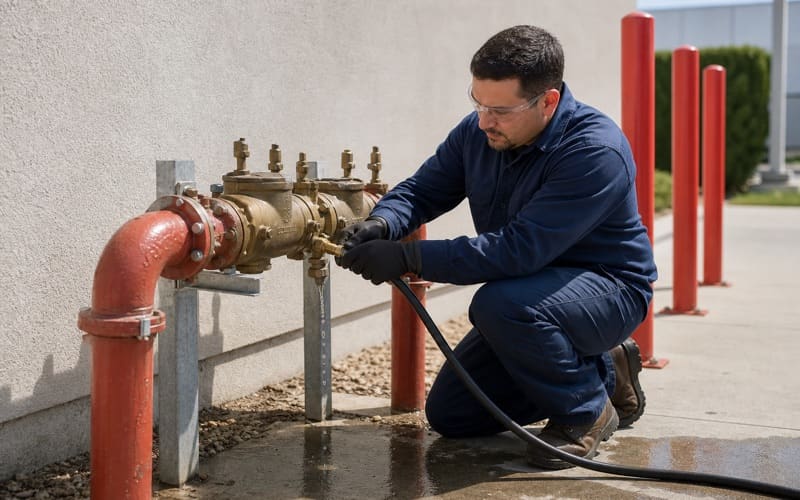
Backflow certification is enforced by the water purveyor rather than the fire authority, which is why it is missed so regularly. A building can be current on every NFPA 25 requirement and still be delinquent on backflow, because the two obligations arrive from different agencies on different notices. Owners frequently learn about the requirement through a delinquency notice rather than through their fire protection vendor, which is an avoidable way to find out. We track backflow certification alongside NFPA 25 intervals so both sit on one schedule, and we perform the certification during the sprinkler visit where timing allows, which means the building takes one impairment rather than two.
Looking for fire suppression closer to San Pedro? See San Pedro Fire Suppression.
Small-City Commercial Property
Hawaiian Gardens is the smallest city in Los Angeles County by area and was incorporated on April 9, 1964. Its population was 14,149 at the 2020 census, down slightly from 14,254 in 2010. A compact municipal footprint concentrates commercial development rather than spreading it across an industrial district, which produces a building stock weighted toward smaller multi-tenant properties, neighborhood retail, and food service. Buildings of that kind change tenants more frequently than large single-occupant facilities, and tenant turnover is the single largest driver of fire protection findings in this market.
Multi-Tenant Buildings and Split Responsibility
Smaller commercial buildings create a split-responsibility structure that causes more compliance trouble than any technical issue. The landlord generally holds the riser, base building sprinkler system, and alarm panel, while tenants hold extinguishers and any suppression equipment inside their suites. That ambiguity tends to persist until an inspection forces the question into the open.
We document findings by suite so responsibility is identifiable rather than disputed, because the fire authority is indifferent to whose obligation a deficiency is — the building is compliant or it is not. Lease structures vary considerably on this point, and a report that separates base building findings from tenant findings gives both parties something actionable. It also prevents the common outcome where a deficiency sits uncorrected for months because the parties are negotiating responsibility rather than addressing the finding, while the correction deadline continues to run. We coordinate access and any shutdown with the landlord and the occupants directly rather than relaying it through one party.
Coverage That Drifts With Turnover
Neighborhood commercial space turns over regularly, and each tenant improvement is an opportunity for coverage to fall out of alignment. New walls create areas the original head layout never contemplated, dropped ceilings leave heads above them protecting nothing, and extinguisher placement stops matching the floor plan. We compare what is installed against the walls standing today and name the areas a change has left short.
Contractors doing that work are also a routine source of damage, painting heads during finish work or striking them during ceiling changes, and neither is typically reported. A painted head cannot be cleaned and returned to service, since the coating interferes with the thermal element it relies on to activate at its rated temperature. Escutcheons and cover plates get mismatched during the same work, and a plate from another manufacturer will not release as listed.
Extinguisher coverage drifts the same way. Requirements are set by hazard classification and maximum travel distance to a unit rather than by floor area, so converting sales floor to stockroom or introducing a hazard the original placement never contemplated changes what the building needs. Units also disappear behind stock and display fixtures as a space fills, and an extinguisher that cannot be reached is not providing protection regardless of its service tag. Travel distance is measured against the route somebody would actually walk, not the straight line across a floor plan.
Establishing a Baseline
Many smaller properties arrive with no usable inspection history, particularly after a change of ownership or management. We establish what systems the building actually has, identify which required intervals appear never to have been performed, and produce a current baseline with a forward schedule. Reconstructing a history that was never kept is slower than maintaining one, and the aim is to stop the paperwork being the problem.
That is more useful than a single compliant year, because it surfaces the long-cycle items nobody has been tracking. Where no record exists of a five-year requirement, we treat it as due rather than assume a previous vendor completed it without documenting it. Smaller properties tend to show a specific pattern of neglect: the annual gets performed because someone invoices for it, while quarterly checks and long-cycle requirements quietly lapse. An inspection history that looks complete at a glance often has gaps once the intervals are laid against each other.
Inspection Records and Correction
Reports Written to Be Used
Each deficiency is documented with a photograph and the code section behind it, so findings are intelligible to an owner reviewing remotely or a manager holding several properties. Severity is separated rather than presented as a flat list, because a painted head and a partially closed control valve are not equivalent problems. Ordering findings by consequence lets an owner act from the report itself rather than arranging a visit to interpret it.
Corrections are priced individually rather than bundled into one figure, which lets an owner clear what is mandatory now and stage the rest across budget cycles. That itemization also makes the quote auditable line by line. It also separates a code obligation from a recommendation, so nothing is funded on the assumption it was compulsory.
Correction Without a Second Vendor
Our crews correct the deficiencies they identify, so an inspection does not end with a referral elsewhere. That removes the gap where a second contractor arrives without context, re-diagnoses findings already documented, bills for the trip, and occasionally disputes the original report. The crew already knows where the riser runs and what the ceiling conceals, which shortens every repair that follows.
For buildings working against a re-inspection date we respond on an emergency basis and sequence the deficiency list so items carrying occupancy consequences clear first. Where a repair requires an impairment, the window is planned and documented rather than improvised. Impairment periods are documented from the moment they begin through the confirmed return to service.
Everything on One Schedule
Sprinklers, extinguishers, alarms, and kitchen suppression run on separate intervals under separate standards, and splitting them across vendors is how requirements fall into the gaps between contracts. We hold all of them, which consolidates the schedule and the records. One provider also means one set of records, which is what an inspector actually asks to see.
Work is scheduled around operating hours so retail suites, offices, and restaurants keep running, with any shutdown coordinated in advance with management and affected tenants rather than announced on arrival. Where an outage will run long enough to require a fire watch, we say so when scheduling rather than on the day.
- Commercial & Industrial Only
- Code-Cited Inspection Reports
- Emergency Impairment Response