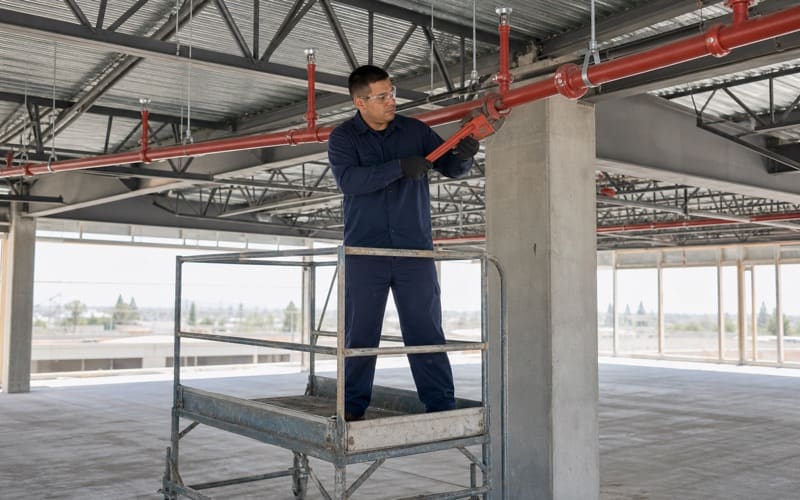
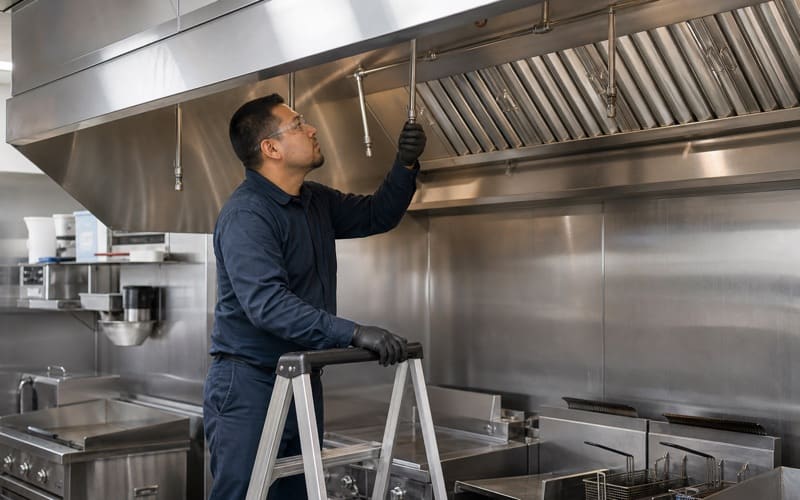
Long Beach Fire Suppression provides commercial fire suppression in La Palma for office buildings, medical and dental practices, retail centers, restaurants, light industrial and flex space, schools, and multifamily property. We install, inspect, service, and repair sprinkler systems, cooking equipment suppression, fire alarms, portable extinguishers, and the backflow assemblies that isolate a fire system from the potable water supply. Everything runs through one provider, so a property carries a single compliance position rather than several partial ones.
Commercial and industrial property is the whole of our practice. The practical benefit is that a technician arriving at a business does not have to reason out how a commercial system differs from a residential one, because hazard classification, occupancy type, storage arrangement, and travel distance to an extinguisher are the terms they work in every day. Recognising a coverage or classification problem on sight is where most of the value in an inspection sits, rather than in confirming that heads are undamaged. No residential work competes for the same technicians, which is also why a booked commercial date holds.
Intervals rather than emergencies generate the work. Water-based systems answer to NFPA 25 for inspection and testing and NFPA 13 for design, cooking equipment to NFPA 96 and NFPA 17A, portable extinguishers to NFPA 10, and detection and notification to NFPA 72, with California enforcing the whole set through its Fire Code and Title 19. We inspect, record each finding against the provision governing it, and complete the corrections ourselves, so closing a single deficiency never depends on two companies agreeing about what a third one wrote down. Recurring due dates are tracked against the property, so an obligation arrives as scheduled work rather than as a notice.
Protecting Office, Medical, and Flex Property
Office and Professional Buildings
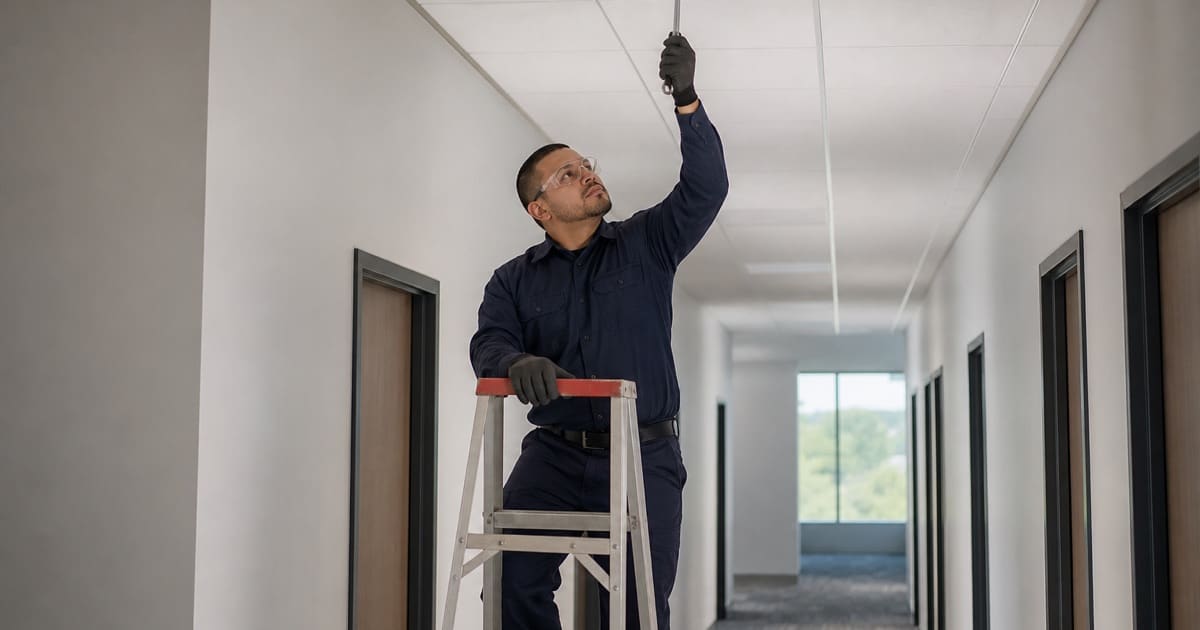
Office property concentrates its fire protection risk in change rather than in inherent hazard, since the occupancies are light but interiors are reconfigured continually. Each build-out is an opportunity for sprinkler coverage to fall behind the floor plan, as new demising walls create areas the original head layout never contemplated and dropped ceilings leave heads stranded above them protecting nothing at all. Extinguisher placement drifts identically, because requirements follow hazard classification and maximum travel distance rather than square footage. Concealed heads painted over during a refit are the cheapest version of this to fix and the one missed most often.
Responsibility usually divides between an owner holding the riser, base building system, and alarm panel and tenants holding whatever sits inside their demised space. We record findings suite by suite so that division stays legible, which matters because a correction deadline runs whether or not the parties have settled who owns the item. A report separating base building findings from tenant findings gives both sides something they can act on without negotiating first. Lease structures vary considerably on this point, and a split report gives both sides something they can act on.
Medical and Dental Facilities
Clinical buildings are judged more strictly on system reliability and on how long protection may be interrupted, and portions of them cannot be taken offline during treatment hours under any arrangement. We sequence these properties in zones agreed with clinical staff rather than proposing one continuous window, accepting that a complete inspection may run across two visits. That is preferable to a rushed pass that skips the areas hardest to access, which are usually the equipment and mechanical spaces where findings actually accumulate. Testing that requires notification appliances to sound is placed in a window agreed with clinical staff beforehand.
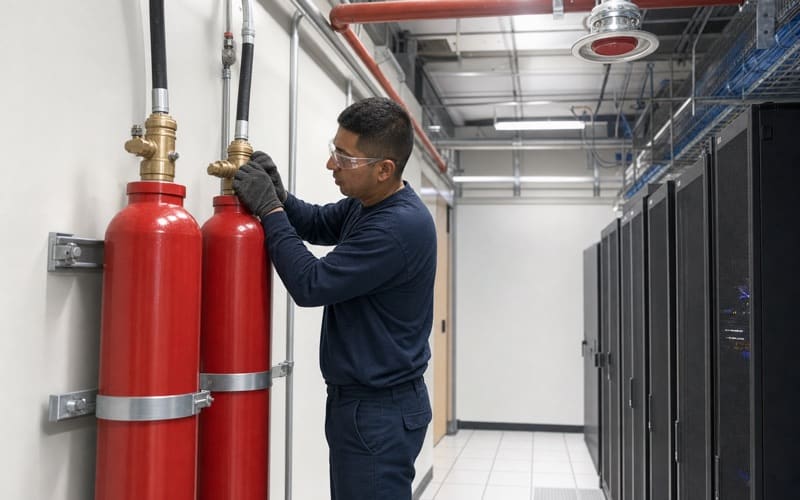
Equipment-dense rooms inside them frequently warrant gaseous protection rather than water, since discharging a sprinkler across imaging or server hardware substitutes one loss for another. Record-keeping carries unusual weight in these buildings, because they are inspected on a predictable cycle and expected to produce current documentation on request rather than assemble it afterward. We record agent quantity, cylinder weights, and detection arrangement so the property has a baseline to test against later.
Light Industrial and Flex Space
Flex buildings combine office frontage with shop or storage behind it, and the two halves rarely share a hazard classification. Sprinkler density, extinguisher type and rating, and travel distance all follow the classification of an area rather than an average taken across a building, so we assess each portion on its own terms. That prevents a compliant front of house from concealing a rear area that stopped matching its own requirements several tenants ago. An office, a shop, and a storage area under one roof are three classifications rather than one averaged across the parcel.
The variable that moves without notice is what a tenant keeps and how high they keep it. A space protected for one commodity class can be materially short for another, and where coverage depends on maintained clearance between the heads and the top of stored goods, stacking into that clearance defeats the design outright while every component remains in perfect working order. Idle pallets and packaging accumulating in a corner belong in the same conversation, and a tenant can usually clear them within the week.
Looking for fire suppression closer to Norwalk? See Fire Suppression Services in Norwalk.
A Small Orange County City
La Palma is a city in northern Orange County with a population of 15,581 at the 2020 census, essentially unchanged from 15,568 in 2010. A city of that size occupying a compact footprint concentrates commercial development rather than spreading it across an industrial district, producing a building stock weighted toward office and business park property, medical and professional suites, neighbourhood retail, and light industrial space rather than large single-occupant facilities. A compact commercial base also means most of what we service sits within a short drive, which keeps small jobs economical.
Smaller Systems, Identical Obligations
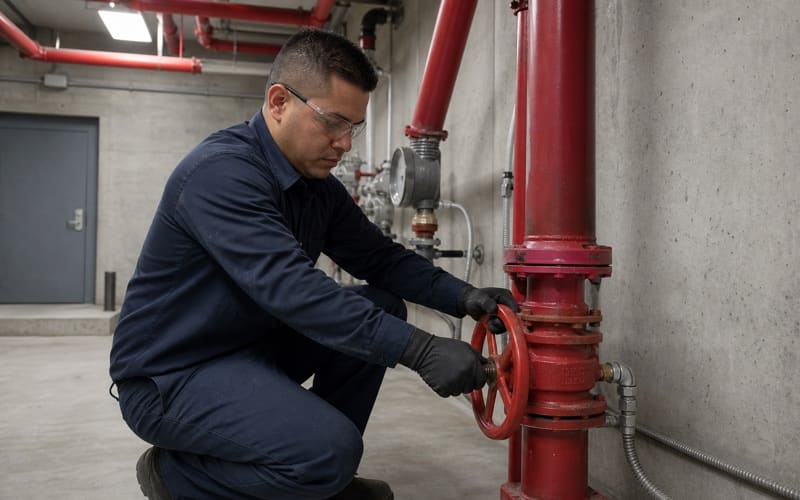
A sprinkler system serving a single-storey commercial building has fewer components than a high-rise riser, but the standard governing it does not change. Every visit begins at the riser, since a system closed at a valve protects nothing however sound the piping above it may be, then moves through main drain testing, waterflow and supervisory device verification, and a walk of the protected area assessing head condition and coverage against the space as it currently exists. Main drain readings are recorded as numbers rather than marked as a pass, because a trend proves what one figure cannot.
Properties at this scale show a characteristic pattern of neglect. The annual gets performed because somebody invoices for it, while quarterly checks and long-cycle requirements quietly lapse, and an inspection history that looks complete at a glance turns out to have gaps once the intervals are laid against each other. The five-year internal obstruction investigation applies here as fully as anywhere, and in smaller buildings it is the requirement most likely never to have been performed at all. Nothing about a compact riser in a tidy mechanical closet signals that an internal inspection is overdue, and five years comfortably exceeds how long many small businesses hold one address.
Coverage That Drifts With Turnover
Commercial space of this kind turns over regularly, and each tenant improvement is an opportunity for protection to fall behind the room it serves. Walls move, ceilings are added, racking is relocated, and head spacing does not follow any of it. Extinguisher placement stops matching a floor plan that has been reorganised around it, and units disappear behind stock and fixtures as a space fills up. Ceiling changes cause the quieter version of the same problem, since a dropped ceiling can strand a head above the space it serves.
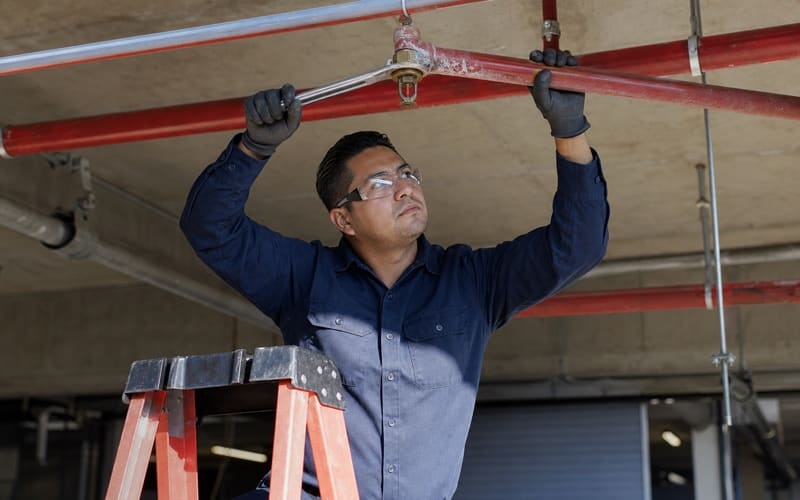
Contractors performing that work are themselves a routine source of damage, painting heads during finish work or striking them during ceiling changes, and neither is typically reported to anyone afterward. A painted head cannot be cleaned and returned to service, because the coating interferes with the thermal element it relies on to activate at its rated temperature, so the unit is replaced rather than restored. Ceiling work is worth flagging to us before it starts rather than after, because relocating a head during a build-out costs a fraction of correcting the coverage afterward. We note where recent work has disturbed the system, so responsibility can be established while the job is still fresh.
Backflow and Obligations From Other Agencies
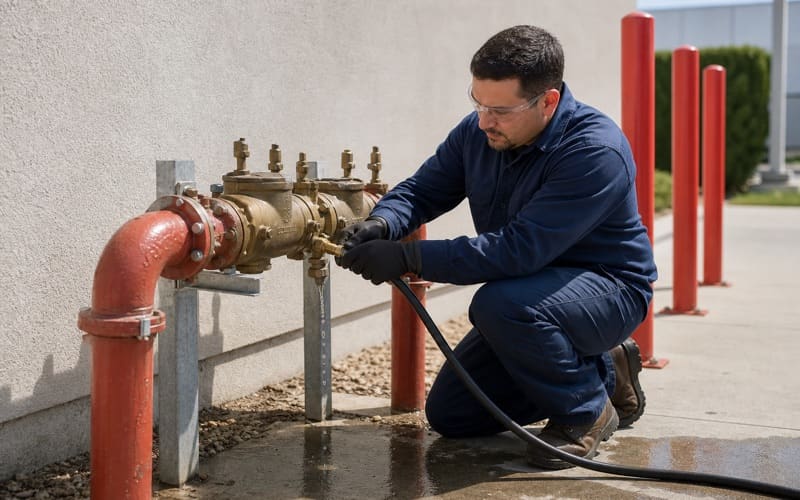
Backflow assemblies isolating a sprinkler system from the potable supply are certified on the water purveyor’s schedule rather than the fire authority’s, which is precisely why buildings lose track of them. A property can satisfy every requirement in NFPA 25 and still be delinquent, because the two obligations originate with different agencies and arrive as different letters to different people. Devices sitting outdoors in an enclosure age faster than the replacement interval assumes, and an enclosure rusted shut blocks testing entirely.
We track that certification alongside the NFPA 25 intervals so both sit on one schedule, and we perform it during the sprinkler visit where timing allows. Beyond the administrative convenience, that means the building takes one impairment rather than two, which matters more in occupied property than the scheduling does. Where a device is past the point of being worth rebuilding, we say so rather than passing it for another year.
Records, Correction, and Response
Establishing What Is Owed
The standard attaches its intervals to components rather than to buildings, which is why a single annual visit leaves most properties carrying obligations they are unaware of. We set the applicable intervals against the equipment actually installed, review whatever history exists, and name the gaps rather than assuming a predecessor closed them quietly. Where no record exists of a five-year requirement, we treat it as due, and we hold the schedule against the property so a change of ownership does not reset it. Nothing about a riser announces that an internal inspection is overdue, and five years outlasts most people’s time at one building.
Reporting That Distinguishes Consequence
Each deficiency carries a photograph and the governing code provision, ordered by consequence so a partially closed control valve never appears beside a cosmetic observation as though the two were equivalent. That ordering is what allows an owner holding several properties to act from the report itself rather than arranging a visit to interpret it. Corrections are priced individually instead of arriving as one figure, making it possible to release compulsory work immediately and schedule the balance deliberately against a budget. Every line traces back to the finding that produced it, so nothing in the total is left unaccounted for.
Repairs and Urgent Situations
Whoever performs the inspection performs the corrections, which removes the sequence in which a second firm arrives without context, re-examines what has already been examined, and invoices for reaching the same conclusion. Buildings working against a re-inspection date move ahead of routine scheduling, with the list ordered so anything bearing on occupancy clears first. Repairs therefore begin from firsthand knowledge of the building rather than a second diagnosis billed before anything is fixed.
Work requiring a shutdown is arranged with management beforehand, held to the smallest practical area, and documented as the code expects. Where a complete repair will run long, the unaffected portion of the system returns to service rather than an entire building sitting unprotected while one section is addressed. The return to full service is confirmed in writing, which is what an owner needs if the period is ever questioned.
- Commercial & Industrial Only
- Code-Cited Inspection Reports
- Emergency Impairment Response