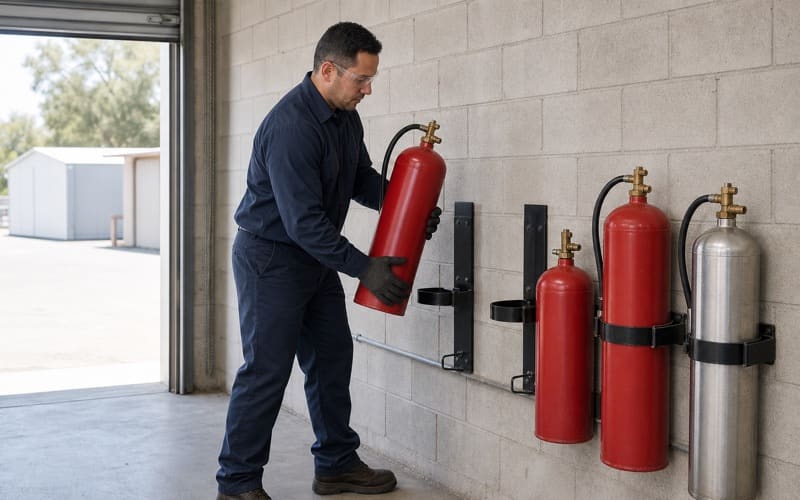
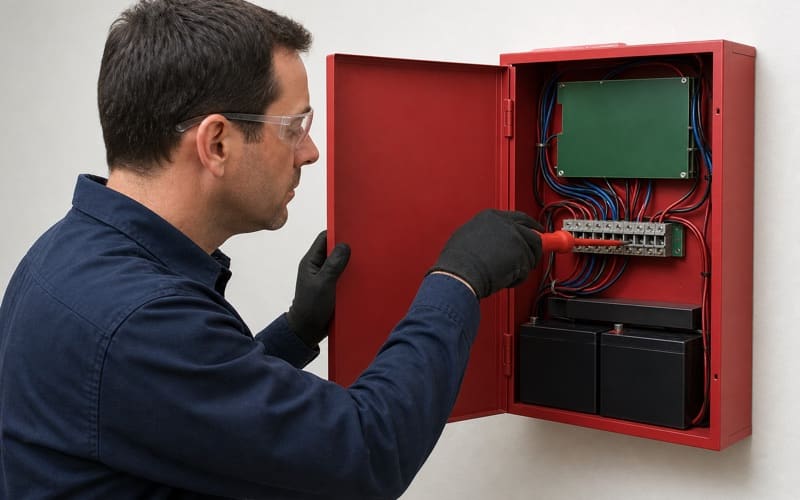
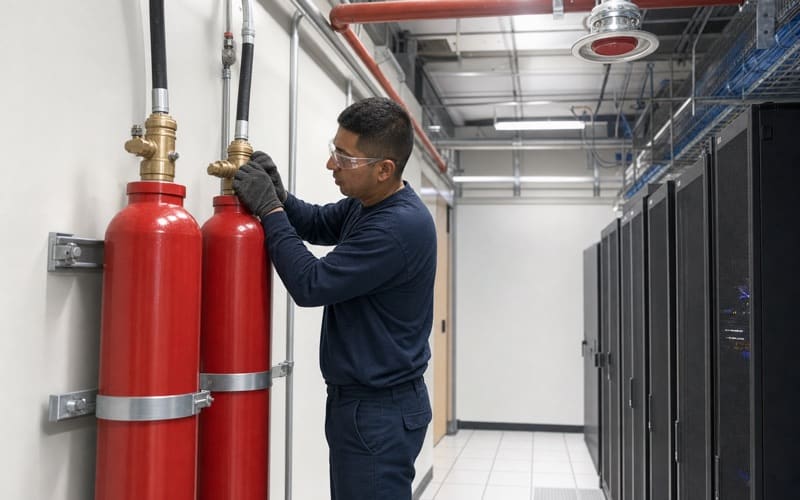
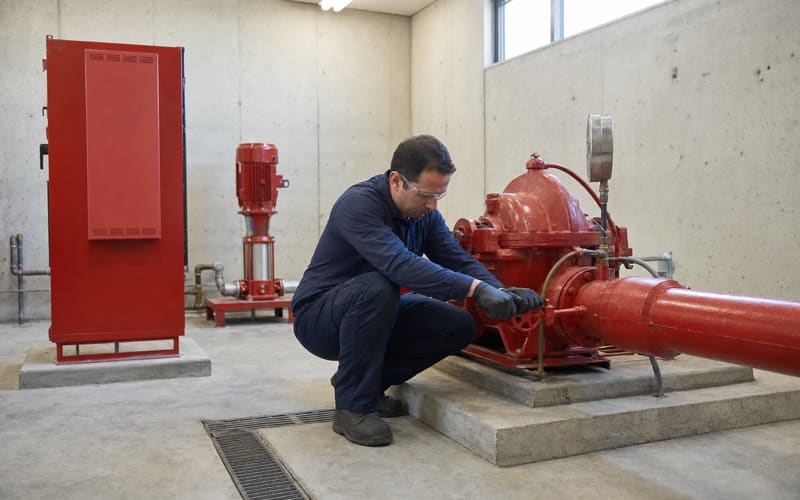
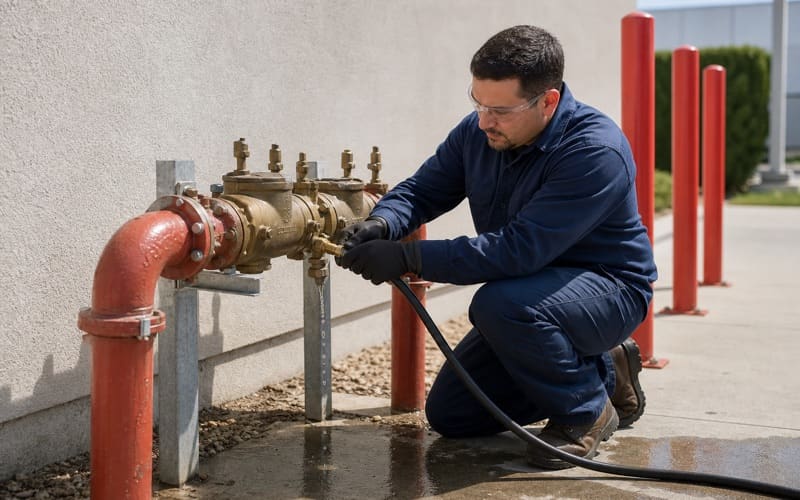
Long Beach Fire Suppression provides commercial fire suppression in Lakewood for retail centers, restaurants, offices, medical suites, schools, apartment properties, and light industrial buildings. We install, inspect, service, and repair sprinkler systems, kitchen hood suppression, fire alarms, portable extinguishers, fire pumps, and backflow assemblies.
Everything we do is commercial and industrial. Keeping residential work off the schedule means our crews stay in the building types and system types they handle daily, and it means the parts on the truck match the equipment in front of them. A retail sprinkler riser, a restaurant hood line, and an apartment building’s garage dry system are three different problems, and none of them resemble a house.
The work is driven by compliance deadlines more than by failures. NFPA 25 sets inspection and testing intervals for water-based systems, NFPA 96 and NFPA 17A govern commercial kitchen suppression, NFPA 10 covers portable extinguishers, and NFPA 72 covers alarms. The California Fire Code and Title 19 put all of it behind an inspection with real consequences. We perform the inspection, document what we find, and correct the deficiencies, so the compliance record and the repair work stay in one place rather than splitting across separate vendors with separate schedules and separate paperwork.
Fire Protection for Retail and Commercial Centers
Multi-Tenant Retail Properties
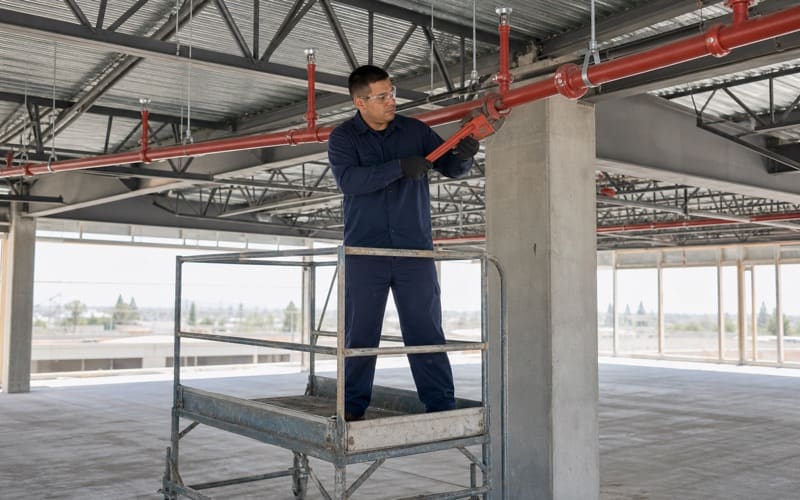
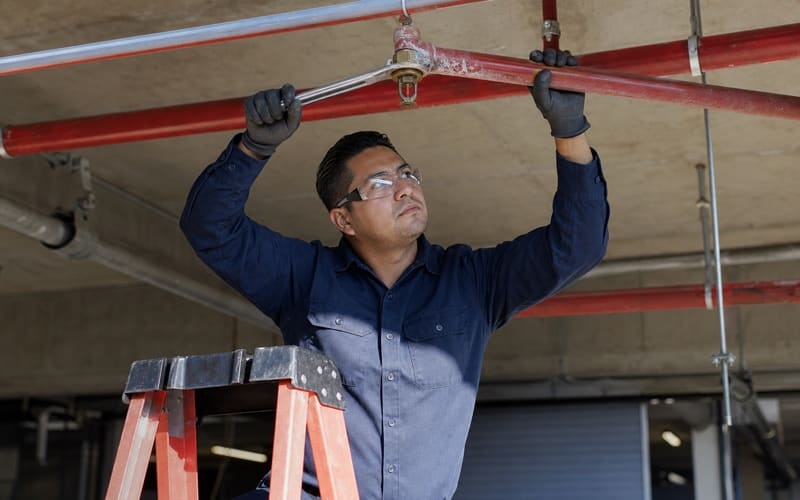
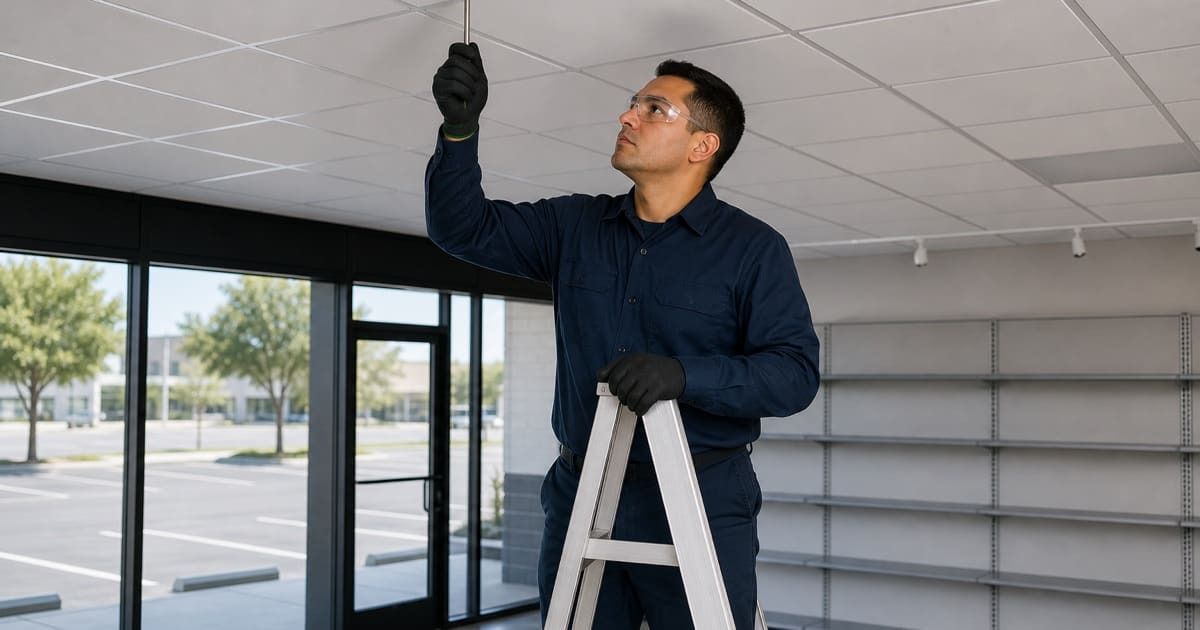
Retail centers create a split-responsibility structure that causes more compliance problems than any technical issue. The landlord generally owns the riser, the base building sprinkler system, the fire pump if there is one, and the alarm panel, while individual tenants own the extinguishers and any suppression equipment inside their suites. We work across both and document findings by suite so responsibility is identifiable rather than disputed. That distinction matters because the fire authority is indifferent to whose obligation a deficiency is — the building is either compliant or it is not. Tenant improvements are the usual source of findings, since new walls, dropped ceilings, and reconfigured layouts routinely leave sprinkler coverage that no longer matches the space beneath it. Contractors performing that work also damage heads regularly, painting them during finish work or striking them during ceiling changes, and neither is typically reported to anyone.
Restaurants and Food Service Tenants
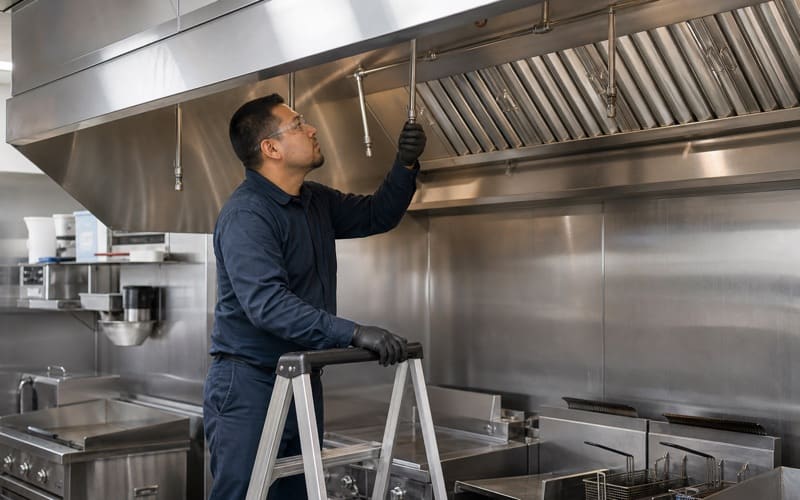
Any tenant cooking under a hood carries a wet chemical suppression system requiring service roughly twice a year, the shortest interval of any system in a commercial building. We service and recharge Ansul R-102 and Pyro-Chem systems, replace fusible links on schedule, verify detection cable travel, and test the gas shutoff, electrical interlock, and manual pull station as a functioning sequence rather than as separate components. Nozzle alignment is checked against the appliance line as it currently sits, because kitchens rearrange equipment constantly and a system that was compliant at installation can be out of coverage a year later without anyone having touched it. Duct and plenum nozzles get the same attention as the ones over the appliances, since a grease fire reaching the duct is the scenario most likely to leave the kitchen and involve the rest of the building.
Offices, Medical Suites, and Service Businesses
Professional and clinical tenants carry lighter hazard classifications but identical inspection obligations. Sprinkler coverage, extinguisher placement and type, alarm device function, and documentation all apply regardless of how quiet the occupancy is. Medical and dental suites add a scheduling constraint, since some areas cannot be taken offline during patient hours, and they often contain equipment or server spaces where clean agent protection is more appropriate than water. We plan these buildings zone by zone rather than as a single visit, and we schedule testing around clinical hours rather than imposing a window on them.
Extinguisher placement is where these suites most often fall short, since coverage follows hazard classification and maximum travel distance rather than the size of the unit. A suite subdivided into private offices can push the travel distance past what the original placement allowed without anyone adding a single hazard. We check that against the floor plan as it currently stands and identify where a unit has been moved, obstructed, or quietly removed during a refit.
Looking for fire suppression closer to Wilmington? See Fire Suppression in Wilmington.
A Post-War Suburb and Its Building Stock
Lakewood is a suburban city in Los Angeles County with a population of 82,496 at the 2020 census. It is bordered by Long Beach on the west, northwest, and south, Bellflower on the north, Cerritos on the northeast, Cypress on the east, and Hawaiian Gardens on the southeast. That position makes it a dense commercial market rather than an industrial one, and the building stock reflects it — shopping centers, strip retail, professional buildings, schools, and multifamily properties rather than large distribution facilities.
Older Systems and Accumulated Modifications
Commercial buildings that have been in service for decades carry fire protection systems that have been extended, modified, and repaired repeatedly, often by different contractors with varying documentation. The practical consequence is that as-built drawings frequently do not match the installed system, and unpermitted modifications are common. We inspect against actual conditions rather than the paperwork, and where we find work that was never submitted for approval we say so, because it will surface at the next inspection regardless of who performed it. Older systems also accumulate internal corrosion and scale that restrict flow without producing any visible exterior sign, which is precisely what the five-year internal obstruction investigation exists to detect.
Multifamily and Mixed-Use Properties
Apartment properties combine dwelling unit sprinkler coverage with commercial requirements in corridors, garages, trash rooms, laundry facilities, and amenity spaces, each carrying different requirements. Parking structures commonly use dry pipe systems that need air pressure monitoring and low-point drainage attention that wet systems do not. Trash and recycling rooms produce recurring findings, since they combine a genuine ignition risk with heads that are easy to obstruct. Unit access is usually the hardest part of the work rather than the technical task itself, so we coordinate with property management well ahead of the visit rather than arriving and improvising.
Schools and Institutional Properties
Educational facilities combine classrooms, kitchens, shops, labs, and assembly spaces under shared alarm infrastructure, with different suppression needs in each. We schedule inspections and corrective work around academic calendars, concentrating disruptive testing into breaks and off-hours. Shop and lab areas frequently need extinguisher types beyond the standard ABC units distributed through the rest of a campus, and because campuses accumulate buildings over decades, system age varies widely across one site with findings clustering in the oldest structures.
Inspection Intervals, Records, and Correction
Establishing What Is Actually Due
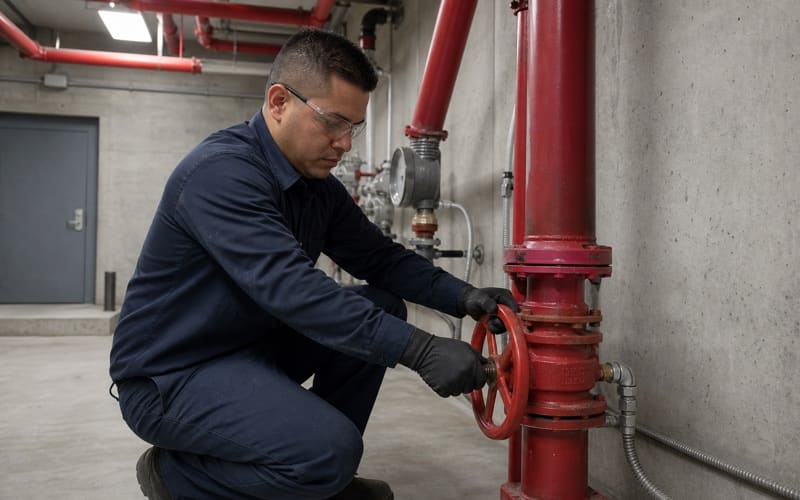
NFPA 25 is not a single annual event, and treating it as one is the most common compliance gap we encounter. Requirements run on quarterly, semi-annual, annual, and five-year cycles depending on the component, so a property that has only ever had an annual visit is almost certainly carrying uncompleted items it does not know about. We establish which intervals apply to the specific systems present, review whatever prior records exist, and identify requirements that appear never to have been performed. Where no record exists of a five-year item, we treat it as due rather than assuming a previous vendor completed it without documenting it. The obligation sits with the building owner regardless of who occupies the space, and it transfers with the property when it changes hands even though the records frequently do not.
Reports That Support a Decision
Every deficiency is documented with a photograph and the code section behind it, so a finding is intelligible to an owner who was not on site and to a manager comparing several properties. Findings are separated by severity, because a painted sprinkler head and a partially closed control valve are not equivalent problems. Corrections are priced individually rather than bundled into a single figure, which lets an owner clear what must be corrected immediately and stage the remainder against budget cycles. That itemization also makes a quote auditable, since you can see what each item costs and why it was written up.
For an owner holding several properties, consistency across those reports is worth as much as the detail inside any one of them. Findings described in the same terms and ranked on the same scale let a portfolio be compared rather than merely filed, which is what makes it possible to direct a limited maintenance budget at the building that genuinely needs it rather than the one that complained most recently.
Correction Without a Handoff
The crew that performs the inspection performs the repairs. That eliminates the gap where a second contractor arrives without context, re-diagnoses findings already diagnosed, bills for the trip, and occasionally disputes the original report. For properties that have failed an inspection and are working against a re-inspection date, we respond on an emergency basis and sequence the deficiency list so items carrying occupancy consequences clear first. Where a repair requires a system to be impaired, we plan and document the window with property management, limit it to the affected area, and restore protection as soon as the work allows rather than leaving a building unprotected overnight for scheduling convenience.
Working Around an Operating Property
Scheduling That Keeps Tenants Open
Retail suites, restaurants, and offices all lose revenue when they close, and fire protection work rarely requires it. We schedule around operating hours, servicing kitchen systems between service periods and performing riser, main drain, and waterflow testing before a center opens. Where a system must be taken out of service, the window is planned in advance rather than announced on arrival, and it is limited to the affected area rather than applied to the whole property. In multi-tenant buildings, notice given a week ahead prevents nearly every scheduling conflict that would otherwise turn a routine visit into a return trip.
Impairment Handling
Taking a system offline carries code obligations rather than just inconvenience. Impairments must be managed, communicated, and documented, and depending on duration and occupancy, interim protective measures may be required. We handle that process rather than leaving it to the owner, coordinating with property management and affected tenants so everyone knows which area is unprotected and when protection returns. Proper documentation matters most in the situation nobody plans for, which is an incident occurring while a system is down.
One Provider Across Every System
Sprinklers, extinguishers, kitchen suppression, and alarms run on separate intervals under separate standards, and splitting them across vendors is how requirements fall into the gaps between contracts. We hold all of them, which consolidates the schedule and the records and means the interfaces get verified — a waterflow switch reporting to an alarm panel, or a hood system tripping a gas valve, otherwise sits between two companies with neither owning it. Operators with several properties get sites grouped where geography allows, which keeps mobilization charges down and keeps compliance visible across a portfolio rather than scattered across individual invoices.
- Commercial & Industrial Only
- Code-Cited Inspection Reports
- Emergency Impairment Response