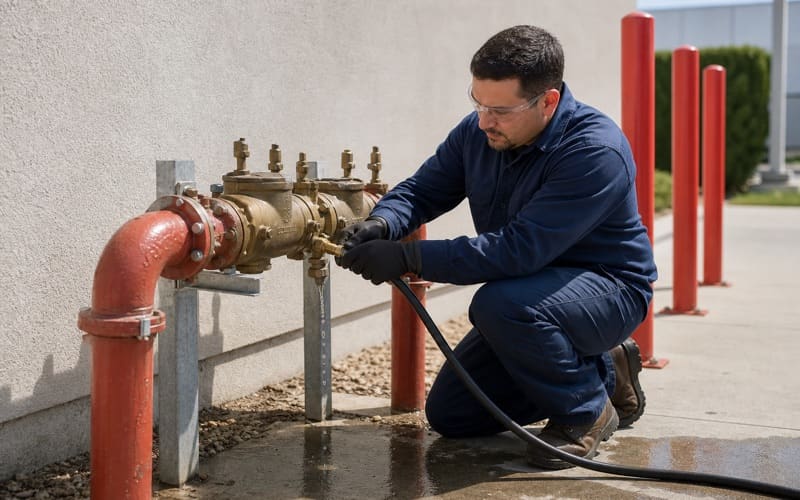
Long Beach Fire Suppression provides commercial fire suppression in Lomita for retail buildings, restaurants, automotive service facilities, medical and dental practices, professional offices, small industrial and shop space, and multifamily property. We install, inspect, service, and repair sprinkler systems, cooking equipment suppression, fire alarms, portable extinguishers, and backflow assemblies. Everything runs through one provider, which leaves a building with a single deficiency list instead of several partial ones.
We take commercial and industrial property exclusively. In a market built largely around smaller buildings and independent operators, that focus matters in a particular way: small commercial property is the kind most often handled as an afterthought by vendors whose schedules are organised around large accounts, and it carries identical obligations regardless of its size. A four-suite building and a distribution centre are inspected against the same standards for whatever systems they contain. Intervals do not scale down with square footage, and the obligation sits with the owner regardless of the building’s size.
Intervals rather than incidents generate the work. Water-based systems answer to NFPA 25 for inspection and testing and NFPA 13 for design, cooking equipment to NFPA 96 and NFPA 17A, extinguishers to NFPA 10, and alarms to NFPA 72, enforced in California through the Fire Code and Title 19. We inspect, document each finding against the provision that governs it, and carry out the corrections ourselves, which keeps a single deficiency from becoming a negotiation between two companies. We track the recurring due dates as well, so an annual does not quietly slip past its month unnoticed.
Fire Protection for Small Commercial Property
Smaller Systems, Identical Obligations
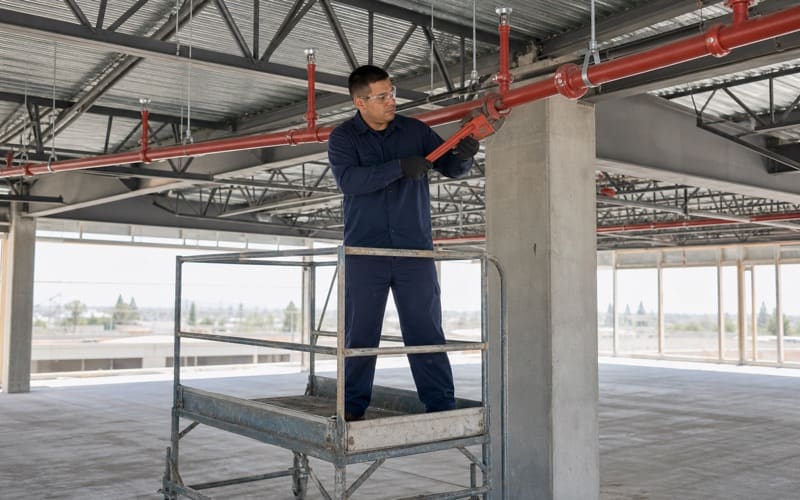
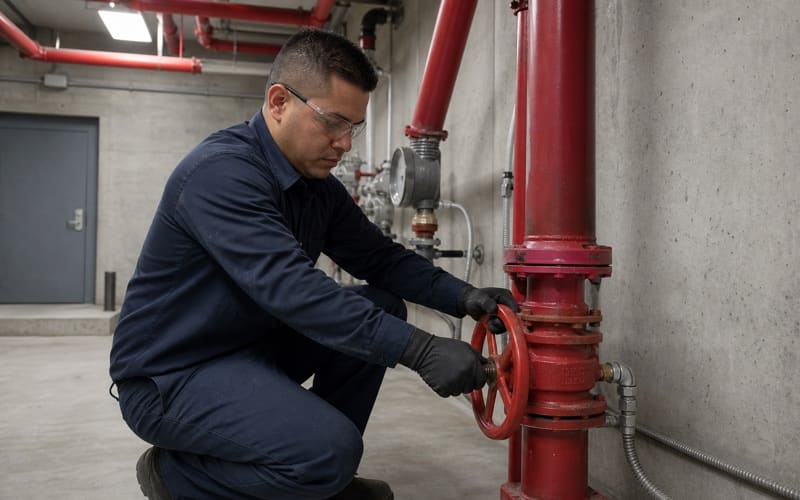
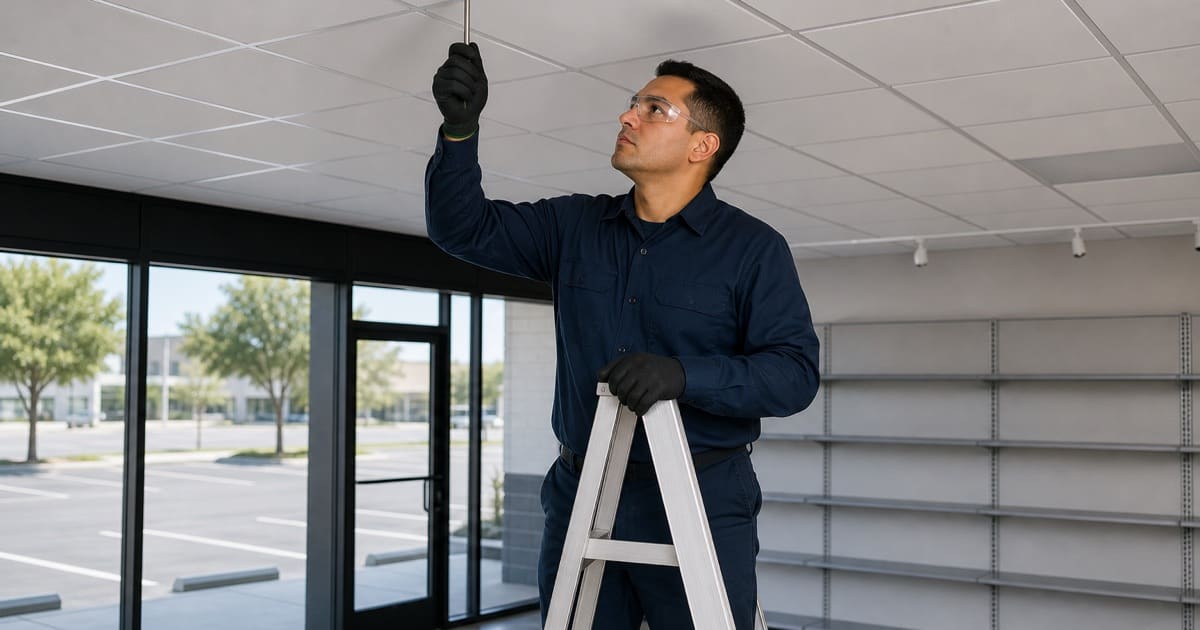
A sprinkler system serving a single-storey commercial building has fewer components than a high-rise riser, but the standard governing it does not change. Every visit begins at the riser, since a system closed at a valve protects nothing however sound the piping above it, then moves through main drain testing, waterflow and supervisory device verification, and a walk of the protected area assessing head condition and coverage against the space as it currently exists. Main drain readings are recorded as numbers rather than marked as a pass, because a trend proves what one figure cannot.
Properties of this scale tend to show a characteristic pattern of neglect. The annual gets performed because someone invoices for it, while quarterly checks and long-cycle requirements quietly lapse, and an inspection history that looks complete at a glance turns out to have gaps once the intervals are laid against each other. The five-year internal obstruction investigation applies here as fully as anywhere, and in smaller buildings it is the requirement most likely never to have been performed at all. Nothing about a compact riser in a tidy mechanical closet signals that an internal inspection is overdue, and five years comfortably exceeds how long many small businesses occupy one address.
Automotive and Shop Space
Service bays bring flammable liquids, hot work, and vehicles together under one roof and typically require more extinguisher coverage than their floor area suggests, with spray and paint operations treated as a distinct hazard warranting dedicated protection rather than absorption into general shop coverage. Parts storage introduces a separate question, since commodity classification rather than shelf count determines what a sprinkler system has to deliver over it. Paint and spray work is treated as a hazard in its own right rather than absorbed into a shop’s general protection.
We classify area by area rather than averaging across a building, which prevents a compliant customer-facing space from concealing a work area that stopped matching its own requirements. Vehicle and equipment traffic also damages heads and exposed piping regularly, and where one location takes repeated damage the durable answer is a guard or a relocation rather than another identical replacement that simply books the next repair. Compressed air lines, lifts, and overhead doors all compete for the same ceiling space as sprinkler piping, and work on any of them is a common source of disturbed hangers and bent drops that nobody thinks to report afterward. A compliant customer-facing area regularly conceals a rear space that stopped matching its own requirements several tenants ago.
Restaurants and Food Service
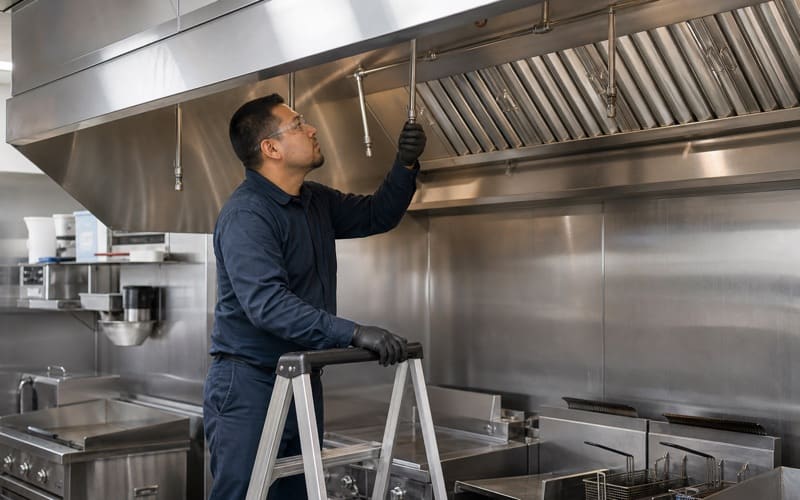
Cooking equipment suppression runs on the shortest interval of anything we service, generally twice yearly. Each visit covers cylinder charge and condition, nozzle position against the appliance line as it currently stands, blow-off caps, fusible link replacement, detection cable travel through its pulleys and conduit, and functional testing of the fuel shutoff, electrical interlock, and manual pull station as one working sequence rather than as separate components. Ansul R-102 and Pyro-Chem units make up most of what is installed here, and each carries its own service particulars.
Nozzle position is the finding that recurs everywhere, because independent kitchens replace and relocate appliances far more often than anyone reviews the system above them, and coverage engineered around one lineup stops matching a different one. Duct and plenum nozzles deserve equal attention, since a fire travelling into the duct is how a contained kitchen incident stops being contained. A Class K extinguisher is required alongside the hood system and must be reachable without passing the cook line. Cylinders additionally carry hydrostatic testing on a longer cycle entirely separate from the semi-annual visit, and those dates lapse more dependably than any other kitchen requirement because nothing about the system indicates they are due. We track them against the equipment rather than against the building.
Looking for fire suppression closer to La Palma? See Fire Suppression in La Palma.
A Compact South Bay City
Lomita had a population of 20,921 at the 2020 census, up slightly from 20,256 in 2010. A city of that size occupying a small footprint concentrates its commercial development rather than spreading it across an industrial district, producing a building stock weighted toward smaller multi-tenant property, independent businesses, automotive and service trades, and food service rather than large single-occupant facilities. A compact commercial base also means most of what we service sits within a short drive, which keeps smaller jobs economical.
Multi-Tenant Buildings and Divided Responsibility
Smaller commercial buildings create a split-responsibility structure that causes more compliance trouble than any technical problem does. An owner typically holds the riser, base building system, and alarm panel, while tenants hold extinguishers and whatever suppression equipment sits inside their demised space, and lease structures vary considerably on where the line falls. That ambiguity tends to persist until an inspection forces the question into the open and a deadline starts running.
We record findings suite by suite so responsibility stays legible, because the fire authority is indifferent to whose obligation an item is — a building is compliant or it is not, and a correction deadline runs while the parties are still discussing it. A report separating base building findings from tenant findings gives both sides something actionable without requiring them to agree first. It also prevents the common stalemate in which a straightforward deficiency sits uncorrected for months while ownership of it is negotiated, and the correction deadline continues running throughout regardless of who eventually pays. We coordinate access and any shutdown with the owner and the occupants directly rather than relaying it through one party.
Coverage That Drifts With Turnover
Commercial space at this scale turns over regularly, and each build-out is an opportunity for protection to fall behind the floor plan. New demising walls create areas the original head layout never contemplated, dropped ceilings leave heads stranded above them protecting nothing, and extinguisher placement stops matching a room that has been reconfigured around it. Concealed heads painted over during a refit are the cheapest version of this to correct and the one missed most often.
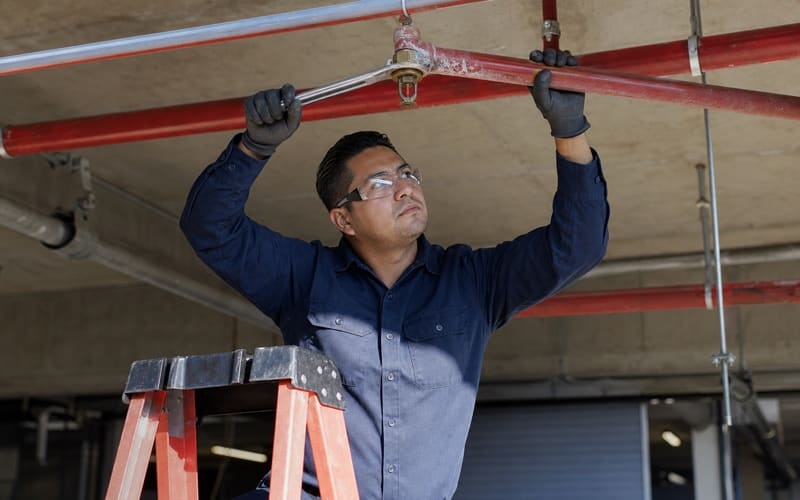
Contractors performing that work are themselves a routine source of damage, painting heads during finish work or striking them during ceiling changes, and neither is typically reported to anyone. A painted head cannot be cleaned and returned to service, because the coating interferes with the thermal element it relies on to activate at its rated temperature, so the unit is replaced rather than restored. Extinguisher coverage drifts along the same path, since requirements follow hazard classification and maximum travel distance rather than floor area, and converting retail floor to stockroom changes what a building needs without anything visibly happening. Ceiling work is worth flagging to us before it starts, since relocating a head costs a fraction of correcting coverage afterward.
Marine Air and Corrosion
Proximity to the coast affects fire protection hardware in ways properties further inland do not share. Exposed piping, hangers, heads, fire department connections, and backflow assemblies deteriorate measurably faster here, which means a corrosion finding carries a shorter timeline than the same observation would elsewhere and warrants correction rather than monitoring. Fire department connections deserve particular attention, since caps corrode into place and seized threads give no warning at all.
External corrosion is at least visible during an inspection. The more consequential problem is internal, where corrosion products and scale restrict flow without producing any exterior sign at all, and older systems extended piecemeal over the years accumulate it fastest where dissimilar metals meet and stagnant branch lines sit undisturbed. That is exactly the condition the five-year internal obstruction investigation exists to detect, and coastal properties reach the point where it matters sooner than their inland equivalents do. Opening the system at the prescribed points is the only reliable way to establish what has accumulated inside the pipe.
Records, Correction, and Response
Establishing a Baseline
Many smaller properties arrive with no usable inspection history, particularly following a change of ownership or management company. We establish what systems the building actually contains, identify which required intervals appear never to have been performed, and produce a current baseline with a forward schedule, which is considerably more useful than a single compliant year. Reconstructing a history that was never kept is slower than maintaining one, and the aim is to stop the paperwork being the problem.
Where no record exists of a five-year requirement, we treat it as due rather than assume a predecessor completed it without documenting it. The obligation itself belongs to the building owner and transfers with the property, which regularly catches new owners whose inspection records did not arrive with the purchase. Records rarely travel with a sale, which regularly catches new owners who assumed the file came with the building.
Reporting and Correction
Every deficiency carries a photograph and the code provision behind it, sorted by consequence so urgent items are distinguishable from minor ones without a phone call. Corrections are priced individually rather than bundled into a single figure, which lets an owner release what is compulsory now and schedule the remainder against a budget, and it leaves nothing in the quote unexplained. It also separates a code obligation from a recommendation, so nothing is funded on the assumption that it was compulsory.
Whoever inspects also corrects, removing the sequence in which a second firm arrives without context, re-examines what has already been examined, and invoices for reaching the same conclusion. Properties working against a re-inspection date move ahead of routine scheduling, ordered so anything bearing on occupancy clears first, and any shutdown is arranged with management beforehand and held to the smallest workable area. Impairment periods are documented from the moment they begin through the confirmed return to full service.
- Commercial & Industrial Only
- Code-Cited Inspection Reports
- Emergency Impairment Response