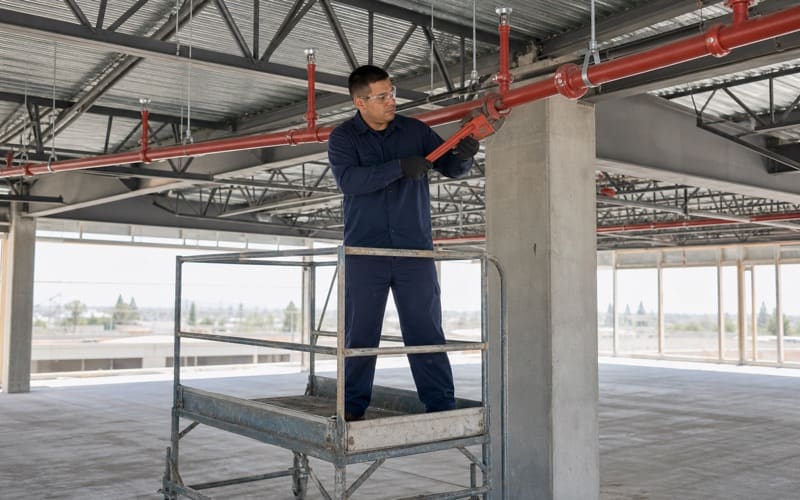
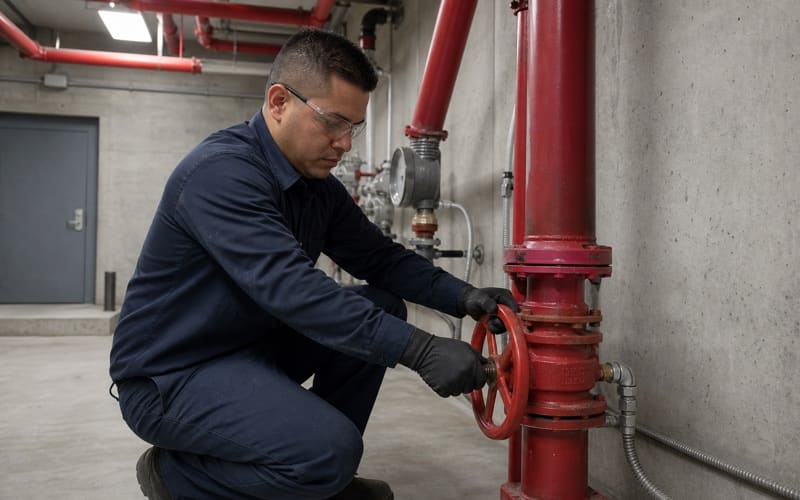
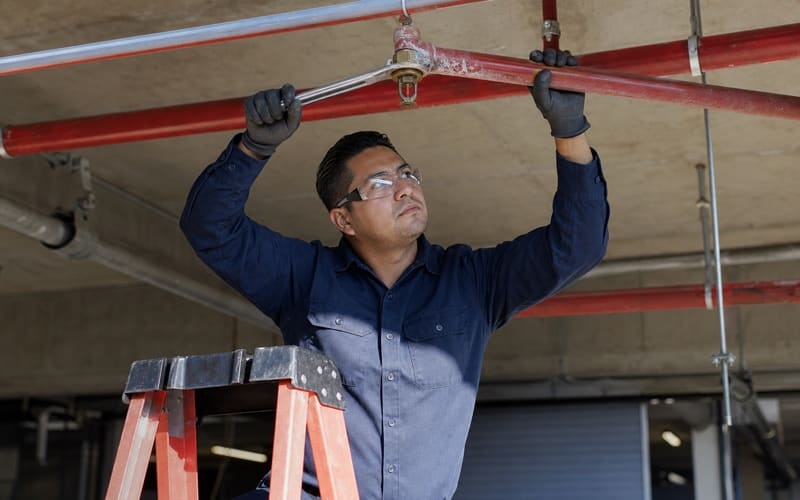
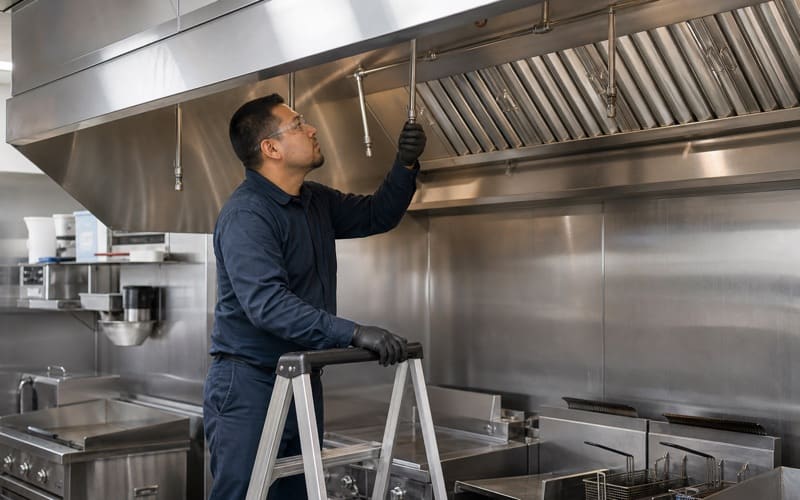
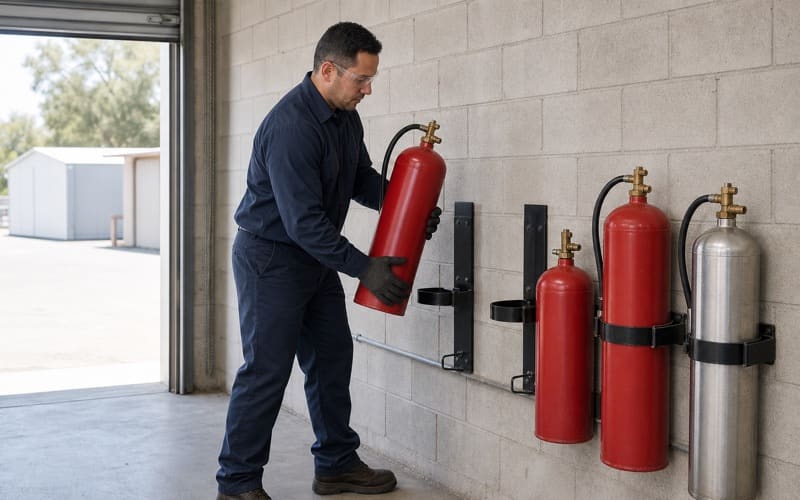
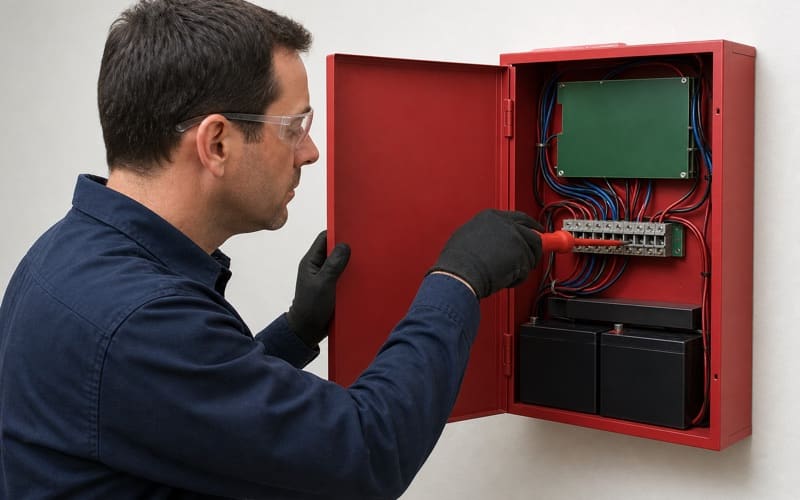
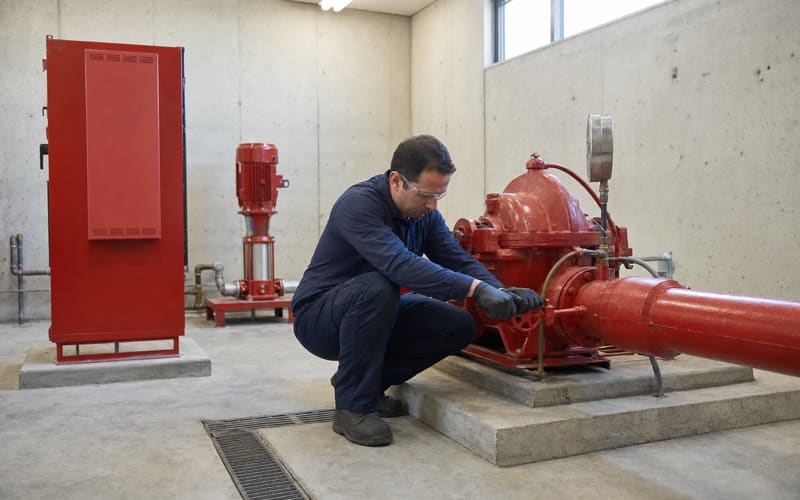
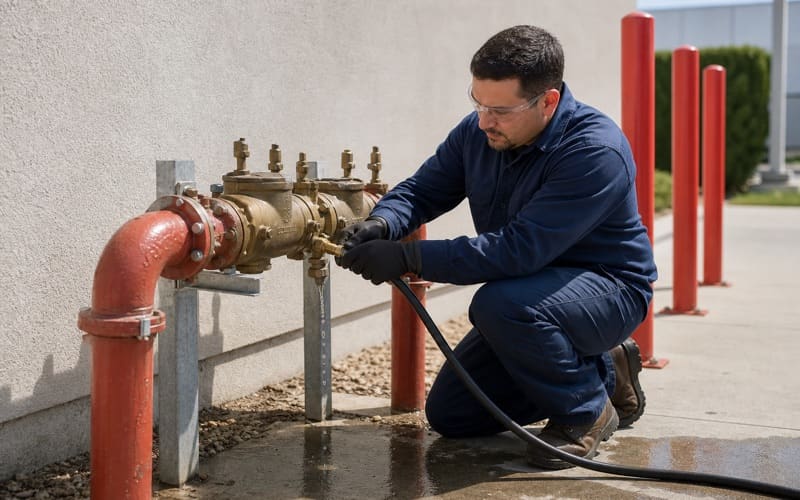
Long Beach Fire Suppression provides commercial fire suppression in Los Alamitos for medical and outpatient facilities, retail centers, restaurants, professional offices, light industrial buildings, and institutional properties. We install, inspect, service, and repair sprinkler systems, kitchen hood suppression, fire alarms, portable extinguishers, fire pumps, and backflow assemblies.
We handle commercial and industrial properties only. That focus means crews arrive familiar with the systems a business property carries rather than treating a commercial building as a scaled-up house, and the difference shows up immediately in how a mixed-occupancy building gets assessed. Hazard classification, storage arrangement, and process all drive commercial requirements in ways that have no residential equivalent.
The work is compliance-driven. NFPA 25 sets inspection and testing intervals for water-based systems, NFPA 13 governs their design, NFPA 96 and NFPA 17A cover kitchen suppression, NFPA 10 covers extinguishers, and NFPA 72 covers alarms. The California Fire Code and Title 19 place all of it behind an enforced inspection. We perform the inspection, document what we find, and correct the deficiencies, so compliance and repair remain in one scope.
Fire Protection by Property Type
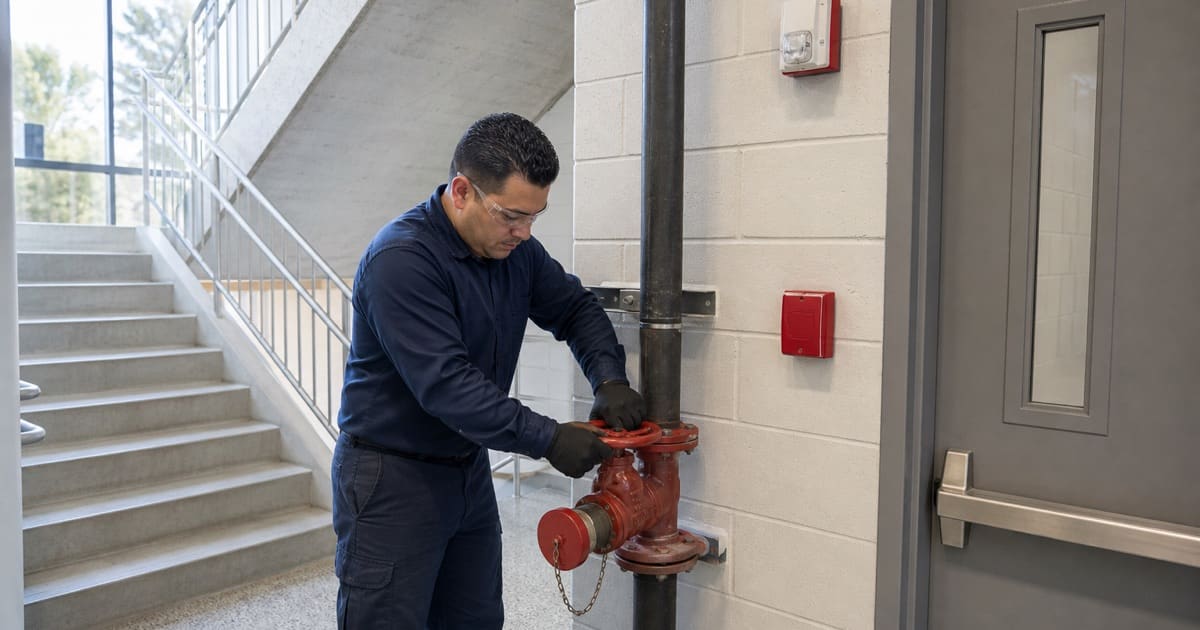
Medical and Outpatient Facilities
Healthcare occupancies are held to stricter expectations for system reliability and for how long protection may be impaired, and some areas cannot be taken offline during patient hours at all. We schedule testing around clinical hours and plan these buildings zone by zone rather than as a single visit, using interim measures where a system genuinely has to be impaired. Imaging suites, server closets, and equipment rooms in these facilities are often better protected by clean agent than by water, since a sprinkler discharge over equipment causes its own substantial loss. Documentation is as important as the equipment here, because these properties are inspected on a predictable cycle and are expected to produce current records on request rather than assemble them afterward.
Outpatient and surgical spaces add their own constraints, since procedure areas cannot be interrupted and recovery areas cannot be evacuated for convenience. We work these buildings in stages agreed with clinical management rather than proposing a single window, and we accept that a full inspection may span more than one visit. That is preferable to the alternative, which is a rushed visit that skips the areas hardest to access — and those are usually the equipment and mechanical spaces where findings actually accumulate.
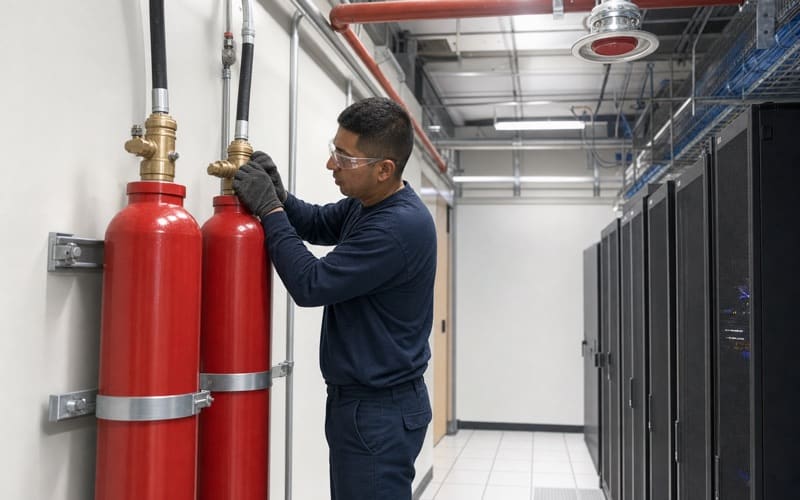
Equipment-dense rooms inside these buildings frequently warrant gaseous protection rather than water, since discharging a sprinkler across imaging or server hardware trades one loss for another. Where such a system exists we inspect it on its own terms, checking agent quantity, cylinder weights, the detection and release sequence, and whether door closures and dampers still operate as the design assumed. Room integrity is the part that degrades quietly, since every cable penetration added since commissioning works against the concentration the system needs to hold.
Retail, Restaurants, and Professional Offices
Multi-tenant commercial buildings split responsibility between the landlord, who typically holds the riser, base building sprinkler system, and alarm panel, and tenants who hold extinguishers and any suppression equipment in their space. We work across both and document findings by suite so the responsible party is identifiable rather than disputed. Tenants cooking under a hood carry wet chemical systems requiring service roughly twice a year, with nozzle coverage verified against the current appliance line and the gas shutoff and manual pull station tested as a working sequence. Tenant improvements are the usual source of sprinkler findings, since new walls and dropped ceilings routinely leave coverage that no longer matches the space.
Contractors performing tenant improvement work are also a routine source of damage. Sprinkler heads are painted during finish work, struck during ceiling changes, or removed and not replaced, and none of it is typically reported. A painted head cannot be cleaned and returned to service, because the coating interferes with the thermal element the head relies on to activate at its rated temperature. We check coverage and head condition against the space as it exists rather than against the drawings, since the drawings are usually the last thing updated after a build-out.
Light Industrial and Service Buildings
Shop, warehouse, and light manufacturing space carries hazards that a general commercial sprinkler package does not always address, including flammable liquids, hot work, spray operations, and stored materials whose classification determines what the system must deliver. Auto and fleet facilities typically need more extinguisher coverage than their floor area suggests, with paint and spray operations treated as a separate hazard requiring dedicated protection. We evaluate whether the installed system still matches the operation currently running in the building, since processes change without anyone revisiting the fire protection design.
Storage arrangement is where this kind of building most often drifts out of compliance. What is kept, how high it is stacked, and how much clearance remains beneath the heads all form part of the design basis, and a tenant who adds a level of racking changes that basis without touching a single component. We measure the clearance that actually exists rather than accepting a nominal rack height, and we record the arrangement so the next inspection has something to compare against.
Storage is the other variable that moves without notice. A building protected for one commodity class can be materially under-protected for another, and the change happens whenever a tenant’s product mix shifts or inventory is stacked higher than the design contemplated. Where sprinkler coverage depends on maintained clearance between the heads and the top of storage, stacking into that clearance invalidates the design without altering a single component. We check storage arrangement against design assumptions during inspection rather than confining the visit to hardware.
Looking for fire suppression closer to Carson? See Fire Suppression in Carson.
A Small City With Institutional Anchors
Los Alamitos is a city in Orange County incorporated in March 1960, with a population of 11,780 at the 2020 census, up from 11,449 in 2010. A significant part of the city is occupied by Joint Forces Training Base – Los Alamitos, and it hosts the USA Water Polo National Training Center. Both are substantial single-purpose facilities rather than conventional commercial tenancies. That composition concentrates the commercial building stock into a comparatively small area alongside institutional and training facilities, which produces a mix of smaller multi-tenant properties and larger single-purpose buildings.
Institutional and Assembly Occupancies
Training, athletic, and assembly facilities combine large open volumes with kitchens, locker areas, mechanical spaces, and equipment rooms, each carrying different requirements. High-ceiling spaces affect both sprinkler head selection and alarm notification coverage, since sound levels and strobe placement must account for the volume rather than the floor area. We schedule inspection and corrective work around programming and event calendars, concentrating disruptive testing into periods when the facility is not in use.
Kitchens serving these facilities are frequently high-volume and intermittent, running heavily around events and sitting idle between them. That pattern makes scheduling easier than in a restaurant but makes neglect more likely, since a system that is not used daily is not noticed daily. We inspect these on the same interval regardless of how often the kitchen operates, because the requirement is tied to the equipment rather than to how much it is used.
Grease accumulation in the hood, plenum, and accessible duct is examined at every service, because it is fuel sitting exactly where a fire would travel and it changes how the system performs when it discharges. A Class K extinguisher is required alongside the hood system and has to be reachable without passing the cook line. Where access panels are missing or have been covered during a remodel, proper cleaning of the duct becomes impossible and we identify that specifically.
Mixed Occupancies on Single Parcels
Smaller commercial properties frequently combine uses on one parcel — office attached to shop space, retail fronting storage, service bays adjacent to parts inventory. Mixed occupancy complicates fire protection because different areas carry different hazard classifications, and therefore different requirements for sprinkler density, extinguisher type, and travel distance to a unit. We classify by area rather than by building, which prevents a fully compliant storefront from concealing an under-protected back of house. Parcels of this kind also tend to have had their occupancy change over time without the fire protection design being revisited, so the classification on file is worth checking against what the space now holds.
Systems That Outlast Their Documentation
Buildings in service for decades carry systems extended and repaired by successive contractors with inconsistent records. As-built drawings often do not match what is installed, and unpermitted modifications are common enough to expect. We inspect against actual conditions rather than the paperwork on file, and we report work that was never submitted for approval, because it surfaces at the next inspection regardless. Older systems also accumulate internal corrosion and scale that restricts flow invisibly, which is what the five-year internal obstruction investigation exists to find.
Compliance Scheduling and Correction
Mapping the Intervals That Apply
NFPA 25 requirements run on quarterly, semi-annual, annual, and five-year cycles depending on the component, so a building with only an annual history is nearly always carrying incomplete items. We establish which intervals apply to the systems actually present, review any prior records, and identify requirements that appear never to have been performed. Long-cycle items lapse most often, since five years exceeds the tenure of many facility managers and nothing about a system’s exterior signals the work is due. We track intervals against the property rather than against current management so the history survives a change of hands.
Findings Documented With Code References
Deficiencies come with a photograph and the code section behind each one, separated by severity so urgent items are distinguishable from minor ones. Corrections are priced individually rather than as a single figure, which lets an owner address what must be corrected immediately and schedule the remainder against budget. That itemization also makes the quote reviewable, since each line can be traced back to the finding that produced it.
Repairs, Impairments, and Emergency Work
Our crews correct the deficiencies they identify, eliminating the handoff where a second contractor re-diagnoses documented findings and bills for the visit. For properties working against a re-inspection date we respond on an emergency basis and sequence corrections so items carrying occupancy consequences clear first. Where a system must be impaired, we plan and document the window with management, confine it to the affected area, and restore protection as quickly as the work allows rather than leaving a building unprotected for scheduling convenience.
Institutional owners generally hold more than one building, and we schedule those together rather than letting each drift onto its own anniversary. One consolidated calendar covering every property, with findings described in consistent terms across all of them, is what lets a facilities director direct a limited budget at the building that genuinely needs it. Recurring due dates are tracked against each property so an obligation arrives as scheduled work rather than as a notice.
- Commercial & Industrial Only
- Code-Cited Inspection Reports
- Emergency Impairment Response