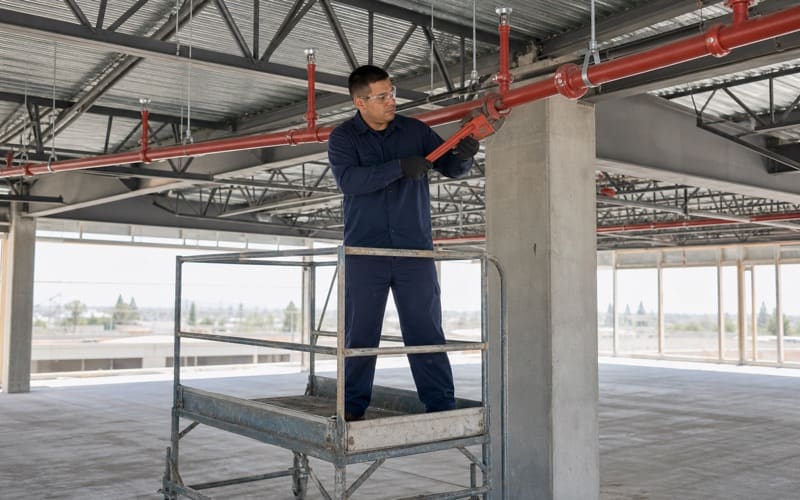
Long Beach Fire Suppression provides fire suppression in Lynwood for commercial and industrial buildings exclusively, which is a deliberate limit rather than an accident of who calls us. Because we take no residential work, the inspection calendar belongs entirely to business property, and a scheduled test date does not get traded away for a house call. Owners here work with one company across sprinklers, alarms, extinguishers, and kitchen hood systems, so a single deficiency list covers the whole building rather than arriving in pieces from separate trades.
A great deal of the commercial stock in this city has been standing for decades, and the fire protection inside it has aged along with the structure. That shapes how we approach an inspection here. Rather than confirming a system still trips and moving on, we look at what age has done to it: internal pipe condition, the state of the heads, whether components installed across three or four different eras still work together the way the original design intended them to.
Every finding we write up carries a photograph and the specific NFPA or code reference behind it, so an owner is not asked to authorize a repair on the strength of an opinion. Where a property has accumulated more deficiencies than one budget can absorb, the correction plan prices them individually and we say clearly which ones carry genuine consequence. The technicians who performed the inspection are the ones who come back to do the repairs, which removes the gap where a finding gets re-diagnosed by somebody who never saw the building.
Legacy Systems and What Age Does to Them
An older sprinkler system rarely fails all at once. It degrades quietly in places nobody looks, and the annual test that only checks whether water flows will not reveal any of it. The work that matters on this kind of building stock happens inside the pipe, at the heads, and in the records, and it takes a technician willing to open things up rather than sign a tag from the walkway.
Pipe Condition and Internal Obstruction
Five-year internal obstruction inspections exist precisely because of what accumulates inside older water-based systems: scale, tubercules, corrosion product, and in some cases material carried in from a municipal main years earlier. Opening a system at the required points and actually looking is the only way to establish whether the pipe still delivers what the hydraulic calculation assumed. On systems that have never had this done, or where nobody can produce evidence that it was, we treat it as the starting point rather than a step to schedule sometime later.
Where an obstruction investigation does turn up material inside the pipe, the finding rarely stops at cleaning it out. The source has to be identified, whether that is internal corrosion generating its own debris, a failing component shedding material, or something drawn in from the supply, because flushing a system without addressing the cause merely resets a clock. We report what was found, where it was found, and what appears to be producing it, and we price remediation separately from the investigation so each stage is visible on its own.
Dry systems age less gracefully still. Trapped water sitting in low points, air compressors cycling more than they should, and corrosion accelerated by the oxygen inside the pipe all shorten the life of a dry pipe installation considerably. We check low-point drains, verify trip times against the system’s design, and document compressor performance, because a dry system that takes too long to trip is a system that will not do its job when it is finally asked to.
Heads, Components, and Mismatched Eras
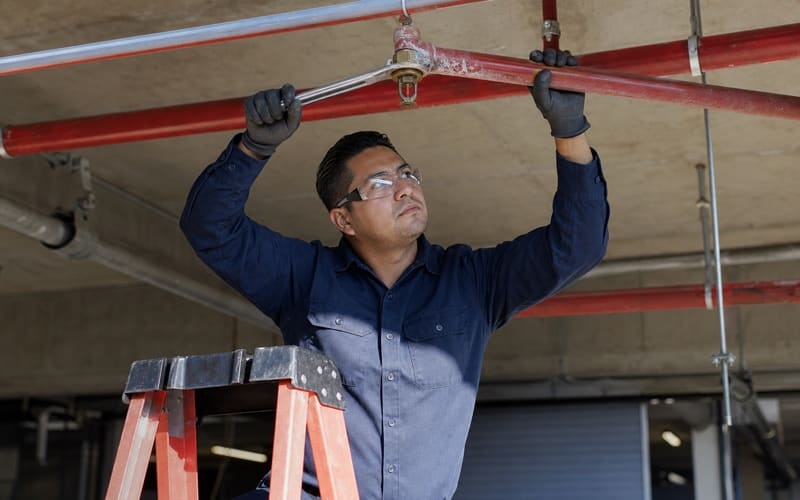
Sprinkler heads carry service life limits and recall histories, and on a building that has changed hands several times nobody on site usually knows which heads are installed. We identify pendent, upright, sidewall, and concealed heads by type and manufacture date, check for paint, corrosion, and loading, and flag anything that has passed the point where testing or replacement is required. Painted heads in particular turn up constantly in older tenant spaces, usually applied by a contractor who had no idea what they were covering.
Escutcheons, cover plates, and the small hardware surrounding a head matter more than their size suggests. A missing escutcheon opens a path into the ceiling void that changes how the head behaves, and a cover plate from a different manufacturer than the head beneath it will not release at the temperature the assembly was listed for. These are inexpensive items routinely mismatched during ceiling work, and they appear on our reports as real deficiencies rather than cosmetic notes, because the listing depends on the components being used together.
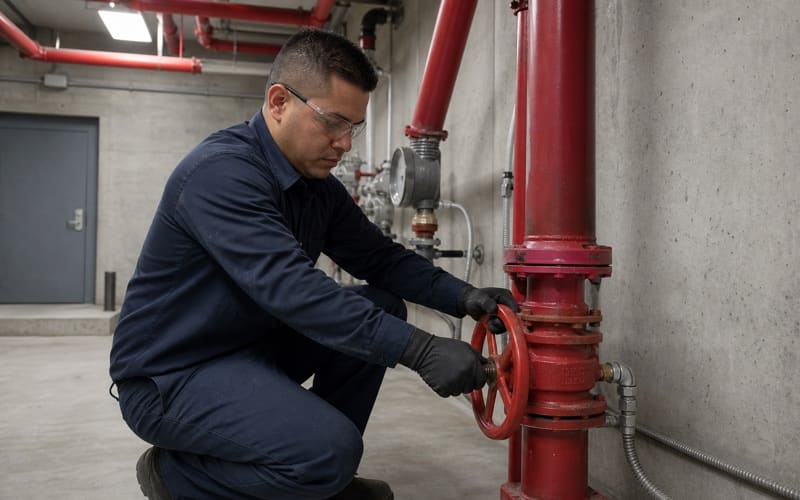
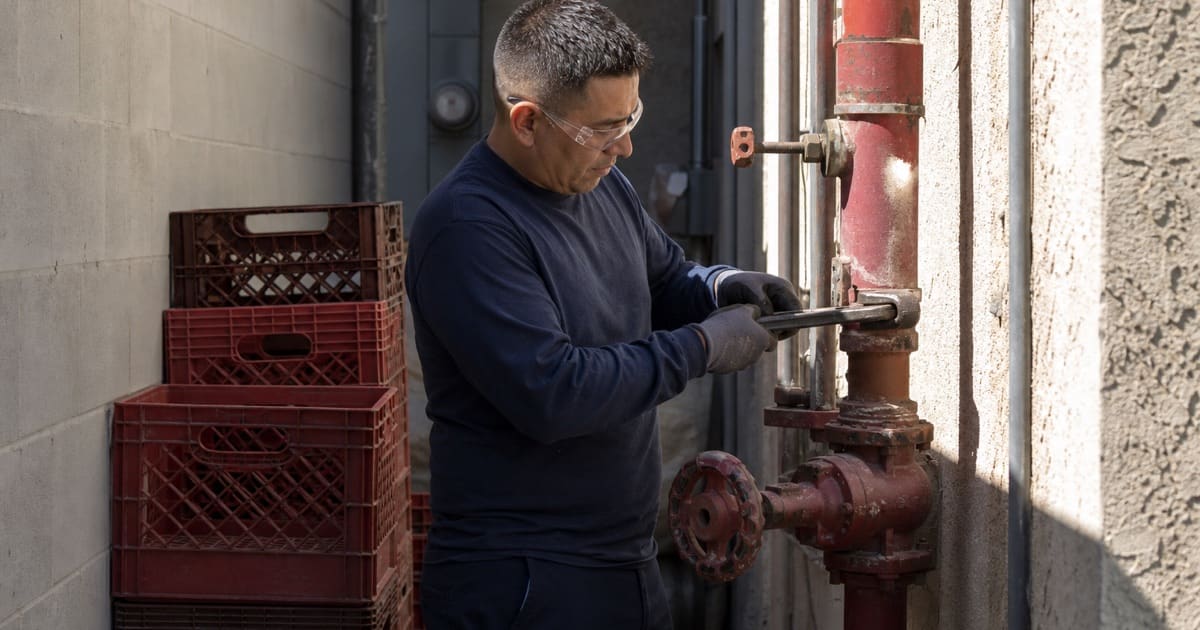
Components installed decades apart do not always cooperate. A riser from one era, a control valve replaced in another, and an alarm interface added later can each function individually while the assembly as a whole behaves in ways the original drawings never described. We verify OS&Y and post indicator valve positions, exercise them, confirm tamper and flow switches actually report to the panel, and note where a modification was made without any accompanying documentation.
Backflow, Risers, and Water Supply
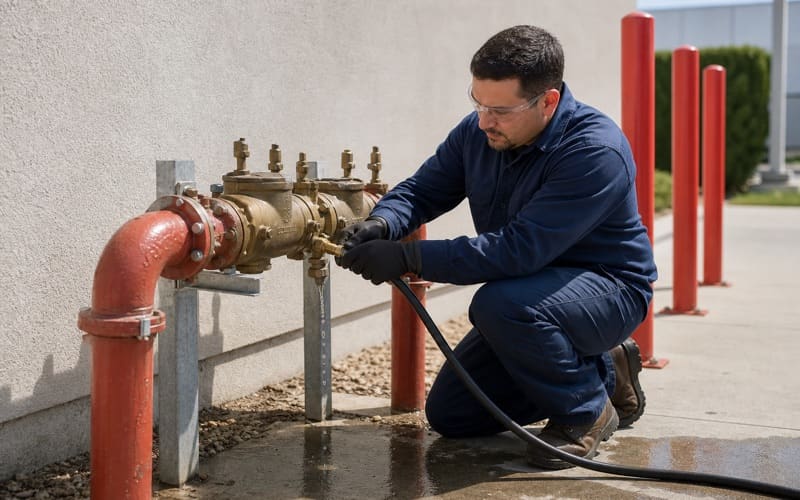
Backflow preventers protecting a fire line need annual testing regardless of their age, and older double check valve assemblies and reduced pressure zone assemblies fail in predictable ways once their internal rubber has hardened. We test and tag them, and where a device is beyond rebuilding we say so rather than passing it for another year. Main drain tests give us a running record of the water supply behind the system, which is often the first indicator that something upstream has changed.
Looking for fire suppression closer to Stanton? See Fire Suppression in Stanton.
A Suburb Built Around a Rail Stop
Lynwood is a suburban city in Los Angeles County with a total population of 67,265 at the 2020 census, down from 69,772 in 2010, sitting near South Gate and Compton in the central portion of the Los Angeles Basin. It was incorporated in 1921 and took its name from the Lynwood Dairy and Creamery, which the local station of the Pacific Electric Railway had been named for. A city that dates to the early 1920s carries commercial buildings from every decade since, and that layering is exactly what an inspection here has to account for.
Storefronts and Small Tenant Spaces
Much of the commercial frontage consists of modest tenant spaces occupied by businesses that cannot absorb a shutdown. A retailer, a salon, or a small office running on thin margins needs its testing done without closing the doors, so we schedule around operating hours and keep any required system shutdown as short and as predictable as we can make it. Where the landlord holds the riser and the tenant holds the space, we deal with both parties directly so nobody discovers a scheduled drain-down the morning it happens.
Restaurants and Commercial Kitchens
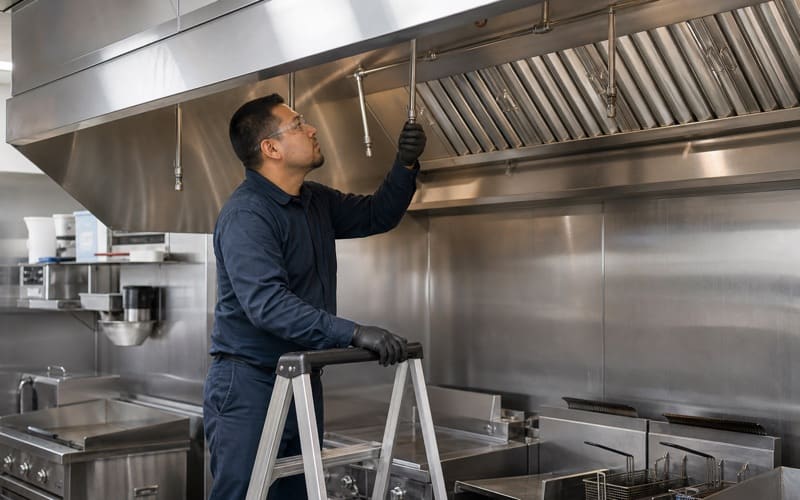
Food service throughout the city runs on NFPA 96 hoods and NFPA 17A wet chemical suppression, and those need service twice a year whether the kitchen is busy or barely running. We work on Ansul R-102 and Pyro-Chem systems, confirm nozzle coverage matches the appliances currently in place under the hood, and test fusible links, manual pulls, and the automatic gas shutoff. Class K extinguishers belong on the line alongside them, and we service those on the same visit rather than treating portable equipment as a separate errand.
Warehouse and Light Industrial Space
The industrial buildings here tend toward the smaller end, often converted or expanded rather than purpose-built, and the sprinkler design frequently reflects a use the building no longer has. Storage height, rack configuration, and commodity type all determine whether the installed system is still adequate, and a tenant who raised the storage two feet may have quietly invalidated the design basis. We measure clearance to the heads, look at how the space is actually being used, and document where the protection and the occupancy have drifted apart.
Older industrial buildings also tend to accumulate unit heaters, added mezzanines, and interior structures built long after the sprinkler system went in. A mezzanine installed beneath an existing head shields everything underneath it, and unless sprinklers were extended below, that area carries no protection at all while the building still looks fully covered from the floor. We look specifically for added structure of this kind, since it is among the most consequential deficiencies a building can have and one of the easiest to walk straight past.
Documentation, Repair, and Deadlines
On buildings with long and poorly recorded histories, the written record is frequently the most valuable thing an inspection produces. We track the recurring due dates for every property we service, so annual and semi-annual obligations arrive as a scheduled appointment rather than as a notice from the fire authority. Reconstructing a compliance history that was never properly kept is slower than maintaining one, and the goal on an older building is to reach the point where the paperwork stops being a problem.
Findings an Owner Can Act On
A report that lists thirty items without ranking them is not much use to somebody deciding what to spend money on this quarter. We separate conditions that put the system out of service from code obligations carrying a deadline, and both of those from wear that is worth correcting before it escalates. Photographs and the cited code section accompany each one, which means an owner, a lender, or an incoming tenant can review the same document and reach the same understanding of the building.
Repairs by the Crew That Found the Problem
Deficiency correction goes back to the technicians who performed the inspection. They have already been in the ceiling, already traced the riser, and already seen the conditions that produced the finding, so the repair does not begin with a second round of diagnosis billed to the owner. On a building where the drawings are incomplete or missing entirely, that continuity is worth considerably more than it would be on new construction with a full set of as-builts.
Impairments and Failed Inspections
Systems on older buildings go out of service with less warning, and an impairment on a fully occupied commercial property is not something that waits comfortably for a routine appointment. We take emergency calls for impaired systems and for buildings that have failed an inspection and are working against a correction deadline. Getting the system back in service comes first, followed by the documentation showing what was wrong, what was done about it, and when the building returned to compliance.
- Commercial & Industrial Only
- Code-Cited Inspection Reports
- Emergency Impairment Response