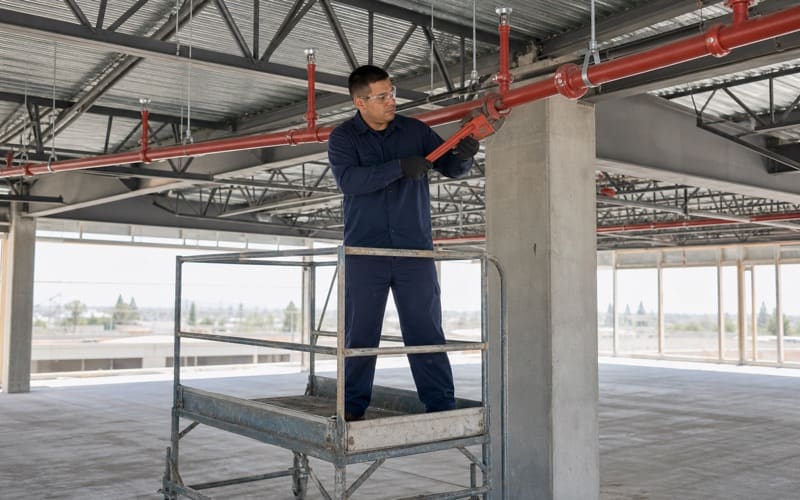
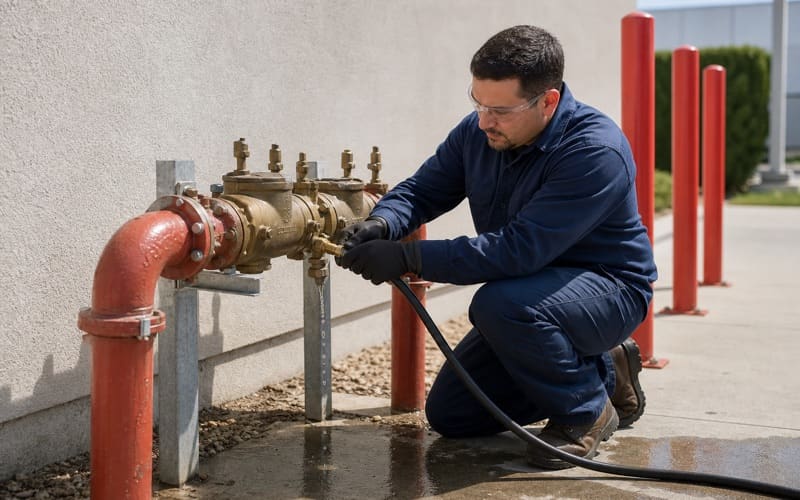
Long Beach Fire Suppression provides commercial fire suppression in Paramount for manufacturing plants, warehouses and distribution buildings, metal and fabrication shops, truck and equipment yards, retail property, restaurants, and multifamily buildings. We design, install, inspect, service, and repair sprinkler systems, fire pumps, standpipes, cooking equipment suppression, alarms, extinguishers, and backflow assemblies across all of them.
Industrial and commercial property is the whole of our practice, which matters here because industrial fire protection is genuinely a separate discipline rather than a larger version of ordinary commercial work. What a system has to deliver in a fabrication shop is set by the process running inside it, and what it has to deliver in a warehouse is set by stored commodity and rack height. Neither question has any residential equivalent, and getting either one wrong produces a building that passes a visual inspection and fails when called upon.
Deadlines rather than emergencies generate most of the calls we take. Water-based systems answer to NFPA 25 for inspection and testing and NFPA 13 for design, cooking equipment to NFPA 96 and NFPA 17A, portable extinguishers to NFPA 10, and detection and notification to NFPA 72, with California enforcing the whole set through its Fire Code and Title 19. We perform the inspection, record what we find against the provision that governs it, and carry out the corrections ourselves, so closing a single deficiency does not require an owner to coordinate two companies who each believe the other holds the context.
Protecting Industrial and Manufacturing Buildings
Process Hazards and Dedicated Suppression
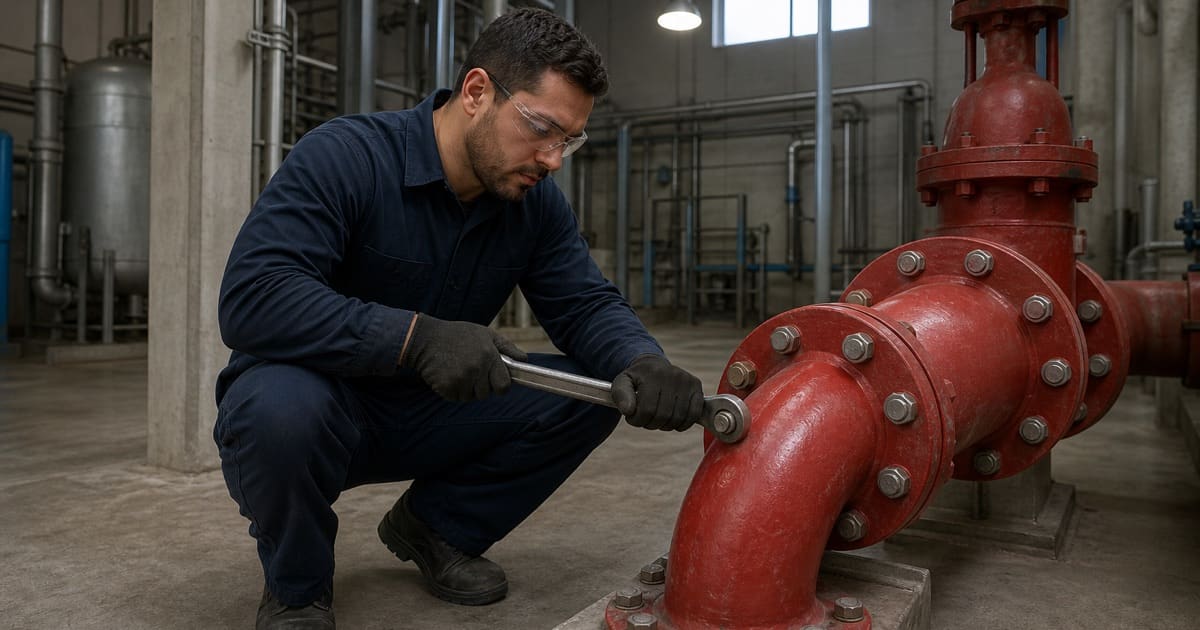
Manufacturing introduces exposures that ceiling sprinklers were never designed to answer, among them flammable and combustible liquids, dust-producing operations, hot work, spray and coating booths, and individual machines that warrant protection independent of the room around them. Depending on what is actually running, the right answer may be a deluge arrangement over a high-hazard area, a foam system where plain water would spread a liquid fire rather than control it, or suppression dedicated to one piece of equipment. These decisions follow the operation, not the square footage, and they are the reason an industrial inspection is worth more than a checklist walk.
The failure we encounter most often is not a broken component but a system that has quietly stopped matching its building. A production line converted to a different solvent, a booth added into an existing bay, or a change in what gets stored between shifts can move a space into a hazard classification the installed protection was never engineered to cover. None of those changes involve touching the fire protection equipment, so nothing prompts anyone to revisit it. We assess whether what is installed still answers what the building now does, and we put it in writing when the two have parted company.
Storage and Distribution Space
Sprinkler protection in a storage building is determined by commodity classification, stack height, and rack configuration rather than by floor area, which is why two identical shells can require substantially different systems under different tenants. A building engineered for one commodity class can be materially short for another, and the shift happens whenever a product mix changes rather than when anyone files a permit. Where protection depends on maintained clearance between the heads and the top of stored goods, stacking into that clearance defeats the design outright while every component remains in perfect working order.
We therefore inspect what is stored and how it is arranged against the assumptions the system was built on, rather than confining a visit to hardware condition. In-rack arrangements receive particular attention, since they sit within reach of moving equipment and take damage that ceiling heads never see. Where the current storage profile exceeds what the installed system can protect, that finding carries more weight than anything else on the report, and we say so plainly rather than burying it among routine observations.
Idle pallets and packaging accumulating along a wall deserve specific mention, since they are among the most hazardous things routinely found in a warehouse and appear in nobody’s plan for the space. Stacked indoors they create a fuel load well beyond what the surrounding protection was sized to handle. This is usually a finding an operator can clear within the week at no cost, which makes it worth stating plainly rather than burying in a list.
Physical Damage and Deterioration
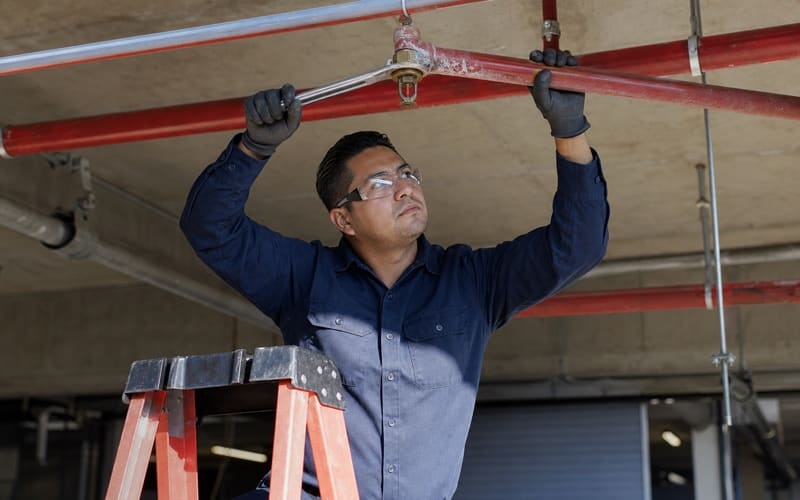
Buildings with forklift and truck traffic sustain damage to heads, drops, and exposed piping frequently enough that it is an expected finding rather than a remarkable one. The durable remedies are guards, relocation, or a head type better suited to the traffic in that aisle, because replacing an identical head in an identical position for the third time simply schedules the next repair rather than addressing what keeps striking it. We treat repeated damage in one location as a placement problem and say so, since the alternative is an annual line item that never resolves.
Dry systems serving unheated docks, canopies, and covered yards contribute their own catalogue of faults, including compressors that run continuously without holding pressure, low-point drains that collect water, and dry pipe valves that will not trip inside the required time. Trapped water is the usual root cause and it accumulates entirely out of view until a drain is finally opened, which is why these systems reward scheduled trip testing rather than visual reassurance. None of it announces itself between inspections.
Looking for fire suppression closer to Cerritos? See Fire Suppression in Cerritos.
A Dense Industrial and Residential City
Paramount had a population of 53,733 at the 2020 census, down slightly from 54,098 in 2010. A city of that population occupying a compact footprint produces a building stock in which industrial and manufacturing space sits directly alongside retail, food service, and dense residential property, frequently on adjoining parcels. That adjacency shapes the work as much as the industrial base itself does, because a shutdown planned around one occupancy has consequences for the neighbours sharing its block.
Mixed Occupancy on Single Parcels
Properties here commonly carry more than one use behind a single address, with office frontage attached to shop space, storage behind a service counter, or vehicle bays adjoining parts inventory. Because sprinkler density, extinguisher type and rating, and maximum travel distance to a unit all follow the hazard classification of an area rather than an average taken across a building, we classify area by area. That approach prevents the outcome we see repeatedly, in which a fully compliant customer-facing space conceals a back of house that stopped matching its own requirements several tenants ago.
Older Systems and Undocumented Alterations
Commercial and industrial buildings that have served several occupancies over decades carry protection extended, patched, and rerouted by a succession of contractors whose documentation varied considerably in quality. Drawings on file frequently describe something other than what is physically installed, and alterations that never passed through plan review are common enough to anticipate rather than to be surprised by. We inspect the building in front of us rather than the paperwork describing it, and unapproved work gets reported because it surfaces at the next inspection regardless of who performed it or how long ago.
Older water-based systems also accumulate internal corrosion, scale, and debris that restrict flow while producing no external sign whatsoever. That condition is precisely what the five-year internal obstruction investigation exists to find, and it remains the requirement buildings skip most reliably, partly because the interval outlasts most people’s tenure and partly because nothing about a healthy-looking riser suggests it is due.
Retail, Food Service, and Residential Neighbours
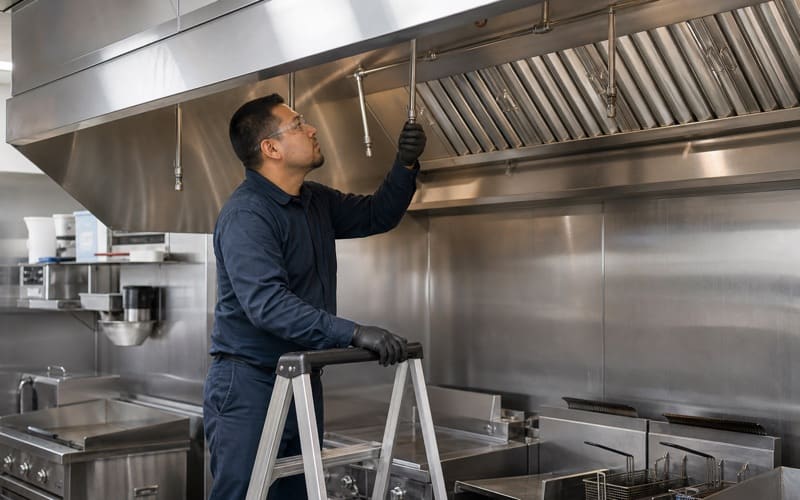
The commercial property serving an industrial district carries its own obligations, and cooking equipment suppression runs on the shortest cycle of anything we service. Each visit covers cylinder charge, nozzle position against the appliance line as it currently stands, blow-off caps, fusible link replacement, detection cable travel, and functional testing of the fuel shutoff and pull station together rather than separately. Nozzle position is the perennial finding, because appliances are replaced and shifted far more often than anyone reviews the system hanging above them.
Grease loading in the hood, plenum, and accessible duct is examined at every service, because it is fuel sitting exactly where a fire would travel and it changes how the system performs on discharge. Where access panels are missing or have been covered during a remodel, proper cleaning becomes impossible and we identify that specifically. A Class K extinguisher belongs on the cooking line alongside the hood system.
Where food service or industrial space sits beneath or adjacent to residential occupancy, the consequences of a contained fire escaping are considerably higher, which raises the importance of the duct and plenum nozzles nobody ever sees. Multifamily buildings themselves combine dwelling unit coverage with commercial requirements in corridors, garages, trash rooms, and laundry areas, and parking structures commonly run dry systems needing air pressure and drainage attention their wet counterparts do not.
Compliance, Documentation, and Response
Reconstructing What Is Owed
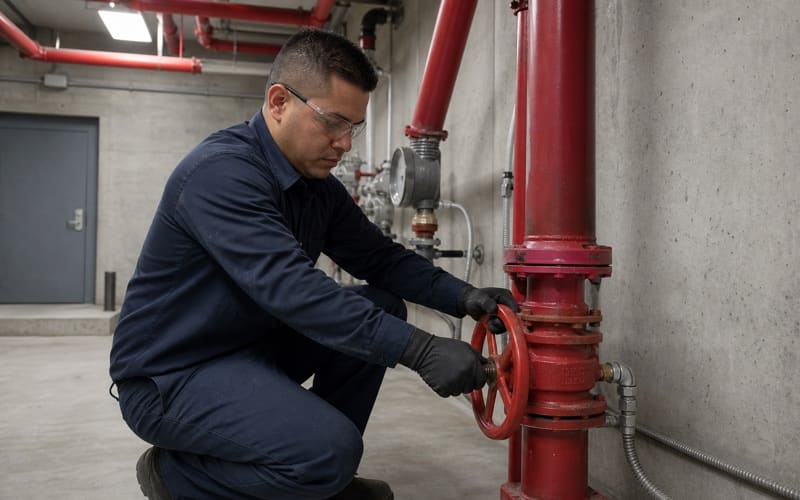
A property with only annual visits in its history is almost certainly carrying incomplete obligations, because the standard staggers requirements across quarterly, semi-annual, annual, and five-year cycles running concurrently on the same system. We establish which intervals attach to the equipment actually present, review whatever record exists, and name what appears never to have been performed rather than assuming a predecessor handled it without documenting it. Long-cycle items are where nearly every building we take on turns out to be behind, and we hold the schedule against the property so a change of ownership does not silently reset it to zero.
Reporting That Distinguishes Consequence
Every deficiency carries a photograph and the code provision behind it, ordered by consequence so a partially closed control valve is never presented alongside a cosmetic observation as though the two were equivalent. That ordering is what allows an owner reviewing several properties remotely to act without first arranging a site visit to work out what the list actually means. Corrections are priced individually rather than delivered as a single figure, which makes it possible to release the compulsory work immediately and schedule the balance deliberately against a budget rather than by default.
Emergency Work and Impairments
A system out of service leaves a building without its primary protection for the duration, and in a plant or warehouse holding inventory and equipment that exposure is substantial rather than theoretical. We respond urgently to systems shut down by damage, failure, or a leak that forced a valve closed, and the first objective is restoring protection to as much of the building as circumstances permit rather than waiting on a complete repair. Isolating a damaged branch and returning the remainder to service is frequently achievable within the same day.
Work requiring a planned shutdown is arranged with management beforehand, confined to the smallest workable area, and documented as the code requires, with interim measures where duration and occupancy call for them. In buildings running production shifts we schedule around changeovers rather than imposing a window, because an interruption to throughput costs considerably more than the work itself.
- Commercial & Industrial Only
- Code-Cited Inspection Reports
- Emergency Impairment Response