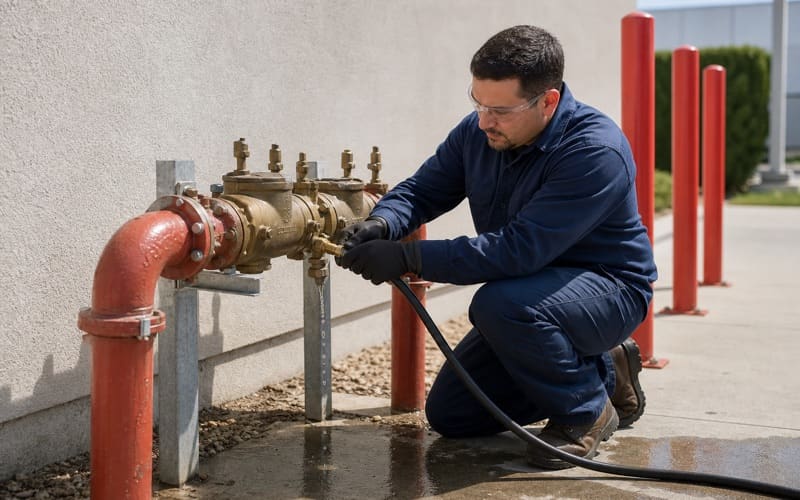
Long Beach Fire Suppression provides commercial fire suppression in Rossmoor for retail buildings, professional offices, medical and dental suites, restaurants, and the service businesses that occupy neighborhood commercial space. We inspect, service, install, and repair sprinkler systems, kitchen hood suppression, fire alarms, and portable extinguishers.
We work on commercial properties exclusively. In an area where most commercial buildings are smaller than a distribution warehouse, that focus matters in a specific way: small commercial buildings are the ones most likely to be treated as an afterthought by a vendor whose schedule is built around large accounts, and they carry the same code obligations regardless of size. A four-suite retail building and a distribution center are both inspected against the same standards for the systems they contain, and a small property with a lapsed five-year requirement is in the same position as a large one.
A tenant suite with a sprinkler system, a handful of extinguishers, and an alarm connection is subject to NFPA 25, NFPA 10, and NFPA 72 exactly as a much larger property is. The intervals do not scale down with square footage, and the owner carries the responsibility either way. That obligation also transfers with the property when it changes hands, which catches new owners regularly — the requirement moves with the building even when the inspection records do not. Establishing what has and has not been done is often the first useful thing an inspection produces.
Fire Protection for Neighborhood Commercial Properties
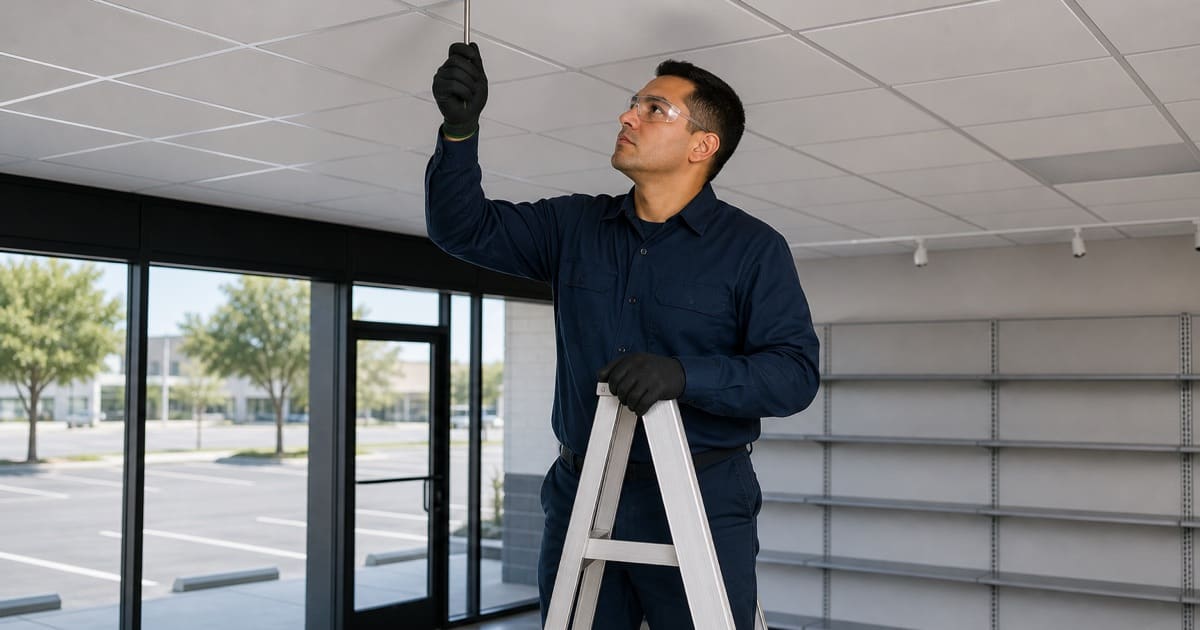
Retail and Professional Suites
Multi-tenant commercial buildings create a split-responsibility problem. The landlord typically owns the riser, the base building sprinkler system, and the alarm panel, while individual tenants own the extinguishers and any suppression equipment inside their space. We work across both and document findings by suite so the responsible party is identifiable, which avoids the common standoff where a deficiency sits uncorrected because ownership of it is disputed. Lease structures vary considerably on this point, and the fire authority is generally indifferent to whose responsibility a deficiency is — the building is either compliant or it is not. Providing a report that separates base building findings from tenant findings gives both parties something they can act on without negotiating first.
Portable extinguisher coverage in small suites is decided by hazard classification and maximum travel distance rather than by floor area, which is why a modest space can still require more units than an owner expects. The recurring failure is not absence but obstruction: units disappear behind shelving, stock, and display fixtures as a tenant fills the space, and one that cannot be reached in seconds is not protecting anyone. We check mounting height, signage, and clear access alongside the service tag.
Medical, Dental, and Outpatient Offices
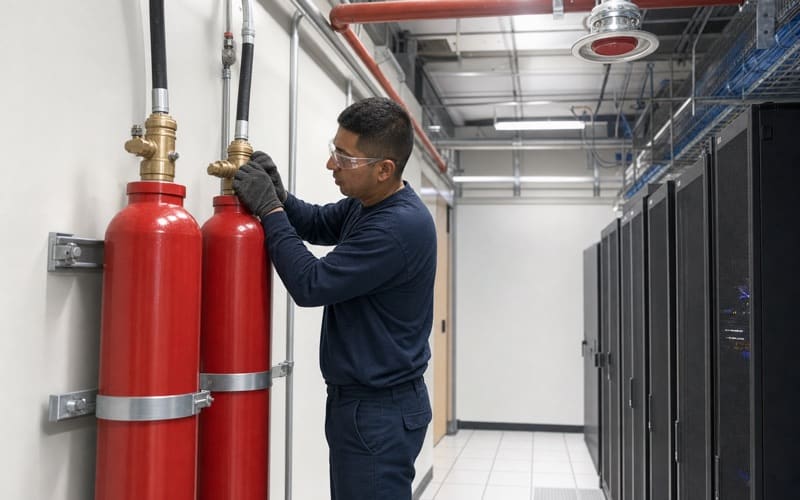
Clinical spaces cannot always be taken offline during patient hours, and some equipment areas are better protected by clean agent than by water. We schedule testing around clinical schedules and plan these buildings zone by zone rather than as a single visit. Where a server or imaging area warrants it, clean agent protection avoids the situation where a discharge causes more loss than the event that triggered it. Records matter in these buildings as much as the equipment does, since healthcare occupancies are inspected on a predictable cycle and are expected to produce documentation on request. We leave service records current at the time of the visit rather than sending them afterward.
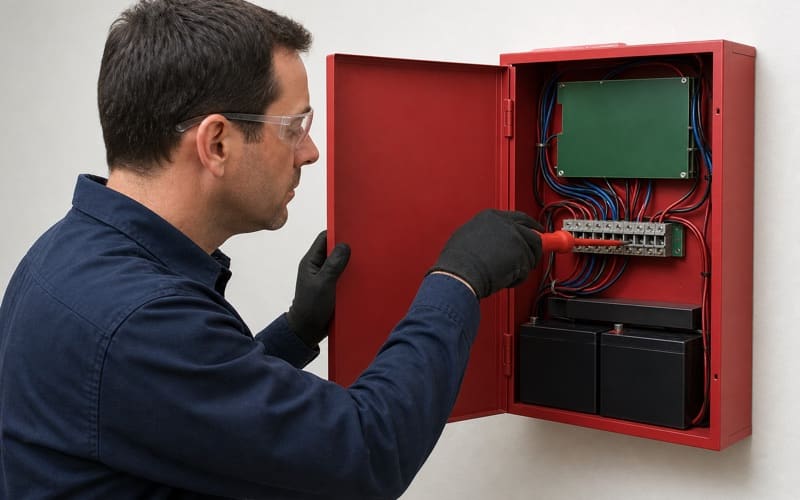
Testing that requires notification appliances to sound needs its own window in these buildings, agreed with clinical staff rather than dropped into a treatment day. We plan those tests around the appointment book and sequence a building in zones where a single continuous outage would be unworkable. Accepting that a full inspection may run across two visits is usually cheaper for the practice than the disruption of forcing it into one.
Restaurants and Food Service
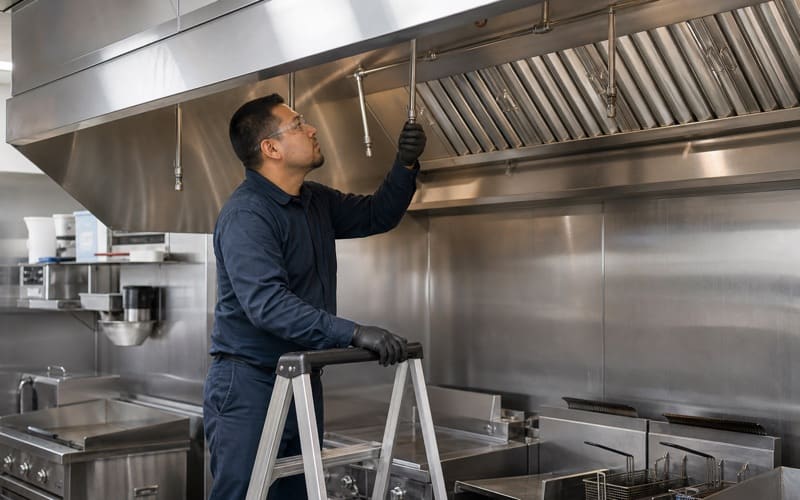
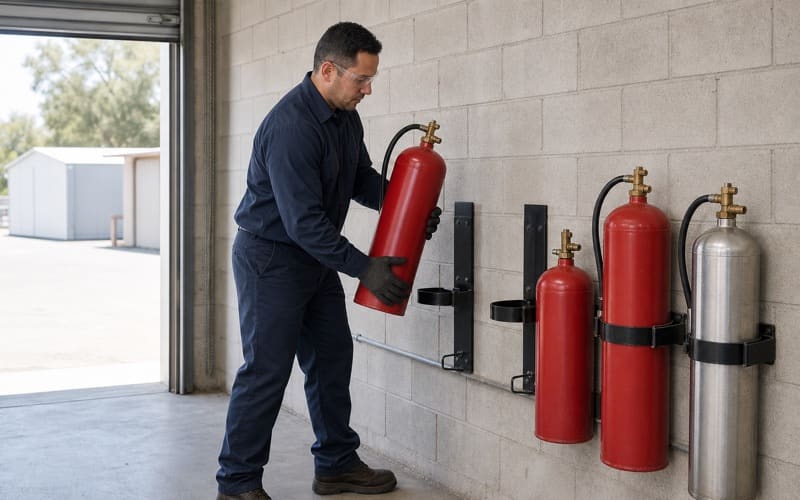
Any commercial kitchen with cooking appliances under a hood carries a wet chemical suppression system requiring service roughly twice a year under NFPA 17A and NFPA 96. We service and recharge Ansul R-102 and Pyro-Chem systems, replace fusible links, verify nozzle coverage against the appliance line as it currently sits, and test the gas shutoff and manual pull station. A Class K extinguisher is required in addition to the hood system, and it has to be reachable without walking past the cook line. Cylinders also carry hydrostatic testing requirements on their own longer cycle, separate from the semi-annual service, and those are the dates most often missed because nothing about the system indicates they are due. We track them per unit rather than per building.
Looking for fire suppression closer to Lakewood? See Lakewood Fire Suppression.
A Planned Community and Its Commercial Edge
Rossmoor is a planned census-designated place in Orange County with a population of about 10,625 as of the 2020 census, up from 10,244 in 2010. It sits north of the gated Leisure World retirement community in Seal Beach and adjacent to Los Alamitos. As an unincorporated planned community, its commercial building stock is concentrated rather than spread across an industrial district, which shapes the kind of fire protection work the area actually needs. The result is a mix weighted toward smaller multi-tenant buildings rather than large single-occupant facilities.
Smaller Systems, Identical Obligations
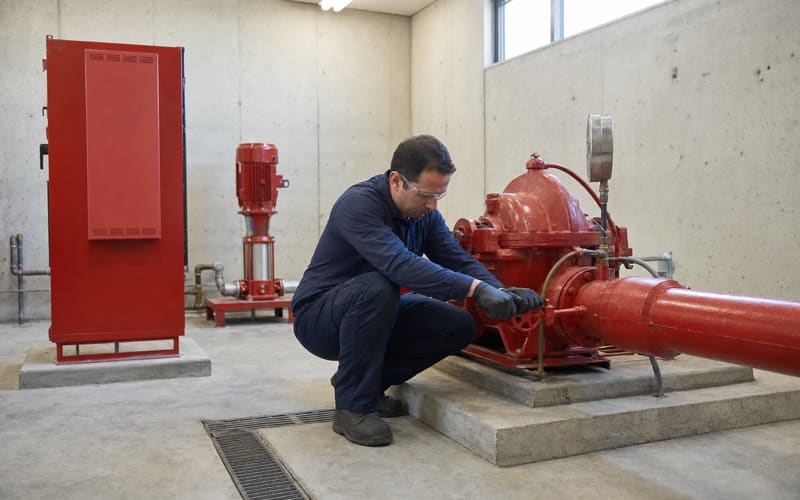
A sprinkler system serving a single-story retail building has fewer components than a high-rise riser, but the inspection requirements come from the same standard. Control valves are verified, main drain testing is performed, waterflow and tamper switches are tested, and heads are examined for damage, paint, corrosion, and obstruction. The five-year internal obstruction investigation applies as well, and in smaller buildings it is the requirement most likely never to have been performed at all. Smaller properties tend to accumulate a specific pattern of neglect: the annual gets done because someone invoices for it, while quarterly checks and long-cycle requirements quietly lapse. An inspection history that looks complete at a glance frequently has gaps once the intervals are laid out against each other.
Coverage That Drifts With Tenant Turnover
Neighborhood commercial space turns over regularly, and each tenant improvement is an opportunity for coverage to fall out of alignment. New demising walls create areas the original head layout never contemplated, dropped ceilings leave heads above them protecting nothing, and extinguisher placement stops matching the floor plan. Because this work is rarely reviewed against the fire protection design, the deficiencies accumulate quietly between inspections. We assess coverage against current conditions rather than the drawings on file. Contractors performing tenant improvements are also a routine source of damage, since sprinkler heads get painted, struck, or removed during ceiling work and are not always reported. A painted head is not cosmetic — the coating interferes with the thermal element the head depends on to activate at its rated temperature, and the unit has to be replaced rather than cleaned.
Unincorporated Status and Inspection Authority
Properties in unincorporated areas are served by county fire authority jurisdiction rather than a city department, which affects who inspects, what documentation is expected, and how corrections are cleared. We are familiar with those inspection and permit processes, which matters most on installation and modification work where a system cannot be placed in service until it has been signed off. Knowing what a submittal needs before it goes in is usually the difference between one review cycle and three, and on a small project that difference is most of the schedule.
That distinction matters most on alteration work. A system that has been extended or modified cannot simply be placed back in service — drawings go to the reviewing office, and the timeline depends on submitting something that office will accept the first time. Review cycles rather than field labour consume the calendar on a small project, so we handle that correspondence rather than handing it back to an owner to navigate alone.
Inspection, Documentation, and Correction
Establishing a Baseline
Many smaller commercial properties arrive with no usable inspection history, particularly after a change of ownership or management. We establish what systems the building actually has, identify which required intervals appear never to have been performed, and produce a current baseline with a forward schedule. That is more useful than a single compliant year, because it reveals the long-cycle items nobody has been tracking. Where no record exists of a five-year requirement ever being performed, we treat it as due now rather than assuming a previous vendor handled it without documenting it.
A baseline visit produces the things a building should already have and usually does not: an inventory of what is actually installed, a map of which valve controls which portion of the property, the manufacture dates and types of the heads in place, and the intervals each component falls under. That record is what turns future inspections into routine appointments instead of investigations, and it survives a change of manager or owner.
Findings You Can Act On
Deficiencies are documented with photographs and the code reference behind each one, and corrections are priced individually rather than presented as a single number. For an owner who manages the property remotely or holds more than one, that difference determines whether a report can be acted on without a site visit. Urgent items are separated from minor ones rather than listed together.
Repairs Without a Second Vendor
Our crews correct the deficiencies they identify, so an inspection does not end with a referral to somebody else. For buildings working against a re-inspection date we respond on an emergency basis. Where a system has to be impaired to complete a repair, we plan and document the window with property management rather than treating it as incidental. Restoring protection quickly matters more than completing the repair in one visit, so where a full correction will take longer we isolate the affected section and return the balance of the system to service.
Keeping Compliance on Schedule
Intervals Tracked Against the Property
Sprinklers, extinguishers, alarms, and kitchen suppression all run on different cycles under different standards. Splitting them across separate vendors is how requirements fall into the gaps between contracts. We hold all of them on one schedule so annual, semi-annual, and five-year work comes due on our calendar rather than depending on someone remembering, and the history stays intact when a building changes hands.
Work That Fits Around Business Hours
Retail suites, offices, and restaurants all lose money when they close. We schedule the disruptive portions of the work outside operating hours and coordinate access and any shutdown directly with management and affected tenants. In a multi-tenant building that coordination is usually harder than the technical work, and doing it properly is what keeps a routine inspection from becoming a disruption. Notice given a week ahead costs nothing and prevents nearly every scheduling problem that would otherwise turn a two-hour visit into a return trip.
- Commercial & Industrial Only
- Code-Cited Inspection Reports
- Emergency Impairment Response