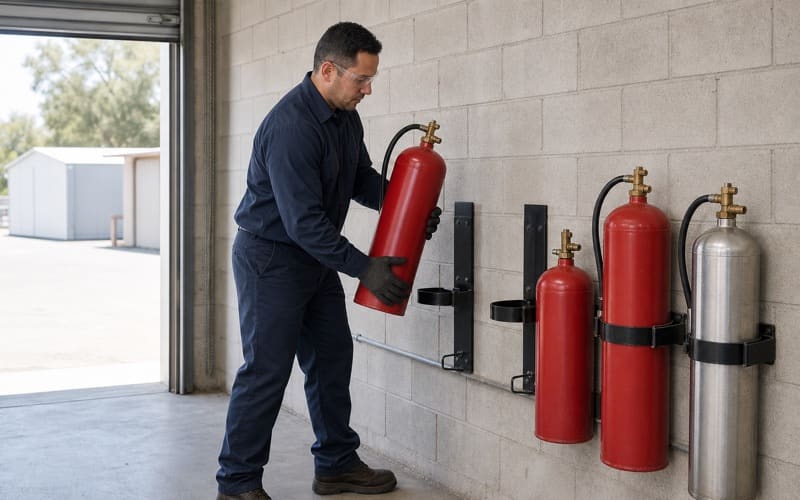
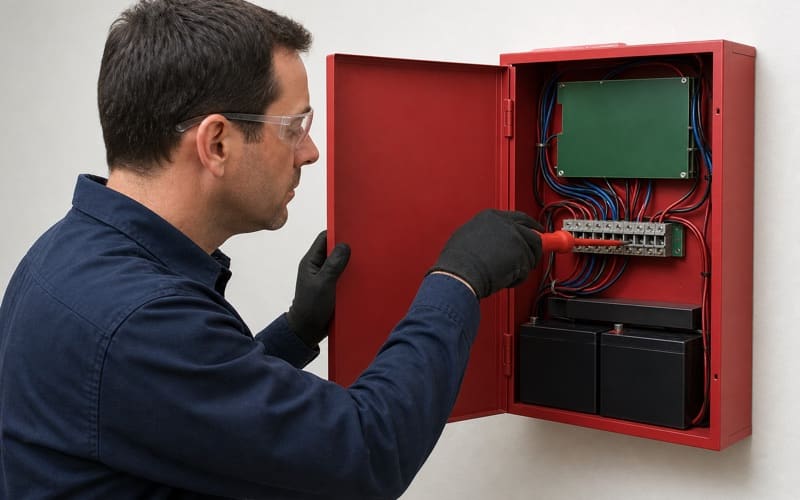
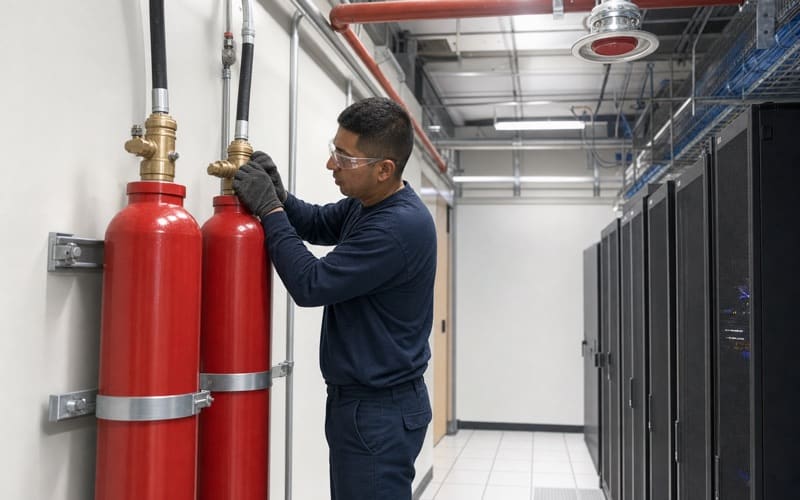
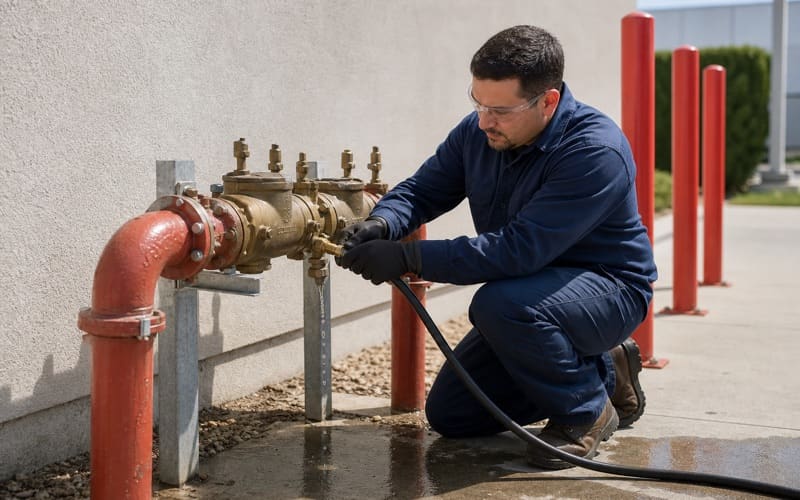
Long Beach Fire Suppression provides commercial fire suppression in San Pedro for port-area industrial buildings, warehouses and logistics facilities, restaurants, retail properties, offices, and multifamily buildings. We install, inspect, service, and repair sprinkler systems, fire pumps, standpipes, kitchen hood suppression, alarms, extinguishers, and backflow assemblies. All of it sits with one provider, so a property carries one deficiency list rather than several partial ones.
Everything we handle is commercial or industrial. In a district that mixes working port and maritime uses with dense neighborhood commercial property, that range matters — the same provider needs to be competent on a warehouse ESFR system and on a restaurant hood line, because both exist within a few blocks of each other here. No residential work competes for the same technicians, which is why a booked commercial date holds.
The work runs on compliance intervals rather than incidents. NFPA 25 governs inspection and testing of water-based systems, NFPA 13 their design, NFPA 96 and NFPA 17A commercial kitchen suppression, NFPA 10 extinguishers, and NFPA 72 alarms, with the California Fire Code and Title 19 placing all of it behind an enforced inspection. We inspect, document, and correct, so compliance and repair stay in one scope. Recurring due dates are tracked against each property so nothing slips quietly past its month.
Marine Exposure and Corrosion
Why Coastal Properties Age Differently
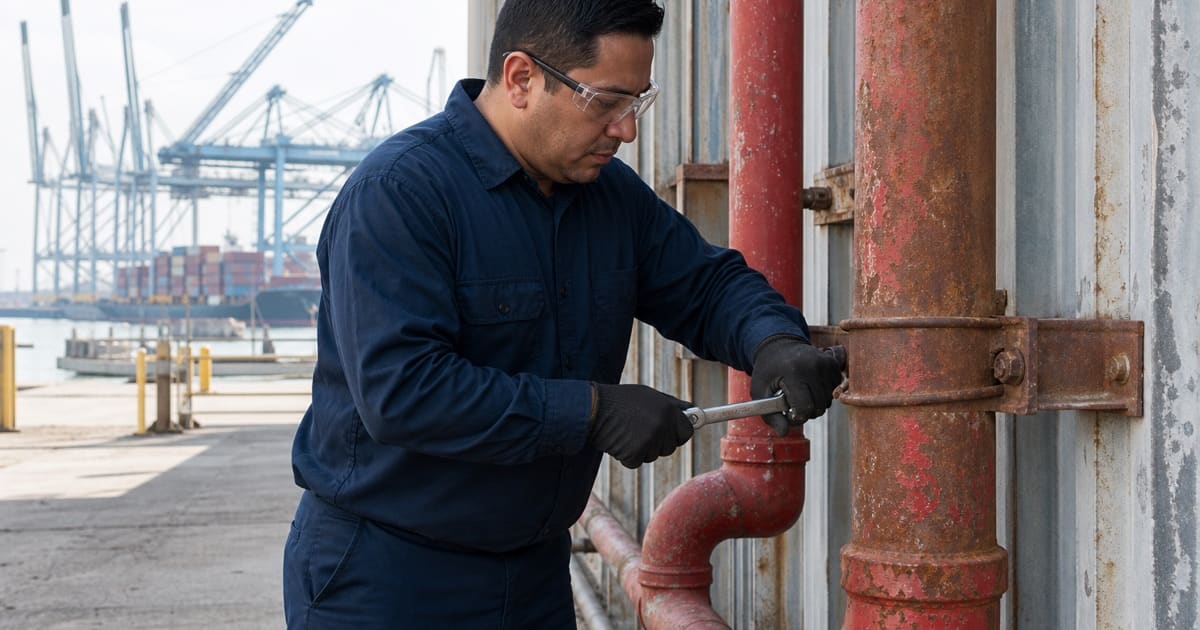
Salt air is the single largest environmental factor affecting fire protection hardware in a waterfront district. Exposed sprinkler piping, hangers, heads, fire department connections, standpipe hose valves, and backflow assemblies corrode measurably faster here than a few miles inland, which means a corrosion finding carries a shorter timeline than the same observation would elsewhere. Enclosures and cabinets housing that equipment corrode alongside it, and one rusted shut prevents access for testing entirely.
External corrosion is at least visible during an inspection. The more consequential problem is internal, where corrosion products and scale build up inside piping and restrict flow without producing any exterior sign at all. That is precisely the condition the five-year internal obstruction investigation exists to detect, and it is the NFPA 25 requirement most often skipped entirely. We record main drain readings each visit rather than marking a pass, since a trend reveals what a single reading cannot.
Exposed and Semi-Exposed Piping
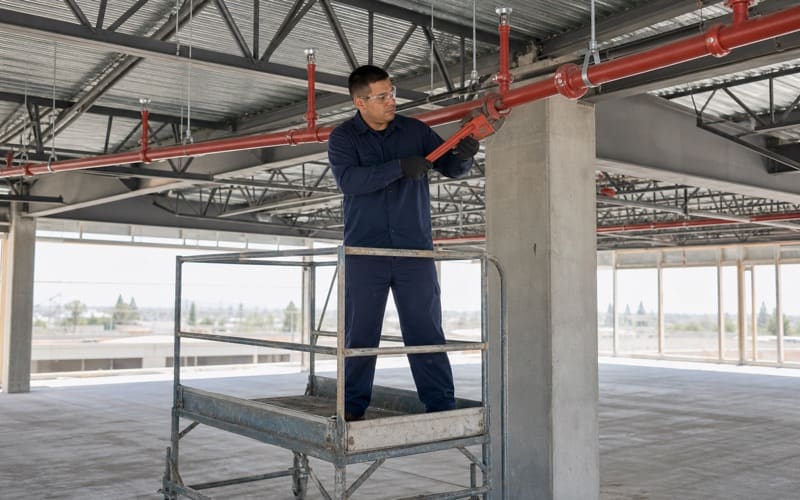
Covered loading areas, dock canopies, open-sided storage structures, and equipment yards all put piping in weather without putting it indoors. Systems in those locations accumulate deterioration faster than a fully enclosed building and warrant closer attention at each visit rather than the same cursory look. Hangers and supports deserve the same scrutiny as the pipe, because a failure there causes damage well beyond the system itself.
Dry pipe systems serving unheated or open structures add their own failure modes, including air compressors that cycle constantly or fail to hold pressure and low-point drains that trap water. Trapped water is the most common underlying cause of dry system trouble and it accumulates invisibly until a drain is finally opened. Pre-action systems add a release panel and detection components whose faults produce no leak, no alarm, and no outward sign, which is why they are found through scheduled trip testing rather than observation.
Older Systems and Layered Modifications
A district that consolidated with Los Angeles in 1909 carries commercial buildings whose fire protection has been extended, repaired, and modified repeatedly by different contractors across decades, with documentation of varying quality. As-built drawings frequently do not match the installed system, and unpermitted modifications are common enough to expect rather than to be surprised by. Where an alteration cannot be reconciled with any approval on record, we say so plainly rather than leave it to a future sale.
We inspect against actual conditions rather than the paperwork on file, and where we find work that was never submitted for approval we report it, because it will surface at the next inspection regardless of who performed it. Piping cut and extended for a tenant improvement warrants particular scrutiny, since workmanship can look acceptable while the hydraulic design is no longer valid. Older systems also carry heads of mixed vintage and temperature rating, replaced over the years with whatever a previous contractor had available, and matching the head to its location is part of what an inspection should establish.
Looking for fire suppression closer to Bellflower? See Fire Suppression in Bellflower.
A Working Port District
San Pedro is a neighborhood within the South Bay and Harbor region of Los Angeles, formerly a separate city until it consolidated with Los Angeles in 1909. The Port of Los Angeles, a major international seaport, is partially located within it. The district has grown from being dominated by the fishing industry to a working-class community and, more recently, to an increasingly dense and diverse one — a progression that left behind a genuinely mixed building stock.
Industrial, Warehouse, and Logistics Buildings
Storage occupancies are where sprinkler design is least forgiving, because commodity classification, storage height, and rack arrangement determine what the system must deliver rather than square footage. A building protected for one commodity class can be materially under-protected for another, and that shifts whenever a tenant’s product mix changes. Idle pallets stacked indoors belong in the same conversation, creating a fuel load beyond what surrounding protection was sized for.
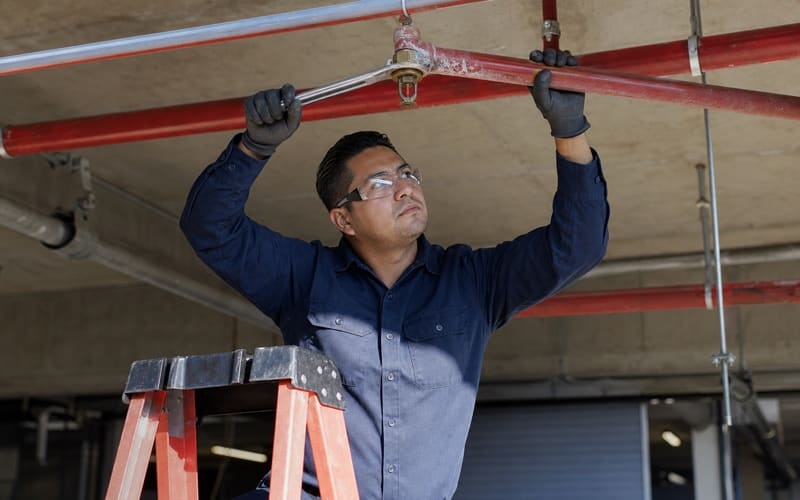
Where coverage depends on maintained clearance between heads and the top of storage, stacking into that clearance invalidates the design without altering a component. We check storage arrangement against design assumptions at every inspection rather than confining the visit to hardware, and equipment traffic here damages heads and piping often enough that physical damage is a routine finding rather than an unusual one. Guards, relocation, or a different head type are the durable answers, since replacing the same head a third time in the same aisle simply schedules the next repair rather than addressing why it keeps being struck.
Fire Pumps and Standpipes
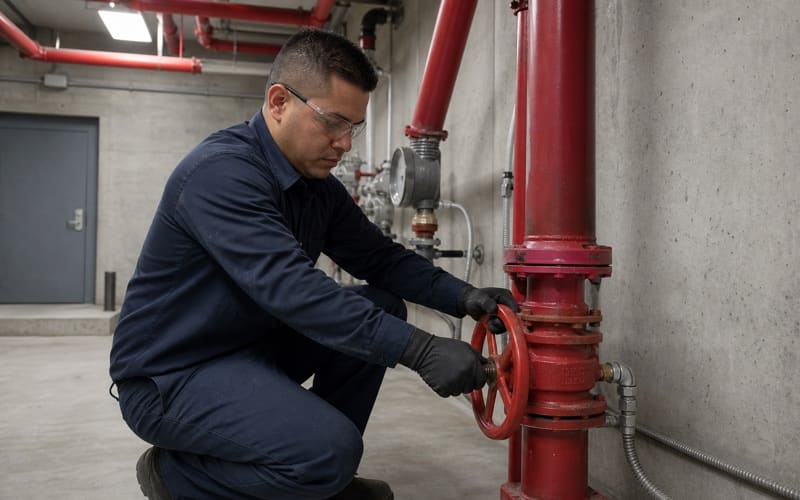
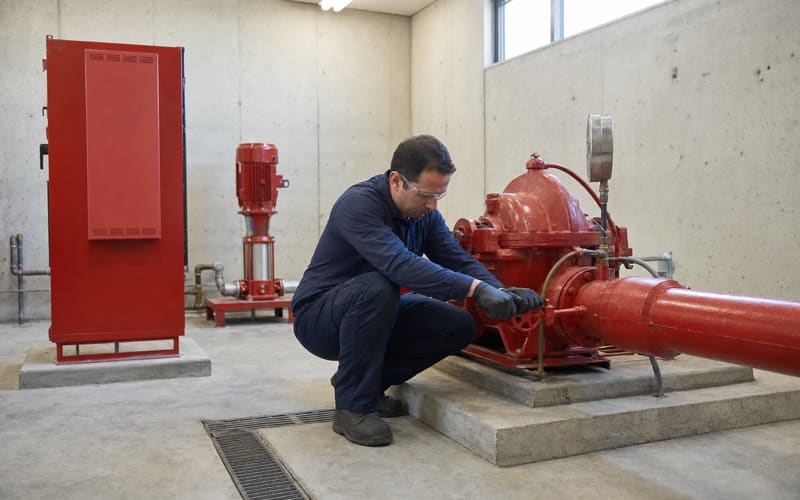
Larger and taller buildings depend on equipment upstream of the sprinkler heads. Fire pumps supply pressure where the municipal supply is insufficient and require frequent churn testing plus annual flow testing at churn, rated capacity, and peak flow to confirm performance against the nameplate curve. A pump can start reliably every week and still deliver materially less than its design output, which only a flow test reveals. Pump rooms are assessed as rooms too, since ventilation, drainage, and clear access all bear on whether a pump runs when called.
Standpipes carry routine inspection plus five-year hydrostatic and remote-connection flow testing. Fire department connections are checked for accessibility, cap presence, gasket condition, and internal obstruction, because that component’s failure is discovered by the fire department rather than by the building — and landscaping, parked vehicles, and construction staging are the usual causes. Because the FDC sits outside the building envelope, it is also the component most exposed to weather and vehicle contact, and in a marine environment cap and gasket condition deteriorate faster than anywhere else on the system.
Restaurants, Retail, and Dense Commercial Property
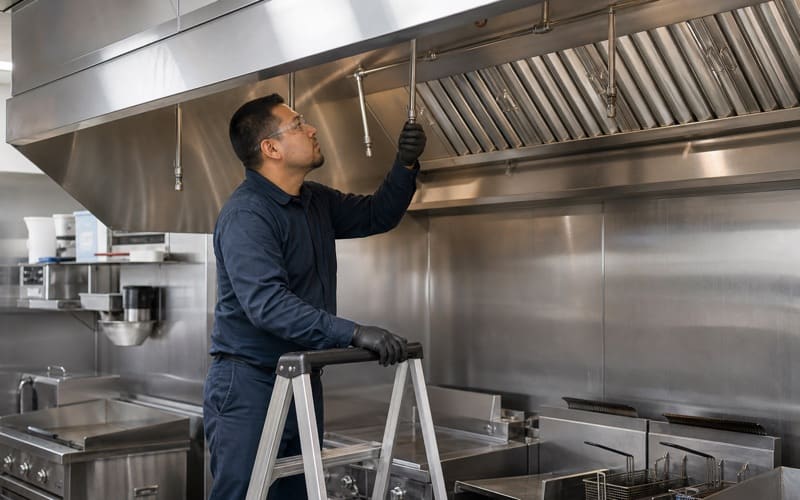
An increasingly dense commercial district produces a substantial concentration of food service, which carries the shortest service interval of any system we handle. Wet chemical suppression over cooking appliances generally requires service twice a year, with fusible links replaced, detection cable travel verified, and the gas shutoff, electrical interlock, and manual pull station tested as a working sequence. Grease loading in the hood, filters, and accessible duct is recorded at the same visit rather than left as a general remark.
Nozzle coverage is checked against the appliance line as it currently sits, because kitchens rearrange equipment far more often than owners expect. Older mixed-use buildings add the complication that a restaurant frequently occupies ground floor space beneath residential or office use, which raises the consequence of a kitchen fire and makes the duct and plenum nozzles more important than the ones anyone can see. A Class K extinguisher is required in addition to the hood system and must be reachable without walking past the cook line, which in a narrow older kitchen is a genuine constraint rather than a formality.
Compliance Records and Correction
Mapping What Is Actually Due
NFPA 25 is not one annual event. Requirements run on quarterly, semi-annual, annual, and five-year cycles depending on component, so a building with only an annual history is nearly always carrying uncompleted items. We establish which intervals apply to the systems present, review whatever records exist, and identify anything that appears never to have been performed. Reconstructing a history that was never kept is slower than maintaining one, and the aim is to stop the paperwork being the problem.
Long-cycle items lapse most reliably, since five years exceeds the tenure of many building managers and nothing about a system’s exterior signals the work is due. We track intervals against the property rather than against current management so the record survives a change in ownership or management company. Where no evidence exists that a long-cycle item was performed, we schedule it rather than assume a predecessor did it quietly.
Findings Documented for Use
Each deficiency comes with a photograph and the code section behind it, separated by severity so urgent items are distinguishable from minor ones. That distinction is what lets an owner reviewing remotely tell a painted head from a partially closed control valve without a site visit. It also separates a code obligation from a recommendation, so nothing is funded on the assumption it was compulsory.
Corrections are priced individually rather than bundled into a single figure, which lets an owner clear what must be corrected immediately and stage the remainder against budget cycles. It also makes the quote auditable, since every line traces back to the finding that produced it. An owner staging work across a budget cycle can see exactly what is being deferred and what deferring it costs.
Repairs, Impairments, and Emergency Work
Our crews correct the deficiencies they identify, which removes the handoff where a second contractor arrives without context and re-diagnoses documented findings. For buildings working against a re-inspection date we respond on an emergency basis and sequence corrections so items carrying occupancy consequences clear first. Repairs therefore begin from firsthand knowledge of the building rather than a second diagnosis billed before anything is fixed.
Where a system must be impaired, we plan and document the window with property management, confine it to the affected area, and restore protection as soon as the work allows. Where a full repair will take longer, isolating the damaged section and returning the balance of the system to service is frequently achievable the same day. Interim measures are agreed with management where an outage will run past a single shift.
- Commercial & Industrial Only
- Code-Cited Inspection Reports
- Emergency Impairment Response