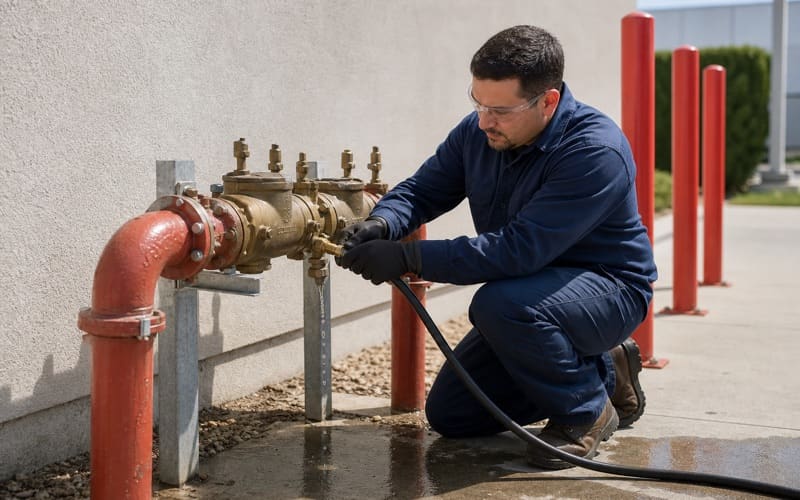
Long Beach Fire Suppression provides fire suppression in Santa Fe Springs for commercial and industrial property, covering sprinkler systems, fire alarms, portable extinguishers, and kitchen hood suppression as a single scope of work. Consolidating those four with one contractor is what allows a building to have one compliance status rather than several partial ones, each held by a different vendor on a different calendar. We take no residential work, which keeps the commercial schedule intact.
A meaningful share of the work we do in this city involves buildings that have been altered recently — new tenants, reconfigured interiors, changed storage arrangements — and altered buildings are where fire protection quietly falls out of alignment. A system that passed its acceptance test perfectly can be inadequate two years later without a single component having failed, simply because the space around it changed. That is a different inspection problem than a worn-out system, and it calls for looking at the occupancy rather than only at the hardware.
Everything we find is documented with a photograph and the code section behind it, and every correction plan prices deficiencies individually so an owner can sequence the work against a real budget. Repairs are carried out by the crew that performed the inspection. Impaired systems and buildings working against a failed inspection get emergency response ahead of routine scheduled testing.
When a Building Changes and the System Does Not
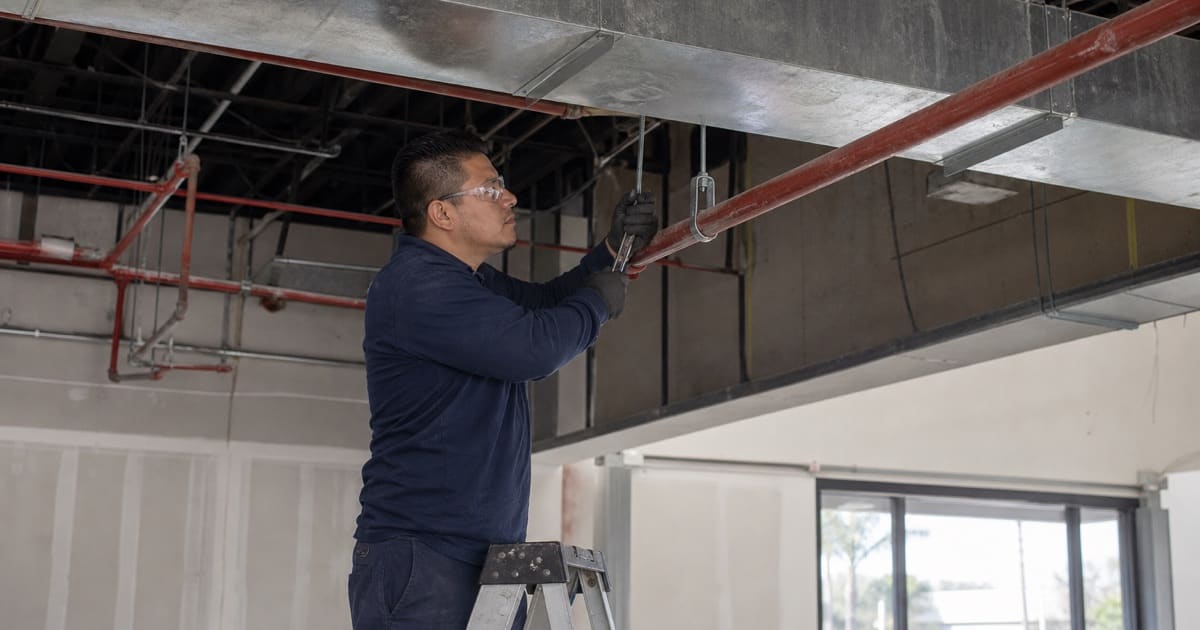
Fire protection is designed against a specific set of assumptions: this occupancy, this ceiling height, this commodity, this floor plan. Every one of those assumptions is subject to change by people who have no reason to think about sprinkler design, and nothing about the system announces when an assumption has been broken. Finding those gaps is a matter of comparing the installation against the building as it exists today.
Tenant Improvements and Coverage
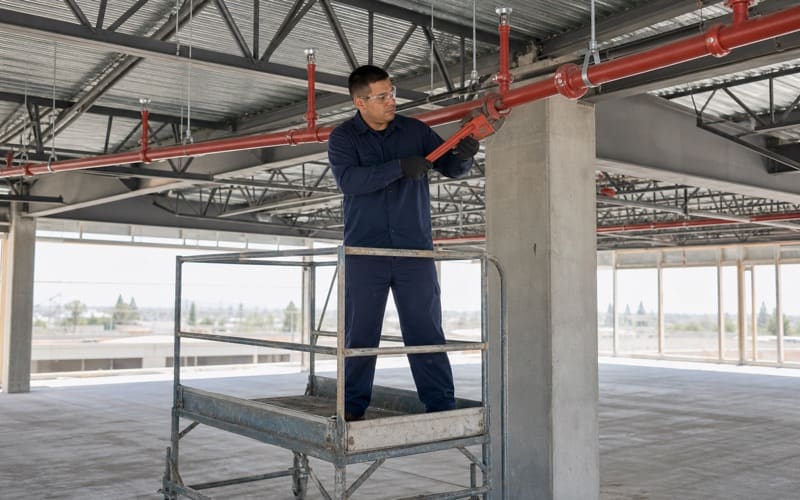
Build-outs are the most frequent cause of coverage problems we encounter. New demising walls create spaces with no head in them, dropped ceilings and added soffits obstruct the ones already there, and finishing crews paint concealed heads without any idea what they are covering. We check spacing, clearance, and obstruction against the current floor plan rather than the approved drawing, and we identify specifically which areas have been left short by the work rather than simply noting that alterations occurred.
Occupancy changes can matter as much as physical alterations. A suite that shifts from office use to storage, or from storage to light assembly, changes the hazard the system was designed around even when not a single wall moves. We ask what a space is actually used for rather than what the lease describes, and where the current use exceeds what the installed protection was designed to handle, that goes in the report as a finding with the reasoning attached rather than as a passing observation.
Storage, Racking, and Design Basis
In buildings used for storage, the design basis depends on commodity classification, storage height, rack arrangement, and the clearance maintained beneath the sprinkler heads. A tenant who adds a level of racking or switches to a different product category can invalidate that basis without any visible change to the system. We measure the clearance that actually exists, look at how the space is genuinely being used, and document where the protection installed no longer corresponds to what is being protected.
Idle or partially occupied buildings create the opposite problem. A system serving a space standing largely empty still needs its full testing schedule, and unheated areas in a vacant building introduce freezing risk that an occupied building would not face. We check that heat is maintained where a wet system depends on it, verify antifreeze loops where they exist, and confirm the system has not been partially valved off by somebody trying to reduce costs during a vacancy.
The First Annual After a Change
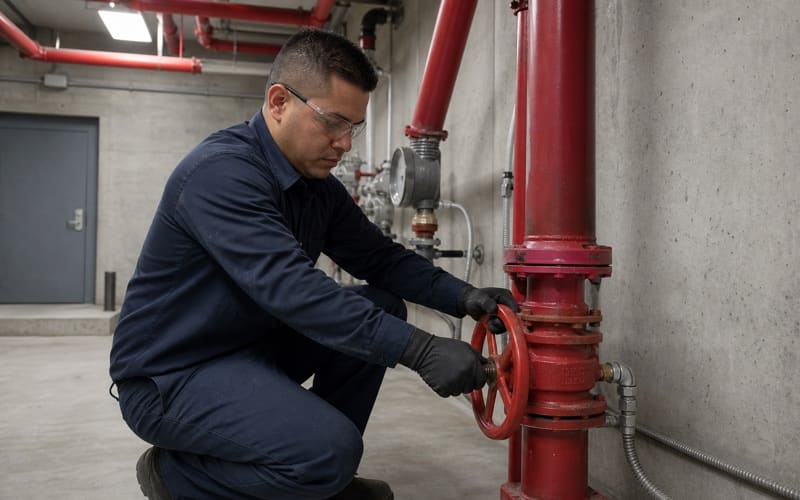
The inspection following a significant alteration is the one most worth doing carefully, because it is where problems introduced during construction first become visible. Heads left capped, valves closed and never reopened, alarm devices disconnected during work and never restored, and monitoring left in test mode all turn up in this window. We verify valve positions, confirm supervisory signals reach the panel and the central station, and check that the system was genuinely returned to service rather than merely left looking as though it had been.
Contractors working on unrelated trades cause a surprising share of these problems. Roofers, electricians, and HVAC crews all work in the same ceiling space the sprinkler system occupies, and a head knocked out of alignment or a pipe hanger removed for access rarely gets reported by the trade that did it. We inspect for recent physical disturbance specifically, and where we find evidence of work done around the system, we document it so responsibility can be established while the memory of the job is still fresh.
Looking for fire suppression closer to La Mirada? See Fire Suppression in La Mirada.
A Growing Gateway City
Santa Fe Springs is a city in Los Angeles County and one of the Gateway Cities of southeast Los Angeles County, with a population of 19,219 at the 2020 census, up from 16,223 in 2010. Growth of that kind brings construction, occupancy turnover, and reconfigured buildings along with it, which is precisely the environment where fire protection needs revisiting rather than assumed to be settled at the time of installation.
Multi-Tenant Buildings and Shared Systems
Where several occupants share one riser, responsibility for the system tends to be genuinely unclear until something forces the question. We establish what the shared system covers, note where one tenant’s work has affected protection in a neighboring suite, and coordinate access and any necessary shutdown directly with the property manager, the owner, and the occupants. That direct coordination is what prevents a scheduled drain-down from arriving as a surprise to the business that has to work through it.
Advance notice extends to anyone the work will touch, not only the party who signed the contract. A drain-down that affects a neighboring suite, an alarm test audible across an entire building, or a fire watch required while a system is out of service all involve people who did not book the appointment. We identify who needs to be told before the day arrives, and where a system must remain impaired long enough to require a fire watch, we say so at the point of scheduling rather than on arrival.
Food Service and Portable Equipment
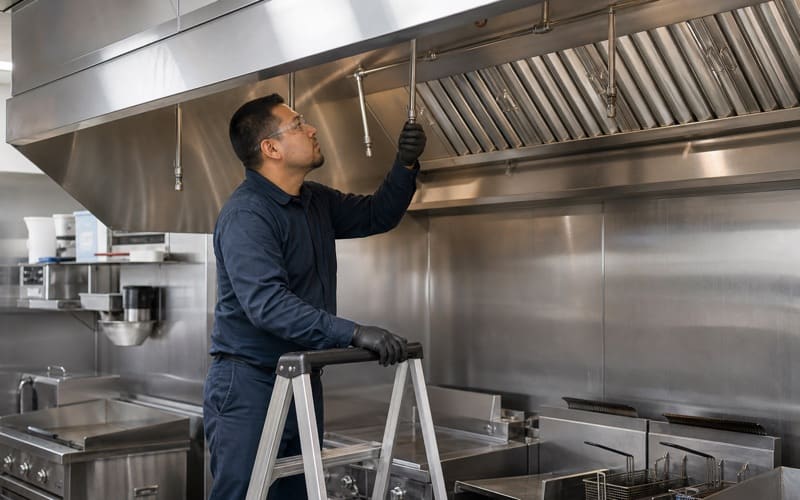
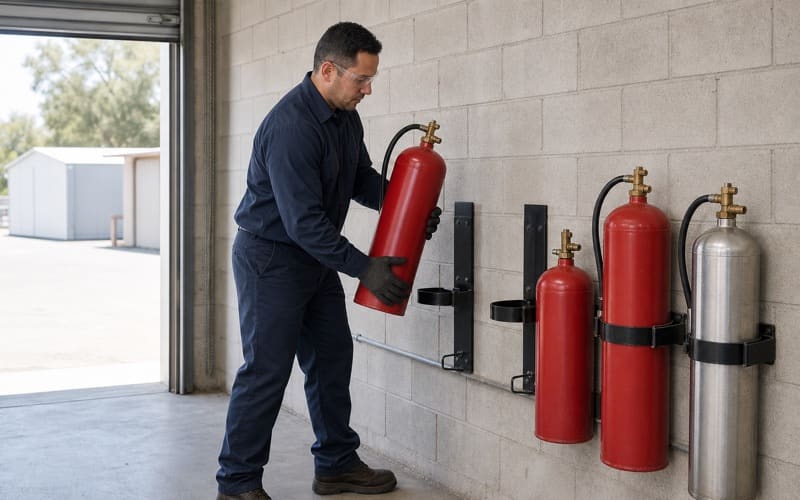
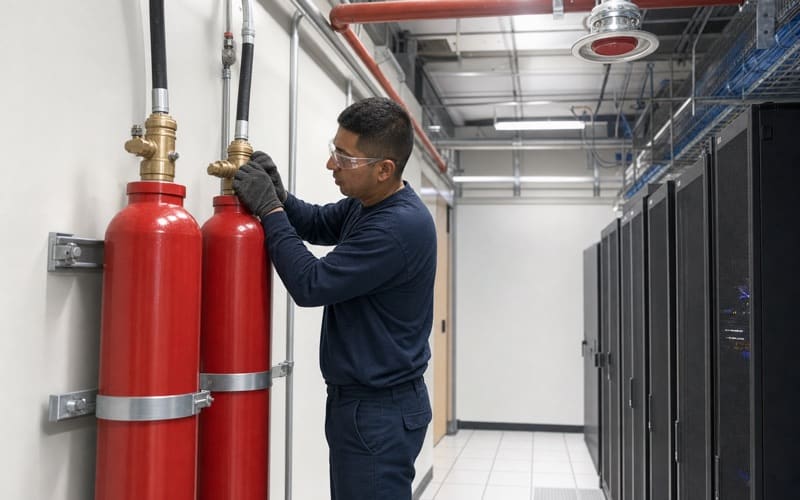
Any building with a commercial cooking line carries NFPA 96 ventilation requirements and NFPA 17A wet chemical suppression, needing service twice a year regardless of how heavily the kitchen operates. We work on Ansul R-102 and Pyro-Chem systems, confirm nozzle coverage matches the appliances currently under the hood, and test fusible links, manual pulls, and gas shutoff. Portable extinguishers under NFPA 10 are handled on the same visit, with Class K in kitchens, ABC dry chemical in general areas, and CO2 where electrical equipment would be damaged by anything else.
Buildings That Cannot Stop Operating
Most commercial property here runs on a schedule that does not accommodate a contractor’s convenience, and a shutdown during operating hours costs the occupant real money. We plan the work around operating hours, keep required system outages as short and as predictable as possible, and give advance notice of anything that will make noise or interrupt access. Alarm testing that requires notification appliances to sound is placed in an agreed window rather than dropped into the middle of a working day.
Scheduled Testing Across Every System
The intervals come from NFPA 25 for water-based systems and NFPA 72 for fire alarms, and they run quarterly, semi-annually, annually, and at five-year marks depending on the component in question. We track the recurring due dates for the properties we service, which turns compliance into a scheduled appointment rather than something remembered late.
Water-Based Systems and Supporting Equipment
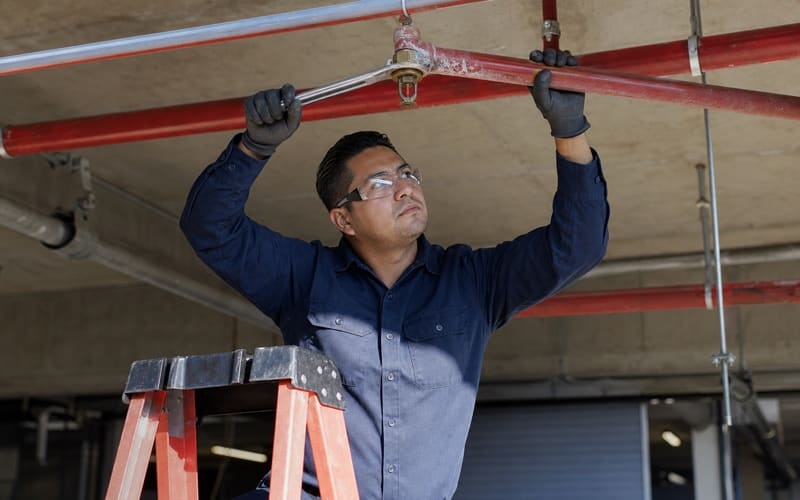
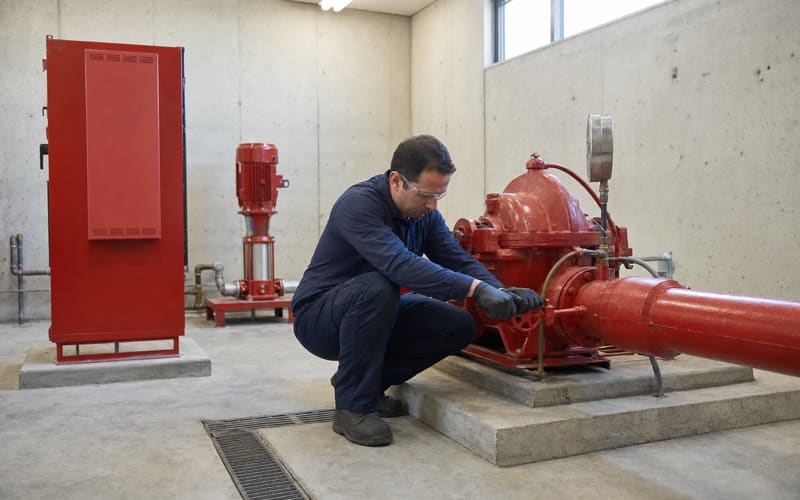
Wet pipe systems cover most of the commercial stock, with dry pipe, pre-action, and deluge installations appearing wherever conditions call for them, and each carries a distinct testing scope. We run main drain tests, exercise OS&Y and post indicator valves, verify flow and tamper switches report correctly, and inspect pendent, upright, sidewall, concealed, and ESFR heads for corrosion, paint, loading, and obstruction. Fire pumps, jockey pumps, standpipes, and fire department connections are tested where present, backflow preventers are tested and tagged, and five-year internal obstruction inspections are scheduled against the documented installation date.
Water supply is the part of a sprinkler system most often taken for granted, and the part a building has least control over. Main drain results recorded consistently across years are what reveal a gradual change upstream, whether that is a partially closed valve somewhere in the supply, municipal work altering pressure, or deterioration in the underground lead-in. We record the numbers every time rather than simply marking a pass, because a single reading proves very little while a trend proves a great deal.
Fire Alarm, Detection, and Monitoring
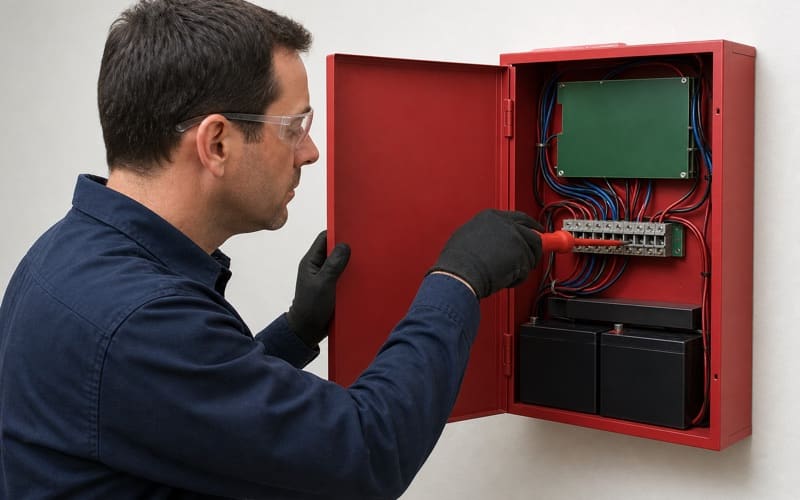
An NFPA 72 annual covers initiating devices, notification appliances, duct detectors, and the interface between the alarm system and the sprinkler system’s supervisory devices. We confirm that signals actually arrive at the central station rather than assuming an intact transmission path, since a monitoring connection that stopped reporting looks entirely normal from the front of the panel. Where components have become obsolete, we document that ahead of failure so a replacement can be planned rather than handled as an emergency.
Documentation, Correction, and Response
California Fire Code and Title 19 state fire marshal requirements place the burden of proof on the property owner, and proof means a record showing that required testing happened on schedule with results attached. We produce documentation built to answer the questions an inspector will actually put, and to remain useful afterward to a lender, an insurer, or an incoming tenant reviewing the building.
Findings Ranked by Consequence
A list of thirty items in the order they were encountered does not help anyone decide what to spend money on. We separate conditions that leave a system unable to perform from code obligations carrying a deadline, and both of those from wear worth correcting before it escalates into either. Each item carries its photograph and its code citation, so the reasoning behind a recommendation is visible rather than requiring trust in the contractor who made it.
Repairs, Staging, and Impairments
Deficiency correction is performed by the technicians who carried out the inspection, which removes the second diagnostic visit that would otherwise be billed before any actual repair began. Itemized pricing lets an owner clear urgent findings immediately and phase the remainder across a budget cycle. When a system goes out of service, the building is in an impairment and we respond accordingly, documenting the period from the moment it starts through the confirmed return to full service.
- Commercial & Industrial Only
- Code-Cited Inspection Reports
- Emergency Impairment Response