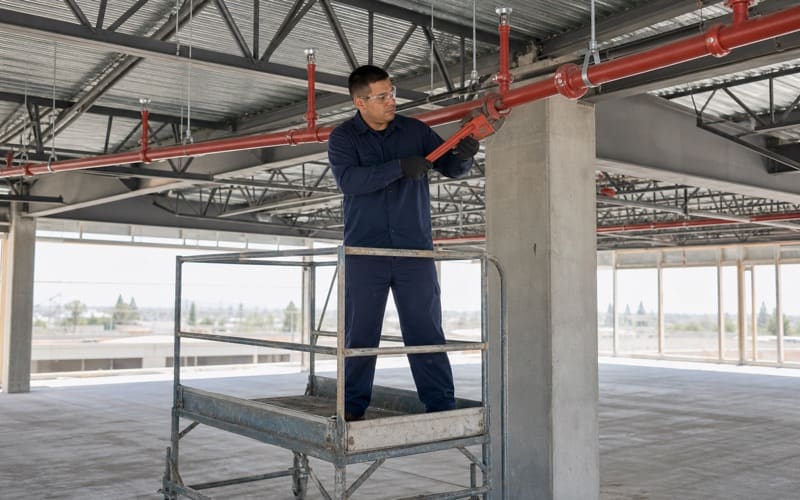
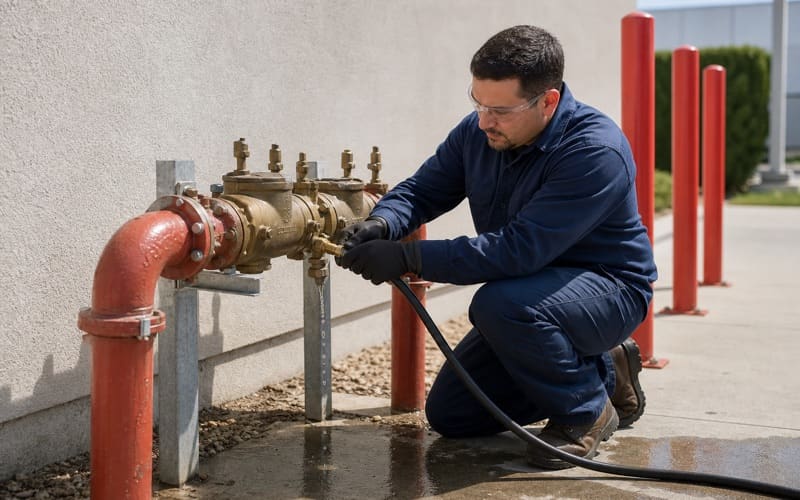
Long Beach Fire Suppression provides commercial fire suppression in Seal Beach for restaurants, retail buildings, hotels and hospitality properties, professional offices, medical suites, and multifamily buildings. We install, inspect, service, and repair sprinkler systems, kitchen hood suppression, fire alarms, portable extinguishers, and backflow assemblies.
Our work is commercial and industrial exclusively. That focus keeps crews in the building types and system types they handle every day, and it means the equipment and parts they carry match what they will actually find. A hospitality kitchen, a retail sprinkler riser, and a multifamily garage dry system are unrelated problems that happen to share a standard.
Compliance intervals drive most of the work rather than failures. NFPA 25 governs inspection and testing of water-based systems, NFPA 96 and NFPA 17A cover commercial kitchen suppression, NFPA 10 covers portable extinguishers, and NFPA 72 covers alarms. The California Fire Code and Title 19 place all of it behind an inspection with consequences that can reach restricted occupancy. We inspect, document, and correct, keeping the compliance record and the repair work with one company.
Fire Protection for Hospitality and Food Service
Restaurant Kitchen Suppression
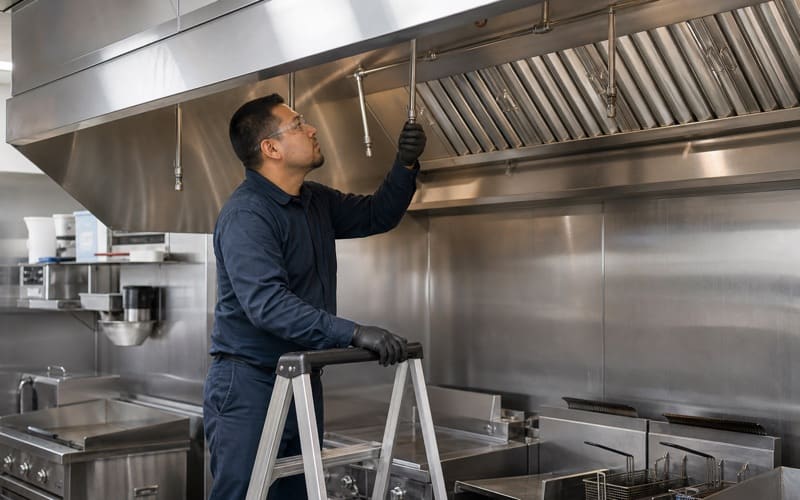
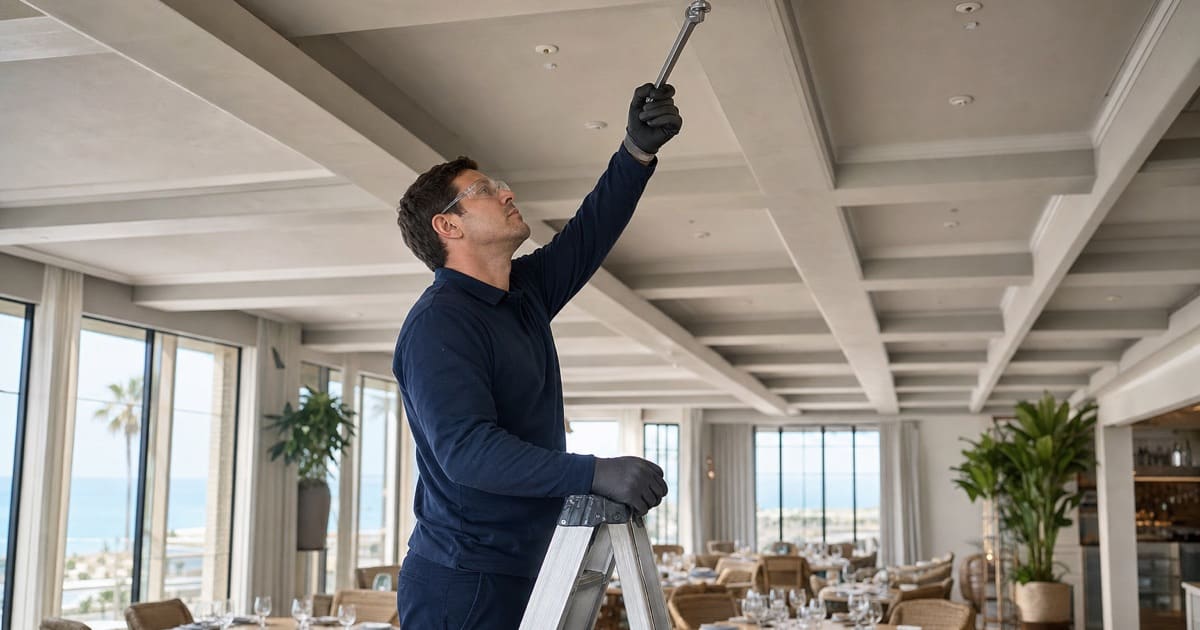
Commercial kitchens carry the shortest service interval of any system in a commercial building, generally requiring wet chemical service twice a year. We service and recharge Ansul R-102 and Pyro-Chem systems, replace fusible links on schedule, verify detection cable tension and travel, and test the gas shutoff, electrical interlock, and manual pull station as a functioning sequence rather than as isolated components. Nozzle coverage is checked against the appliance line as it currently sits, because kitchens rearrange equipment far more often than owners expect and a system correct at installation can be out of coverage within a year without anyone touching it. Duct and plenum nozzles receive the same attention as those over the appliances, since a grease fire that reaches the duct is the scenario most likely to leave the kitchen entirely. A Class K extinguisher is required in addition to the hood system and must be reachable without passing the cook line.
Cylinders carry hydrostatic testing requirements on a longer cycle separate from the semi-annual service, and those dates are missed more often than any other kitchen requirement because nothing about the system indicates they are due. We track them per unit rather than per building. Grease accumulation in the hood, plenum, and duct is examined during service as well, since it is fuel positioned exactly where a fire would travel and it directly affects how the system performs. Accumulation rates vary enormously with cooking method and volume, so a high-output kitchen frequently needs cleaning intervals shorter than the code minimum.
Hotels and Hospitality Properties
Hospitality buildings combine guest rooms, commercial kitchens, laundry facilities, and assembly spaces under one roof, which puts several different suppression and alarm requirements in a single structure. We coordinate inspections around occupancy so guest floors are tested in blocks rather than all at once, and we service kitchen and laundry systems on their own cycles. Guest room access is the practical constraint rather than the technical work, so we operate from a rooms list agreed with housekeeping instead of attempting a floor cold. Documentation matters more in hospitality than in most occupancies, because these properties are inspected frequently and change management often, and a missing record is treated the same as missing work.
Laundry and mechanical areas deserve more attention than they usually receive in these buildings. Lint accumulation, heat, and continuously running equipment make them a genuine ignition risk, and they are frequently the rooms furthest from anyone’s routine walkthrough. We inspect them specifically, check that heads have not been obstructed by stored linen or supplies, and confirm the protection suits what the room now holds rather than what it held when the building opened.
Hospitality kitchens also run on schedules that leave very little maintenance window, since breakfast service, banquet preparation, and dinner can occupy most of the day. We plan around the actual service pattern rather than a nominal one, and where a property has multiple food outlets we sequence them so no more than one is affected at a time. Laundry facilities carry their own considerations, since lint accumulation and dryer equipment present a genuine ignition risk in a space that is often treated as back-of-house and inspected less carefully than the guest areas.
Retail and Seasonal Businesses
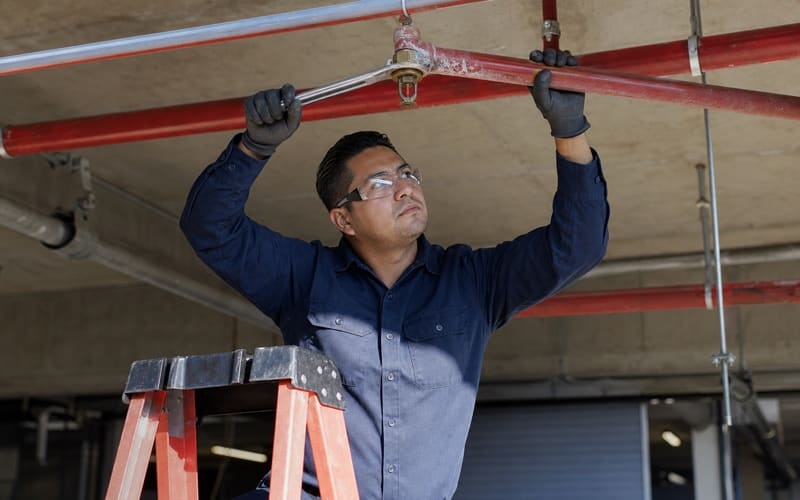
Retail properties see coverage drift as tenants change and fixtures move. New walls and dropped ceilings leave sprinkler spacing that no longer matches the space, and extinguishers disappear behind displays and stock as a store fills up. Businesses with seasonal volume swings accumulate this faster, since storage expands into areas that were clear when the last inspection was performed. We assess coverage against current conditions rather than the original placement, and obstruction findings are reported plainly because an extinguisher that cannot be reached is not providing protection regardless of its service tag.
Businesses whose revenue concentrates into a seasonal peak cannot absorb an outage dropped into the wrong month. We schedule the disruptive portions of the work outside that window wherever the intervals allow it, and where a required test falls in a busy period we keep the affected area as small and the duration as short as the work permits. Advance notice goes to every occupant the job will touch, not only the party who booked it.
Coverage requirements are determined by hazard classification and maximum travel distance to a unit rather than by floor area alone, which is why a store can become non-compliant without anything being removed. Converting sales floor to stockroom, or adding a hazard the original placement never contemplated, changes the requirement. We reassess placement against the current layout at each visit and identify where a unit type is wrong for what is actually in the space, which is a more useful finding than confirming the existing units are in date.
Looking for fire suppression closer to Los Alamitos? See Los Alamitos Fire Suppression.
A Coastal City and Its Commercial Properties
Seal Beach is a coastal city in Orange County, originally known as Bay City before being incorporated under its current name on October 24, 1911. Its population was 25,242 at the 2020 census, up from 24,168 in 2010. Its coastal position has a direct effect on fire protection equipment that inland properties do not share, and it shapes the commercial mix toward food service, retail, hospitality, and professional space rather than heavy industry.
Corrosion and Marine Air Exposure
Salt air is hard on fire protection hardware. Exposed sprinkler piping, hangers, heads, fire department connections, and backflow assemblies corrode faster near the coast than a few miles inland, which means corrosion findings here carry more weight and shorter timelines than the same observation would elsewhere. External corrosion is visible during inspection, but the more consequential problem is internal, where corrosion products and scale restrict flow without producing any exterior sign. That condition is exactly what the five-year internal obstruction investigation exists to detect, and it is the NFPA 25 requirement most often missed entirely.
Older Buildings and Modified Systems
Commercial buildings in a city incorporated over a century ago carry systems that have been extended, repaired, and modified repeatedly by different contractors with inconsistent documentation. As-built drawings frequently do not match the installed system, and unpermitted modifications turn up regularly. We inspect against actual conditions rather than the paperwork, and where we find work that was never submitted for approval we say so, because it will surface at the next inspection regardless of who performed it. Piping cut and extended for a tenant improvement deserves particular attention, since the workmanship can look acceptable while the hydraulic design is no longer valid.
We inspect against what is physically present rather than against the drawings on file, because on a building of that age the drawings are frequently the least reliable document available. Riser tags, head types and manufacture dates, valve positions, and pipe sizing are the evidence that actually describes the system. Where an alteration cannot be reconciled with any approval on record, we report it plainly rather than leaving it to surface during a sale or a change of tenancy.
Multifamily and Mixed-Use Properties
Apartment and mixed-use buildings combine dwelling unit coverage with commercial requirements in corridors, garages, trash rooms, and shared amenity spaces. Parking structures commonly use dry pipe systems requiring air pressure monitoring and low-point drainage that wet systems do not need, and trapped water at low points is the most frequent underlying cause of dry system trouble. Trash and recycling rooms produce recurring findings because they combine a real ignition risk with heads that are easy to obstruct. Coordinating unit and common area access with management is typically harder than the work itself.
Inspection Records and Deficiency Correction
Establishing What Is Due
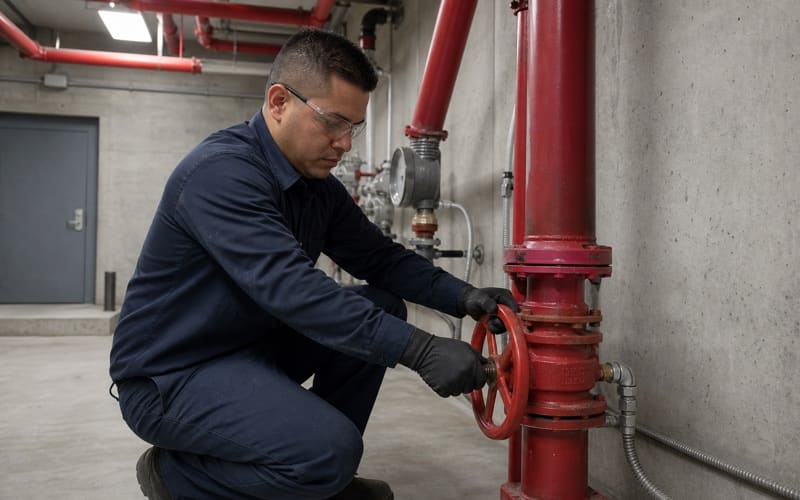
NFPA 25 is not one annual event, and treating it as one is the most common gap we find. Requirements run on quarterly, semi-annual, annual, and five-year cycles depending on the component, so a property with only an annual history is almost certainly carrying uncompleted items. We establish which intervals apply to the systems present, review whatever records exist, and identify anything that appears never to have been performed. Where no record exists of a five-year requirement, we treat it as due rather than assume it was completed and not documented. The obligation belongs to the building owner and transfers with the property, which regularly catches new owners whose records did not come with the building.
Reports Written to Be Acted On
Each deficiency is documented with a photograph and the code section behind it, so findings are intelligible to an owner reviewing remotely or a manager comparing properties. Severity is separated rather than presented as a flat list, because a painted head and a partially closed control valve are not the same problem. Corrections are priced individually rather than bundled, which lets an owner clear what is mandatory now and stage the rest across budget cycles, and it makes the quote auditable line by line.
Pricing each correction separately rather than as one figure is what makes a deficiency list actionable. An owner can release the work that carries a deadline immediately and stage the remainder deliberately across a budget cycle, instead of deferring everything because the total looked daunting. Every line traces back to the finding that produced it, so nothing in the number is unexplained.
Correction and Emergency Response
The crew that performs the inspection performs the corrections, which removes the handoff where a second contractor arrives without context and re-diagnoses findings already documented. For buildings working against a re-inspection date we respond on an emergency basis and sequence the list so items with occupancy consequences clear first. Where a repair requires an impairment, we plan and document the window with management, keep it confined to the affected area, and restore protection as soon as the work permits rather than leaving a building unprotected overnight for scheduling convenience.
- Commercial & Industrial Only
- Code-Cited Inspection Reports
- Emergency Impairment Response