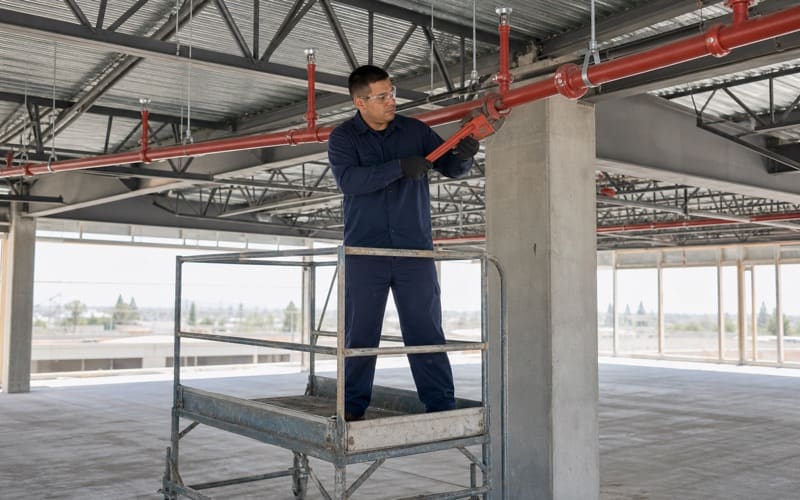
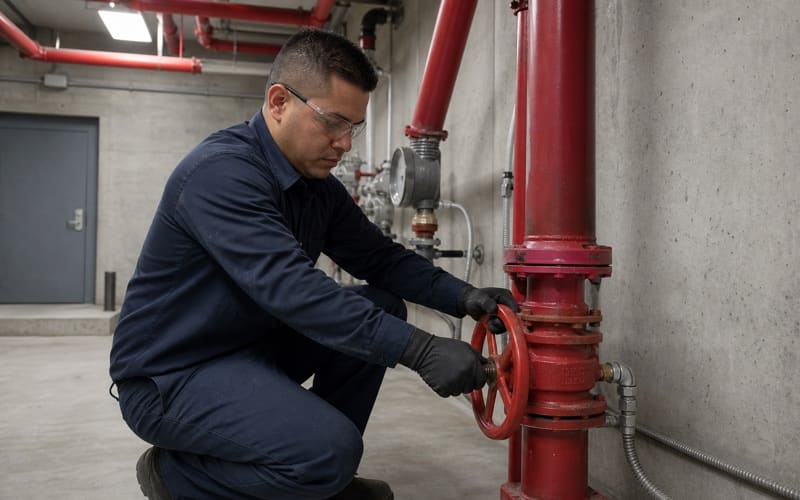
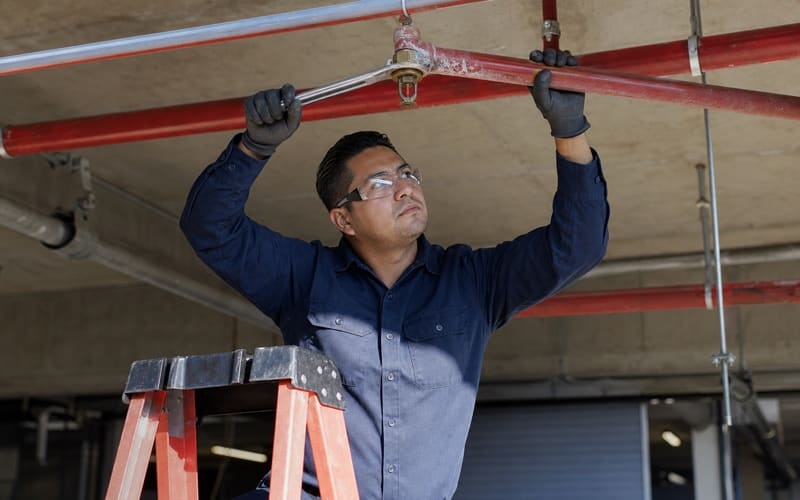
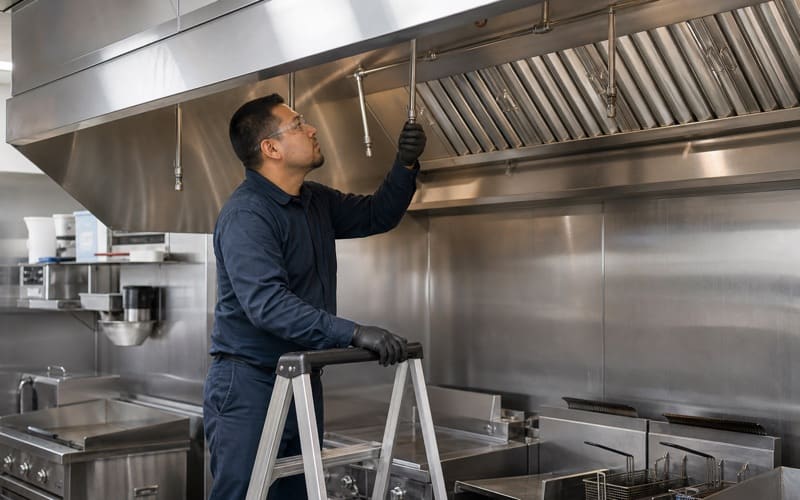
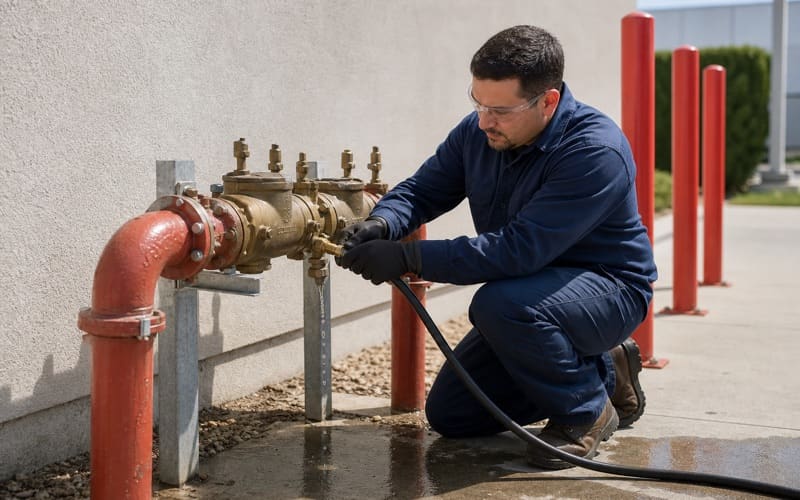
Long Beach Fire Suppression provides commercial fire suppression in West Carson for medical and outpatient facilities, retail buildings, restaurants, professional offices, light industrial space, and multifamily properties. We install, inspect, service, and repair sprinkler systems, kitchen hood suppression, fire alarms, portable extinguishers, and backflow assemblies. All of it runs through one provider, which leaves a building with a single deficiency list rather than four partial ones.
Our work is commercial and industrial exclusively. That focus means crews arrive already familiar with the systems a business property carries and the standards those systems are inspected against, rather than treating a commercial building as a larger version of a residential one. A booked commercial date also holds, since there is no residential side of the business competing for the same technicians.
Compliance intervals drive the schedule rather than failures: NFPA 25 governs inspection and testing of water-based systems, NFPA 13 their design, NFPA 96 and NFPA 17A commercial kitchen suppression, NFPA 10 extinguishers, and NFPA 72 alarms. The California Fire Code and Title 19 place all of it behind an inspection with consequences that can reach restricted occupancy. We inspect, document, and correct, keeping compliance and repair in one scope. We track the recurring due dates as well, so an annual or semi-annual obligation arrives as scheduled work rather than as a notice.
Fire Protection by Property Type
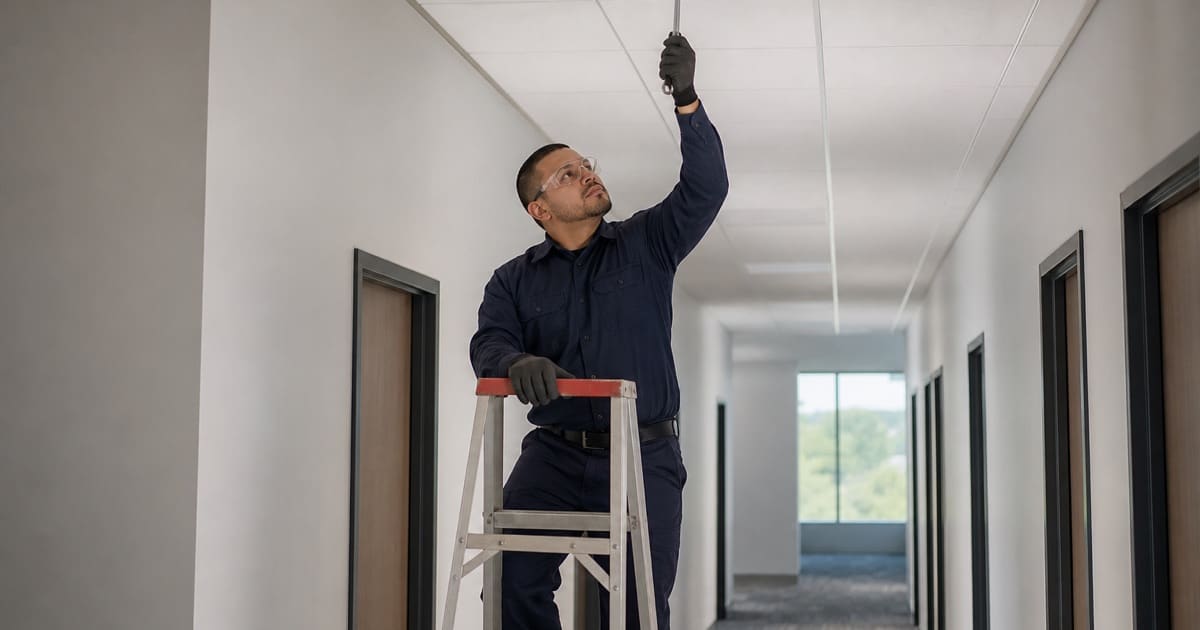
Medical and Outpatient Facilities
Healthcare occupancies are held to stricter expectations for system reliability and for how long protection may be impaired, and some areas cannot be taken offline during patient hours at all. We schedule testing around clinical hours and plan these buildings zone by zone rather than as a single visit, using interim measures where a system genuinely must be impaired. Notification appliance testing is placed in a window agreed with clinical staff rather than dropped into a treatment day.
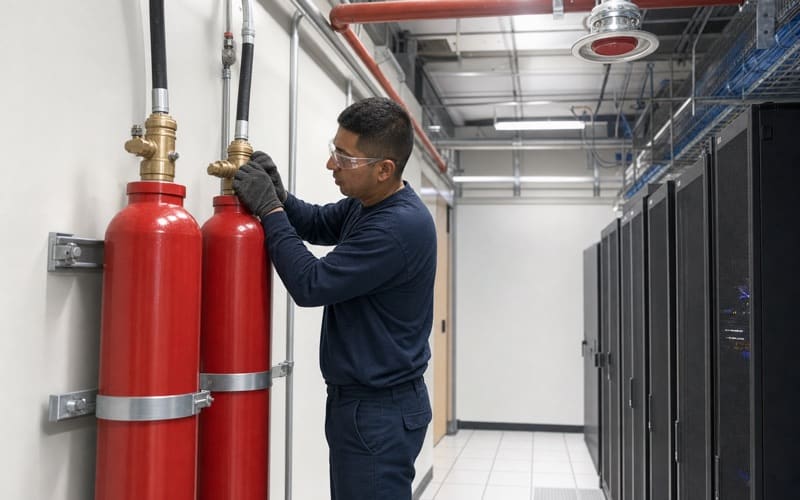
Imaging suites, server closets, and equipment rooms are frequently better protected by clean agent than by water, since a sprinkler discharge over equipment causes its own substantial loss. Documentation matters as much as equipment in these buildings, because they are inspected on a predictable cycle and expected to produce current records on request rather than assemble them afterward. Agent quantity, cylinder weights, detection, and whether room integrity still holds after years of added cable penetrations all get checked.
Retail, Restaurants, and Professional Space
Multi-tenant commercial buildings split responsibility between the landlord holding the riser, base building sprinkler system, and alarm panel, and tenants holding extinguishers and any suppression equipment in their suites. We document findings by suite so the responsible party is identifiable rather than disputed. Where a build-out has affected coverage in an adjacent suite, that is stated explicitly rather than left for the parties to work out between themselves.
Tenants cooking under a hood carry wet chemical systems requiring service roughly twice a year, with nozzle coverage verified against the current appliance line and the gas shutoff and manual pull station tested as a working sequence. Cylinders carry hydrostatic testing on a separate longer cycle, and those dates lapse more often than any other kitchen requirement because nothing indicates they are due. Grease loading in the hood, filters, and accessible duct is recorded at the same visit, since a heavily loaded duct outmatches the system discharging into it.
Light Industrial and Service Buildings
Shop, warehouse, and light manufacturing space carries hazards a general commercial sprinkler package does not always address, including flammable liquids, hot work, spray operations, and stored materials whose classification determines what the system must deliver. Auto and fleet facilities typically need more extinguisher coverage than their floor area suggests, with paint and spray operations treated as a separate hazard requiring dedicated protection. Charging areas, compressed gases, and quantities of flammable liquid each introduce requirements that general coverage does not satisfy on its own.
We evaluate whether the installed system still matches the operation currently running in the building. Processes and storage change without anyone revisiting the fire protection design, and a change in stored materials can move a space into a hazard classification the system was never built to cover without anyone touching the equipment. Idle pallets and packaging accumulating in a corner belong in the same category, and that is usually a finding a tenant can clear within the week.
Looking for fire suppression closer to Cypress? See Fire Suppression in Cypress.
An Unincorporated South Bay Community
West Carson is an unincorporated community in the South Bay region of Los Angeles County, defined by the Census Bureau as a census-designated place, with a population of 22,870 at the 2020 census. Its unincorporated status affects fire protection administration directly, since properties are served by county fire authority jurisdiction rather than a city department. Knowing what that office expects to be handed is the difference between closing a violation and carrying it into another cycle.
County Jurisdiction and Plan Review
Jurisdiction determines who inspects, what documentation is expected, and how corrections are cleared. It matters most on installation and modification work, where a system cannot be placed in service until it has been submitted, reviewed, and signed off. Preparing a submittal against what the reviewing office actually expects is the main lever on how many correction cycles a project goes through. A system placed in service ahead of that sign-off becomes somebody’s problem later, generally at the least convenient moment available.
Fewer review cycles is usually the largest schedule saving available on this kind of work, and on a small project the difference between one cycle and three is most of the timeline. We handle that process rather than leaving an owner to navigate it. Reinspection benefits from the same preparation, since the documentation package is assembled alongside the physical work rather than after it.
Mixed Occupancies and Changing Use
Properties here frequently combine uses on a single parcel — office attached to shop space, retail fronting storage, service bays adjacent to parts inventory. Mixed occupancy complicates fire protection because different areas carry different hazard classifications, and therefore different requirements for sprinkler density, extinguisher type, and travel distance to a unit. An office, a shop, and a storage area under one roof are three classifications rather than one averaged across the parcel.
We classify by area rather than by building, which prevents a fully compliant storefront from concealing an under-protected back of house. Occupancy also changes over time without the fire protection design being revisited, so the classification on file is worth checking against what the space now actually holds. Asking what a space currently holds takes a minute and regularly contradicts the file.
Marine Air and Corrosion Exposure
Proximity to the coast affects fire protection hardware in ways inland properties do not share. Exposed sprinkler piping, hangers, heads, fire department connections, and backflow assemblies corrode faster here, which means a corrosion finding carries a shorter timeline than the same observation would further inland. Fire department connections deserve particular attention, since caps corrode into place and seized threads produce no symptom until the day they matter.
External corrosion is at least visible. The more consequential problem is internal, where corrosion products and scale restrict flow without producing any exterior sign — which is exactly the condition the five-year internal obstruction investigation exists to detect, and the NFPA 25 requirement skipped most often. We record main drain readings each visit rather than marking a pass, because a single figure proves little while a trend proves a great deal.
Compliance Scheduling and Correction
Mapping Intervals to the Systems Present
The intervals in NFPA 25 attach to components rather than to buildings, which is why a single annual visit rarely satisfies a property in full. Quarterly, semi-annual, annual, and five-year requirements coexist on the same system, and the shorter ones are the easiest to rationalise away because each takes only minutes. We lay the applicable intervals out against the equipment actually installed and against whatever record exists, then identify the gaps. Reconstructing a history that was never properly kept is slower than maintaining one, and the aim is to stop the paperwork being the problem.
The five-year items are where nearly every property we take on turns out to be behind. Nothing about a riser or a run of pipe indicates that an internal inspection is overdue, and the interval outlasts most people’s tenure at a single building. Where no evidence exists that one was ever performed, we schedule it rather than assume a predecessor did it quietly. We hold that schedule against the property rather than its current manager, so a change of ownership does not reset the record to zero.
Findings an Owner Can Weigh
A deficiency list without context forces an owner to guess at priority. Ours attaches a photograph and the governing code section to each item and sorts them by consequence, so the difference between a cosmetic finding and one that renders a system inoperative is visible without a phone call. That is particularly useful for owners holding property they do not visit weekly. It also separates a code obligation from a recommendation, so nothing is funded on the assumption that it was compulsory.
Pricing follows the same logic. Each correction is quoted on its own rather than rolled into a single number, which makes it possible to authorise the mandatory work immediately and defer the rest deliberately instead of by default. It also means nothing in the quote is unexplained. An owner staging work across a budget cycle can see precisely what is being deferred and what deferring it will cost.
Repair, Impairment, and Urgent Response
We correct what we find, using the crew that found it. That avoids the familiar sequence where a second company arrives cold, re-inspects work already inspected, and charges for the privilege of arriving at the same conclusion. Buildings under a re-inspection deadline get priority, with the list ordered so anything affecting occupancy is cleared first. The crew already knows where the riser runs and what the ceiling conceals, which shortens every repair that follows an inspection.
Any work requiring a system to be shut down is planned with management beforehand, limited to the smallest practical area, and documented as the code requires. Where a complete repair will run long, we return the unaffected portion of the system to service rather than leaving an entire building unprotected while one section is worked on. The return to full service is confirmed in writing, which is what an owner needs if the period is ever questioned.
- Commercial & Industrial Only
- Code-Cited Inspection Reports
- Emergency Impairment Response