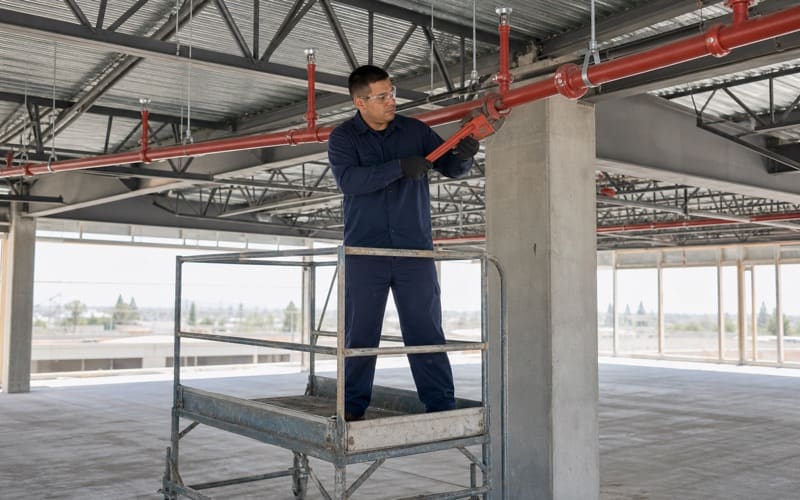
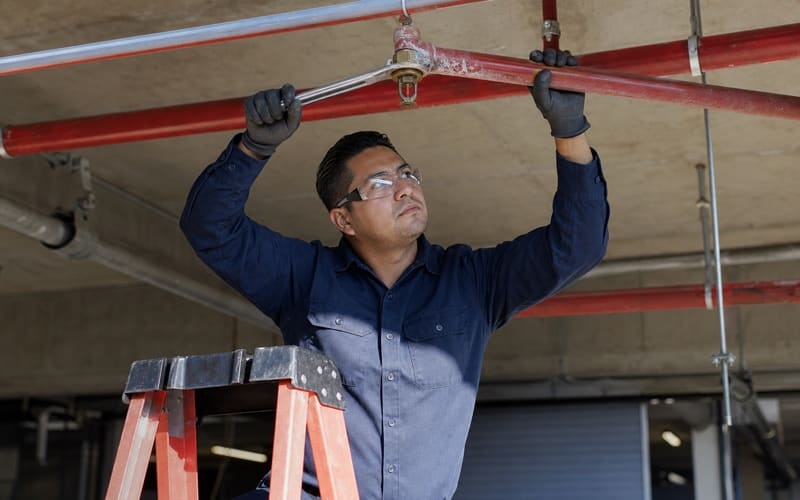
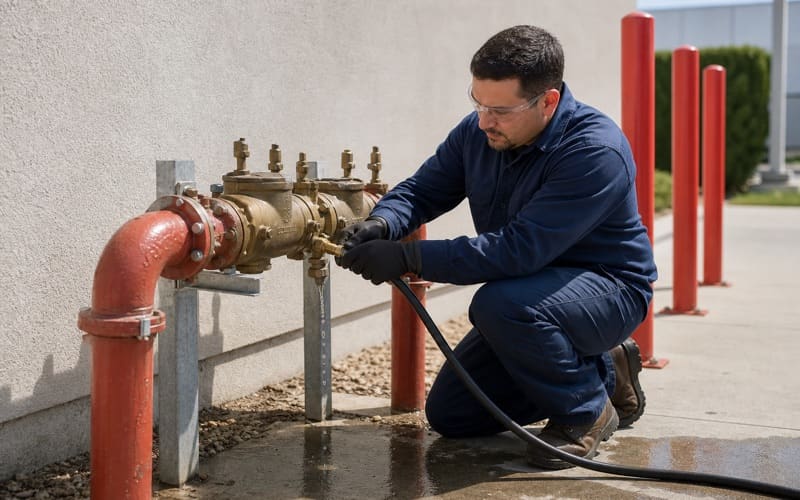
Long Beach Fire Suppression provides commercial fire suppression in Wilmington for warehouses, distribution buildings, manufacturing facilities, truck and equipment yards, auto and fleet shops, restaurants, and the commercial properties serving them. We install, inspect, service, and repair sprinkler systems, fire pumps, standpipes, kitchen hood suppression, alarms, extinguishers, and backflow assemblies.
We work commercial and industrial only, and in this part of the metro that focus is the point. Industrial fire protection is a different discipline from general commercial work — hazard classification drives everything, storage arrangement can invalidate a design without anyone touching the system, and the processes running inside a building frequently require protection that standard sprinkler coverage was never intended to provide.
Most work begins with a compliance interval rather than an incident. NFPA 25 governs inspection and testing of water-based systems, NFPA 13 governs their design, and the California Fire Code and Title 19 put those requirements behind an inspection that carries consequences up to restricted occupancy. We inspect, document, and correct, so the compliance record and the repair sit with one company instead of splitting across two.
Industrial and Warehouse Fire Protection
Storage Occupancies and Commodity Classification
Warehouse sprinkler design is driven by what is stored, how high it is stacked, and how the racking is arranged — not by square footage. A building protected for one commodity class can be seriously under-protected for another, and that change happens whenever a tenant’s product mix shifts. ESFR systems, which drive large droplets down through a rack at high pressure, depend on maintained clearance between the heads and the top of storage, and a tenant stacking into that clearance invalidates the design without altering a single component. In-rack sprinkler arrangements carry their own inspection requirements and are more vulnerable to physical damage than ceiling heads. We check storage arrangement against the design assumptions during every inspection rather than confining the visit to hardware, and where the current profile exceeds what the system was designed to protect, we put that in writing.
Process Hazards and Special Protection
Manufacturing and industrial operations carry hazards that ordinary sprinkler coverage does not address, including flammable liquids, combustible dust, spray and coating operations, and process equipment that needs protection in its own right. Depending on the hazard, that can mean deluge arrangements over a high-hazard area, foam systems where water alone would spread rather than control a fire, or dedicated suppression on individual equipment. The recurring problem is that operations change without anyone revisiting the fire protection design — a line converted to a different solvent, a spray booth added in an existing bay, or a change in stored materials can move a space into a hazard classification the installed system was never built to cover. We assess whether what is installed still matches what the building actually does.
Physical Damage and Corrosion Exposure
Buildings with forklift and container-handling traffic sustain damage to sprinkler heads and piping often enough that it is a routine finding rather than an unusual one. Guards, relocation, or a different head type are the durable answers, since replacing the same head a third time simply schedules the next repair. Proximity to the water also matters: marine air is hard on exposed piping, hangers, and hardware, so corrosion findings carry more weight here than they would on an inland property. Exposed piping in covered loading areas and staging yards sees weather directly, which shortens the interval at which corrosion moves from cosmetic to a genuine deficiency requiring correction rather than monitoring.
Looking for fire suppression closer to Seal Beach? See Fire Suppression Services in Seal Beach.
A Harbor-Area Industrial District
Wilmington is a neighborhood in the South Bay and Harbor region of Los Angeles, covering 9.14 square miles. That harbor-area position shapes the building stock toward industrial, warehouse, logistics, and support commercial uses rather than office or retail concentration, and it shapes the fire protection work accordingly — larger systems, heavier hazards, more fire pumps and standpipes, and more equipment that sits in mechanical rooms where nobody looks between scheduled tests.
Fire Pumps and Water Supply
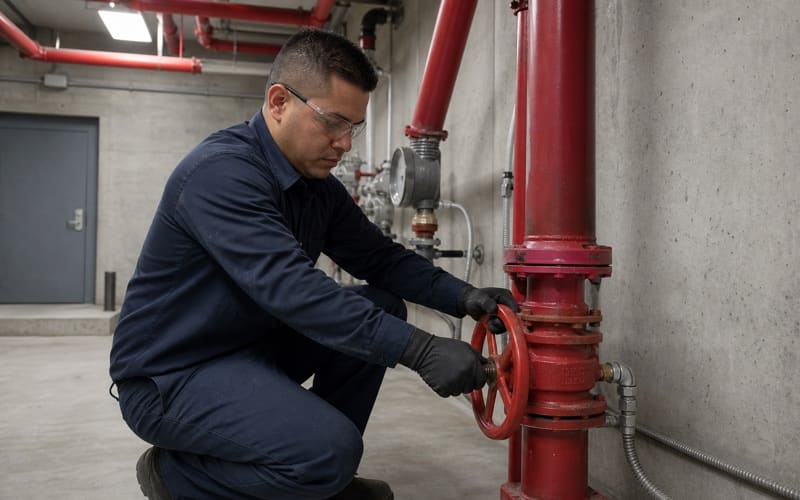
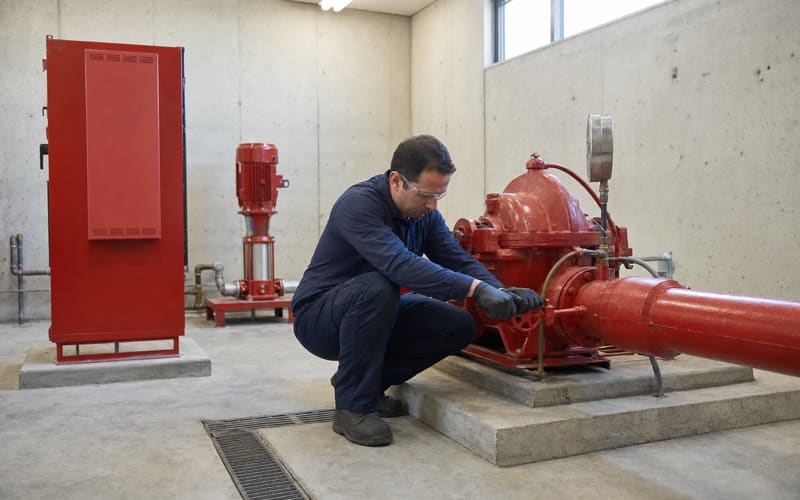
Large-footprint and high-demand buildings frequently require a fire pump, because the available municipal supply cannot deliver the pressure and flow the system needs on its own. Pumps require frequent no-flow churn testing to confirm they start and run, plus annual flow testing at churn, rated capacity, and peak flow to verify they still perform to the nameplate curve. That annual test is the meaningful one, because a pump can start reliably every week and still deliver materially less than its design output. Controllers left in manual after service work, closed or partially closed suction valves, failing batteries on diesel units, and jockey pump problems account for most of the findings we write up.
The room around the pump matters as much as the pump inside it. Adequate ventilation, clear access, working drainage, and freedom from stored material all bear on whether the equipment will run when it is called on and whether anyone can service it when it does not. We assess the room alongside the machinery, and we flag where a pump room has gradually become a storage space — a common finding on properties where the equipment itself is in sound condition.
Standpipes and Fire Department Connections
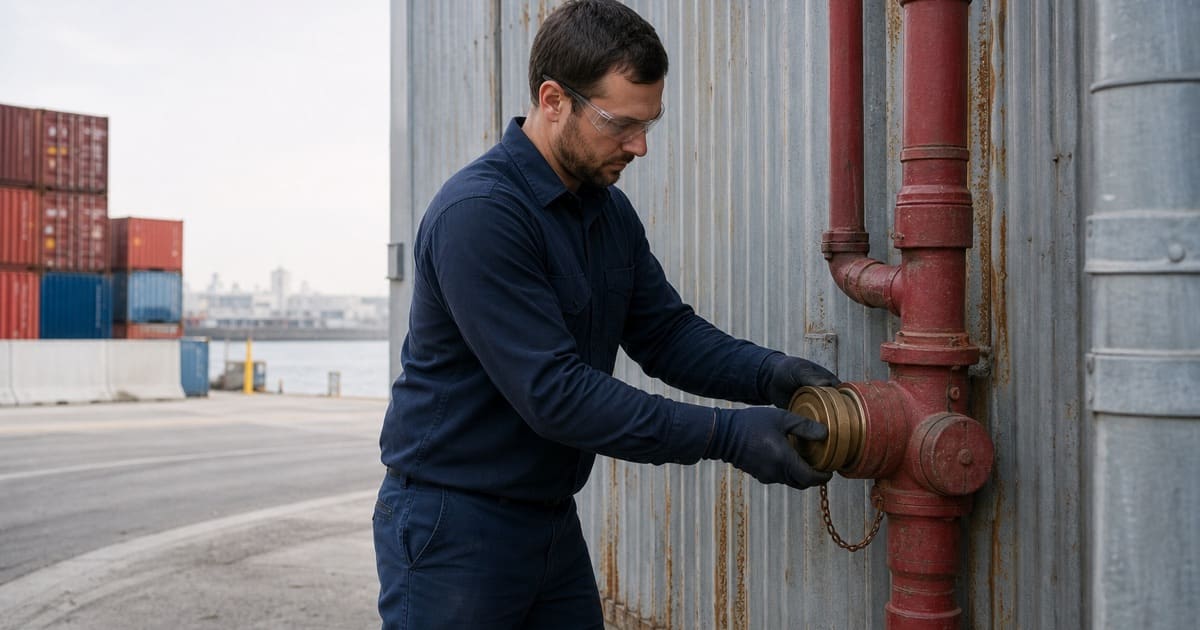
Standpipe systems deliver water to hose connections inside a building so responding crews are not running hose from street level. They carry routine inspection requirements plus five-year hydrostatic testing and flow testing at the hydraulically most remote connection, and those long-cycle items are among the most commonly missed in NFPA 25. The fire department connection is checked for accessibility, cap presence, gasket condition, and internal obstruction, because it is one of the few components whose failure is discovered by the fire department rather than by the building. Landscaping, parked vehicles, and construction staging are the routine causes of obstruction, and it is nearly always inexpensive to correct once someone identifies it.
Support Commercial and Food Service
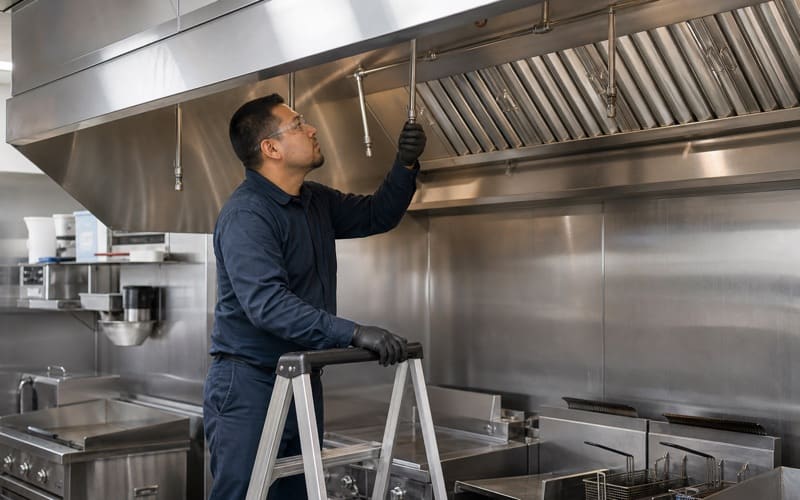
The commercial properties serving an industrial district carry their own requirements. Restaurants and cafeterias with cooking under a hood need wet chemical service roughly twice a year, with nozzle coverage verified against the current appliance line and the gas shutoff and manual pull station tested as a working sequence. Auto and fleet shops combine flammable liquids, hot work, and vehicles under one roof and typically need more extinguisher coverage than their floor area suggests, with paint and spray operations treated as a separate hazard requiring dedicated protection rather than the shop’s general coverage.
Compliance, Documentation, and Correction
Knowing What Falls Due and When
NFPA 25 requirements run on quarterly, semi-annual, annual, and five-year cycles, and a building that has only ever had an annual visit is nearly always carrying uncompleted items. We establish which intervals apply to the systems actually present, review whatever records exist, and flag requirements that appear never to have been performed. Long-cycle items are the ones that lapse, partly because five years exceeds the tenure of many facility managers and partly because nothing about a system’s exterior indicates the work is due. We track these against the building rather than against whoever currently manages it, so the history survives a change in ownership or management.
The five-year internal obstruction investigation is the requirement industrial buildings miss most reliably, and the one an exterior inspection can never substitute for. Opening the system at the prescribed points is the only way to establish whether corrosion product, scale, or material carried in from the supply has begun restricting flow. Where no evidence exists that one was ever performed, we schedule it rather than assume a predecessor quietly took care of it.
Documentation Built for an Inspector
Deficiencies are documented with photographs and the code section behind each one, separated by severity so urgent findings are distinguishable from minor ones. Corrections are priced individually rather than as one figure, which lets an owner clear what must be addressed immediately and stage the rest against budget. For operators running several buildings, records stay consolidated rather than scattered across separate vendors and separate addresses, which is what makes confirming compliance across a portfolio a document request rather than a research project.
Emergency Response and Impairments
An impaired sprinkler system means a building is without its primary fire protection until it is restored, and in a warehouse holding significant inventory that exposure is substantial. We respond on an emergency basis for systems shut down by failure, damage, or a leak that forced a valve closed, and the first objective is restoring protection to as much of the building as possible even where the full repair will take longer. Isolating a damaged branch and returning the balance of the system to service is frequently achievable the same day. Impairments are managed, communicated, and documented as the code requires, with interim measures where duration and occupancy call for them.
Working Around Industrial Operations
Scheduling Around Shifts and Throughput
A distribution building running multiple shifts cannot absorb an unplanned interruption, and fire protection work almost never requires one. We schedule main drain testing, waterflow testing, and riser work before a shift starts or during a changeover, and we plan pump testing around the times when water discharge will not interfere with yard traffic or drainage. Where a system must be taken out of service, the window is agreed in advance and confined to the affected area rather than applied to an entire facility. In buildings with dock activity, coordinating around inbound and outbound schedules is usually more constraining than the technical work itself.
Coordination Across Landlord and Tenant
Industrial buildings are frequently leased, which splits fire protection responsibility between the property owner holding the base building system and the tenant whose operation determines the hazard. That structure causes problems when a tenant’s storage or process changes and nobody informs the owner, since the system that was adequate at lease signing may no longer be. We document findings in a way that identifies what belongs to the building and what belongs to the operation inside it, and we coordinate access and shutdowns directly with both rather than relying on messages passed between them.
One Provider Across Every System
A single industrial property may carry a sprinkler system, a fire pump, standpipes, an alarm panel, extinguishers, backflow assemblies, and special hazard protection, each on its own interval under its own standard. Splitting those across separate vendors produces four schedules, four record sets, and a set of interfaces nobody owns — a flow switch reporting to a panel, a special hazard system signaling an alarm, a pump controller reporting a trouble condition. We handle all of them, which consolidates the schedule and means those connections are actually verified rather than assumed by each vendor to be someone else’s responsibility.
- Commercial & Industrial Only
- Code-Cited Inspection Reports
- Emergency Impairment Response